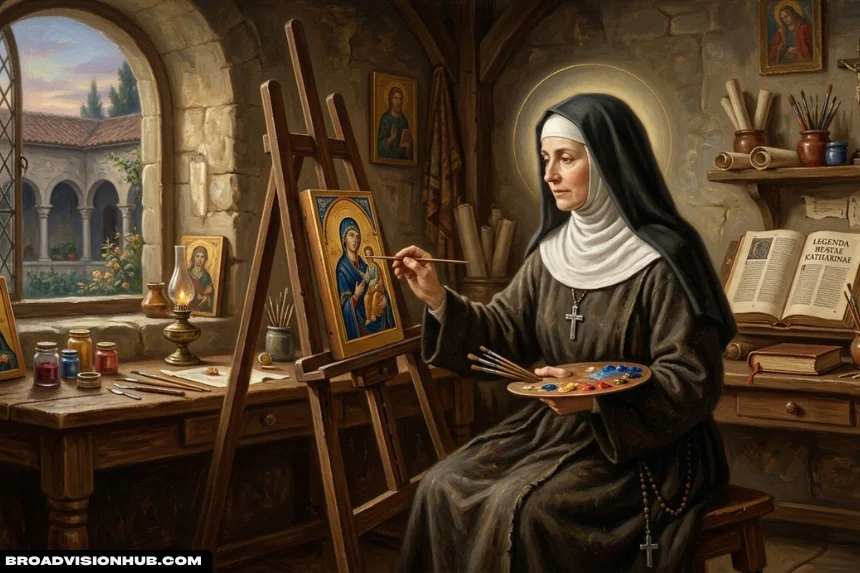
St Catherine of Bologna was a 15th-century Italian religious woman, writer, artist and later Poor Clare abbess whose life connected Renaissance culture with Franciscan spirituality. Born Caterina de’ Vigri in Bologna in 1413, she received an unusually broad education at the Este court in Ferrara before leaving court life as a teenager to pursue a religious vocation. Her later life would bring together prayer, service, writing, art and leadership.
Although she is less widely known today than Catherine of Siena, her historical record is unusually rich in several respects. The Holy See documents her education in painting, music, poetry, Latin and manuscript arts, while surviving works and objects associated with her are preserved in Bologna.
Her story is therefore more than a conventional medieval saint biography. It also provides a window into women’s education, convent culture, artistic activity and Franciscan religious life during the Italian Renaissance.
Quick Answer: Who Was St Catherine of Bologna?
St Catherine of Bologna, born Caterina de’ Vigri on September 8, 1413, was an Italian Poor Clare known for religious writing, artistic work, spiritual teaching and monastic leadership.
As a child, she moved from Bologna to Ferrara and entered the court of Nicholas III d’Este. There, she studied subjects that included music, painting, poetry and Latin. However, at only 14 years old, she left court life and joined a community of young women dedicated to God. She later chose the Rule of St Clare and became part of the Franciscan tradition.
The Holy See’s detailed account of her life can be read in Benedict XVI’s official catechesis on Saint Catherine of Bologna.
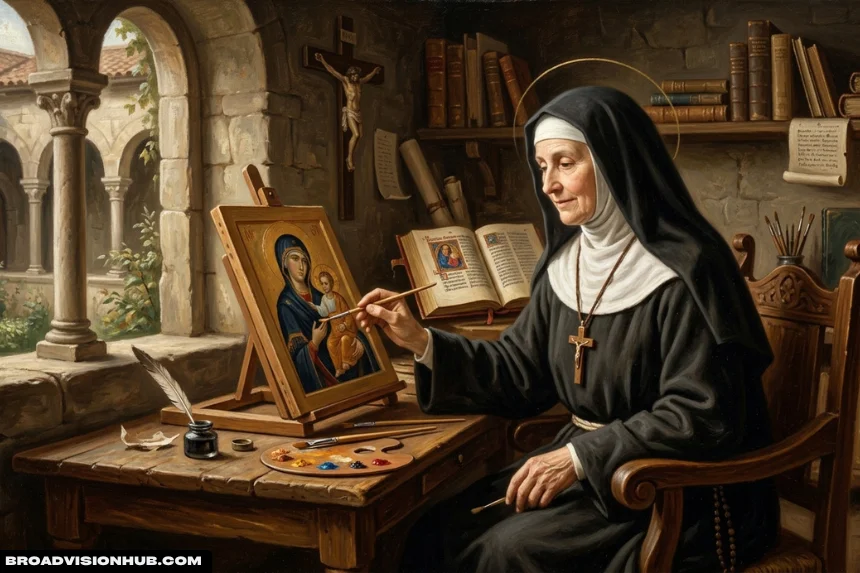
Quick Facts
| Detail | Information |
|---|---|
| Birth name | Caterina de’ Vigri |
| Common English name | Catherine of Bologna |
| Born | September 8, 1413 |
| Birthplace | Bologna, Italy |
| Mother | Benvenuta Mammolini |
| Father | John de’ Vigri |
| Childhood locations | Bologna and Ferrara |
| Court connection | Court of Nicholas III d’Este |
| Role at court | Lady-in-waiting to Margaret d’Este |
| Education | Music, painting, poetry, Latin, miniature painting and copying |
| Left court life | 1427, at about age 14 |
| Religious tradition | Franciscan / Poor Clare |
| Rule followed | Rule of St Clare of Assisi |
| Later known for | Spiritual writing, art, teaching and religious leadership |
These biographical points are recorded in the Holy See’s account of Catherine’s life. Benedict XVI also cautioned that information about her earliest childhood is limited and that not every later tradition about those years can be treated as equally reliable.
Understanding Catherine de’ Vigri
The woman now commonly known in English as St Catherine of Bologna was born Caterina de’ Vigri.
Her connection with Bologna ultimately became so strong that the city entered the name by which she is remembered. Nevertheless, Ferrara was also crucial to her development.
Catherine’s father, John de’ Vigri, was described by Benedict XVI as a wealthy and educated patrician from Ferrara. He was trained in law, lectured publicly in Padua and performed diplomatic missions for Nicholas III d’Este, Marquis of Ferrara. Her mother was Benvenuta Mammolini.
Therefore, Catherine did not begin life in an isolated monastic environment. Instead, her family had connections with one of northern Italy’s important Renaissance courts.
That background later shaped both her intellectual development and artistic abilities.
Early Life in Bologna
Catherine was born in Bologna on September 8, 1413.
However, historians have relatively little secure information about her earliest years.
The Holy See notes specifically that surviving accounts of her infancy and childhood are sparse and not all details are reliable. What can be stated with greater confidence is that she spent part of her childhood in Bologna in the home of her grandparents. Her relatives helped raise her, while her mother played an especially important role in her religious formation.
This uncertainty is worth acknowledging.
Biographical articles about medieval and Renaissance saints sometimes present later traditions as though every detail were independently documented. In Catherine’s case, the stronger approach is to distinguish well-supported facts from less certain stories.
Around the age of 10, however, the historical picture becomes clearer.
Moving to the Este Court in Ferrara
When Catherine was approximately 10 years old, she moved with her mother to Ferrara.
There, she entered the court of Nicholas III d’Este as a lady-in-waiting to Margaret, one of the marquis’s daughters.
The change placed the young Catherine inside a culturally ambitious court.
Ferrara was developing into an important center of art and learning. Nicholas III encouraged artists and scholars, while court life exposed Catherine to an environment very different from the domestic setting of her earliest childhood.
Moreover, she became close to Margaret and served not simply as an attendant but also as a trusted companion.
This period would prove crucial because the skills Catherine acquired at court did not disappear after she chose religious life.
Instead, she later carried many of them into the convent.
An Unusually Broad Education
Catherine’s education was remarkable in its range.
According to the Holy See, she studied:
- music;
- painting;
- dancing;
- poetry;
- literary composition;
- Latin;
- miniature painting;
- manuscript copying.
She also learned to play the viola.
Therefore, it would be misleading to describe her merely as someone who happened to paint later in life.
Her artistic and literary training began early and formed part of a broader court education.
Painting and Miniature Work
One particularly important skill was miniature painting.
Before printing transformed European book production, manuscripts were copied and decorated by hand. Miniature painting required careful technique, control and patience.
Catherine became skilled both in miniature work and in copying manuscripts.
These abilities later aligned naturally with convent culture, where handwritten religious texts, devotional images and books continued to play central roles.
Literature and Poetry
Her education also extended beyond visual art.
Catherine learned to write poetry and other literary compositions. In addition, she strengthened her knowledge of Latin, an especially valuable skill in a religious and intellectual environment where Latin remained central to liturgy, theology and written culture.
Consequently, her later emergence as a religious author did not occur without preparation.
The literary skills required for that work had already begun developing during her youth.
Music
Music formed another part of her education.
The Holy See records that she learned to play the viola, while Italy’s Ministry of Culture preserves a 15th-century stringed instrument associated with her among the objects at Bologna’s Museo della Santa.
Therefore, Catherine’s creative identity crossed several disciplines rather than belonging exclusively to painting.
Why Did She Leave Court Life?
Despite the cultural opportunities available in Ferrara, Catherine eventually chose a very different future.
In 1427, at approximately 14 years old, she left the Este court and joined a group of young noblewomen who were living together in dedication to God. Her mother consented to the decision even though she had envisioned a different path for her daughter.
The decision is one of the defining transitions in Catherine’s biography.
At court she had access to education, social connections and cultural opportunities. Nevertheless, she chose a form of communal religious life instead.
Importantly, this did not amount to rejecting education or creativity.
Rather, many of the abilities developed in Ferrara later became part of her religious vocation.
Her life therefore challenges a simple contrast between Renaissance culture and convent spirituality. In Catherine’s case, the two became closely connected.
The Beginning of Her Religious Vocation
The community Catherine entered was not yet a straightforward version of the Poor Clare monastery she would later know.
Instead, the group of young women was still determining its religious direction.
During this period, Catherine devoted herself increasingly to prayer and the pursuit of religious life. At the same time, her own later writings describe significant inner struggles rather than uninterrupted spiritual certainty.
This distinction matters because simplified saint biographies can make religious vocation appear immediate and effortless.
Catherine’s own account presents something more complicated.
She described serious doubts, internal suffering and periods of spiritual difficulty. The Holy See’s biography likewise emphasizes these struggles.
Later sections of the article will examine those experiences in connection with her best-known spiritual writing rather than repeating them here.
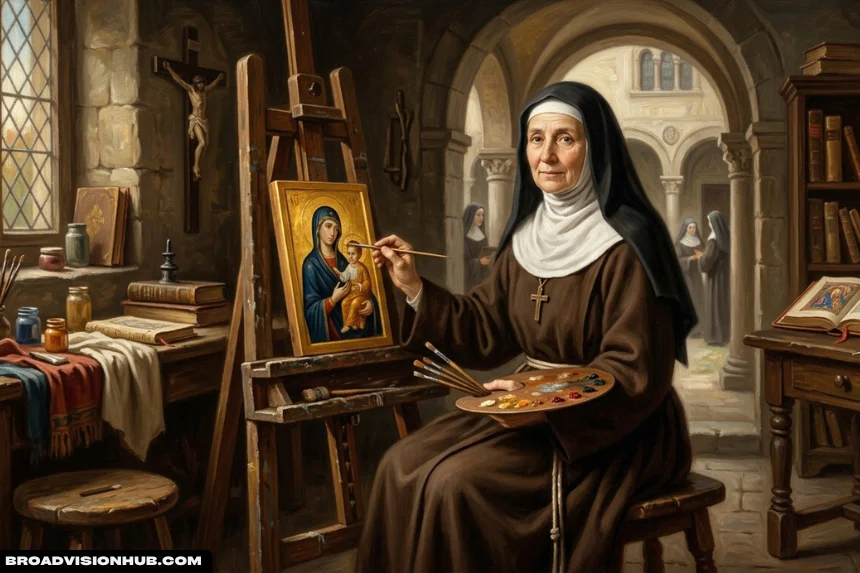
Choosing the Rule of St Clare
A significant division eventually developed within Catherine’s community.
Some members leaned toward an Augustinian form of religious life. Others preferred a Franciscan direction.
Between 1429 and 1430, Lucia Mascheroni, who led the community, decided to establish an Augustinian monastery.
Catherine, however, made another choice.
She and several companions committed themselves to the Rule of St Clare of Assisi, placing their religious life within the Franciscan tradition.
This decision established the foundation for Catherine’s later identity as a Poor Clare.
Furthermore, the community lived near the Church of the Holy Spirit and a convent of Observant Friars Minor. As a result, the women could participate regularly in liturgical life and receive Franciscan spiritual guidance. They also heard the preaching of St Bernardine of Siena.
Therefore, Catherine’s Franciscan identity emerged gradually from a real choice between different religious paths.
What Did Becoming a Poor Clare Mean?
The Poor Clares trace their origins to St Clare of Assisi and the broader Franciscan movement.
Their spirituality traditionally emphasizes poverty, prayer, community life and dedication to Christ.
For Catherine, however, embracing this way of life did not mean immediately taking on an elevated role.
Quite the opposite.
Once established in convent life, she performed ordinary forms of work.
The Holy See records that she served as:
- a laundress;
- a dressmaker;
- a breadmaker;
- a caretaker of animals.
Later, she was also given responsibilities involving novices and visitors.
This part of her biography is especially important because it provides context for her later leadership.
Before becoming an abbess, she spent years doing routine communal work.
From Courtly Life to Daily Convent Work
The contrast is striking.
As a young girl in Ferrara, Catherine had learned poetry, painting, music, Latin and the sophisticated customs of an aristocratic court.
In the convent, meanwhile, she washed clothes, made bread, sewed and cared for animals.
Yet her biography does not present these two worlds as contradictory.
Instead, her intellectual abilities and willingness to perform ordinary work developed alongside one another.
Later, she accepted responsibility as novice mistress, although the Holy See reports that she initially considered herself unsuitable for the position. She subsequently gained a reputation as an effective teacher.
Consequently, her authority developed gradually through years of community participation rather than appearing suddenly when she received a formal title.
The Foundation for Her Later Life
By this stage, several elements that would define Catherine’s later reputation were already present.
She possessed a strong artistic and literary education.
She had deliberately left court life.
Moreover, she had chosen Franciscan spirituality and the Rule of St Clare rather than following the alternative Augustinian path available to her community.
At the same time, she was gaining practical experience in service, religious discipline and teaching.
These developments created the foundation for the next period of her life, when Catherine would become known not only as a Poor Clare but also as a spiritual writer, artist, teacher and eventually abbess in Bologna.
Her most important writing, her artistic legacy, the spiritual experiences she recorded, and her later leadership belong to the next stage of the story.
From Religious Sister to Spiritual Teacher
Years of ordinary convent work gradually prepared Catherine for greater responsibility.
Although she had entered religious life after an unusually sophisticated court education, she did not immediately become a leader. Instead, she spent years serving her community before receiving responsibility for younger sisters.
Eventually, Catherine became novice mistress, meaning that she helped guide women who were preparing for full religious life.
According to the Holy See, she initially considered herself unsuitable for the role. Nevertheless, she accepted it out of obedience and became a respected teacher.
This period is significant because Catherine’s later spiritual writings were not produced in isolation. Her experience of teaching, advising and living alongside other sisters gave her practical reasons to explain the difficulties she believed could arise in religious life.
Consequently, her best-known work combines personal experience with instruction.
Her Spiritual Struggles
Accounts of saints can sometimes make religious commitment appear effortless. Catherine’s own writings present a more complicated picture.
She described periods of severe inner struggle after entering religious life. According to Benedict XVI’s summary of her writings, she experienced profound spiritual distress, doubts and temptation, including difficulty concerning belief in the Eucharist.
Therefore, her spiritual development was not a simple progression from certainty to greater certainty.
Instead, Catherine described:
- doubt;
- fear;
- discouragement;
- temptation;
- questions about her vocation;
- periods of intense spiritual darkness.
The Vatican account even says that she came close to despair during one particularly difficult period.
These experiences later became important to her teaching because she wanted other members of her community to understand that religious difficulty did not necessarily mean a vocation had failed.
How Should Her Visions Be Described?
Catherine also wrote about experiences that she understood as visions.
For an informational article, it is important to distinguish between what Catherine reported and what can be independently established as historical fact.
Therefore, a careful formulation is:
Catherine’s writings describe visions and mystical experiences that she interpreted within her Catholic faith.
The Holy See’s account states that she described an experience involving the Real Presence in the Eucharist after a period of serious doubt. She also wrote about receiving assurance of divine forgiveness in 1429 and about a vision of the Last Judgment in 1431.
These accounts form an important part of her spiritual autobiography.
However, they should not be presented as though modern historical research independently verified the supernatural events themselves.
That distinction keeps the article factual while accurately representing Catholic tradition.
What Is The Seven Spiritual Weapons?
Catherine’s best-known text is Le sette armi spirituali, usually translated into English as The Seven Spiritual Weapons.
It is both an instructional and partly autobiographical work.
Benedict XVI described the treatise as combining spiritual teaching with Catherine’s reflections on her own struggles. She sometimes wrote in the third person when discussing extraordinary experiences and in the first person when acknowledging her own faults.
Importantly, the work is not known only through later references.
The British Library holds a 15th-century manuscript containing Le sette armi spirituali under the shelfmark Add MS 10767. Its catalogue identifies Caterina Vigri, also known as Catherine of Bologna, as the author and describes the text as a visionary work.
For readers interested in the surviving manuscript tradition, see the British Library catalogue entry for Le sette armi spirituali.
Why Did She Write It?
The work was intended to do more than record unusual experiences.
Catherine wanted to help other religious women recognise and resist what she understood as spiritual dangers.
Her own struggles gave the text an unusually personal character.
According to the Vatican account, she wanted readers to recognise deceptive temptations involving:
- doubts about faith;
- uncertainty about vocation;
- spiritual discouragement;
- sensual temptation;
- excessive confidence in one’s own abilities.
Therefore, The Seven Spiritual Weapons functions as both testimony and practical religious instruction.
The Seven Spiritual Weapons Explained
The title refers to seven principles Catherine believed were necessary for spiritual life.
Rather than reproducing the historical wording, they can be explained in modern language as follows.
1. Make a Deliberate Effort to Do Good
The first principle concerns active effort.
Catherine did not present spiritual growth as something that happened automatically. Instead, she believed a person should consciously seek what is good and practise it consistently.
In practical terms, the lesson emphasises discipline rather than intention alone.
2. Do Not Depend Entirely on Yourself
Her second principle concerns humility.
Catherine believed that human beings should recognise their limitations instead of assuming that personal strength alone could overcome every spiritual difficulty.
This idea fits closely with the humility that appears repeatedly throughout accounts of her convent life.
3. Trust God During Difficulty
The third teaching concerns trust rather than fear.
She encouraged readers not to abandon their spiritual commitments simply because difficulties appeared.
Therefore, struggle itself was not evidence that a person should give up.
4. Reflect on the Life and Passion of Jesus
Another principle was frequent meditation on the life of Christ, especially his Passion and death.
For Catherine, contemplation was not separate from daily conduct. Instead, religious reflection was supposed to shape how a person responded to hardship.
5. Remember Mortality
The fifth weapon involves remembering that human life is temporary.
This idea, sometimes described through the broader Christian tradition of memento mori, encouraged readers to place immediate difficulties within a larger spiritual perspective.
6. Keep Eternal Goals in View
Closely connected with remembering death was Catherine’s instruction to keep the goods of Heaven in mind.
In other words, she advised readers not to measure every decision solely by short-term comfort or success.
7. Know Sacred Scripture
Her final principle emphasised familiarity with Scripture.
Catherine believed biblical teaching should be remembered closely enough to guide both thought and action.
Benedict XVI presented these seven principles as the central structure of her spiritual programme.
Why the Book Matters to Her Biography
The Seven Spiritual Weapons is important because it reveals more than Catherine’s theology.
It also provides insight into how she understood herself.
The text presents a woman who could be:
- intellectually disciplined;
- deeply religious;
- uncertain;
- frightened;
- self-critical;
- persistent.
Consequently, it complicates an overly idealised picture of medieval sainthood.
Her influence did not come from claiming that she never struggled. Instead, she turned those struggles into instruction for others.
That feature is one reason the work remains central to understanding her personality.
Her Creative Life Inside the Convent
Catherine did not leave her artistic education behind when she abandoned court life.
The skills she had developed in Ferrara remained part of her religious world.
She continued to be associated with:
- painting;
- manuscript work;
- writing;
- music;
- devotional imagery.
This connection is supported by more than later biographies.
Italy’s Ministry of Culture maintains the Museo della Santa at the Corpus Domini complex in Bologna. The museum preserves manuscripts and objects connected with Catherine, including her breviary, The Seven Spiritual Weapons, paintings attributed to her and a 15th-century stringed instrument associated with her musical activity.
Readers can view the official description through the Italian Ministry of Culture’s Museo della Santa page.
Paintings Associated With Catherine
The Museo della Santa identifies two devotional paintings as works by Catherine:
- Madonna del Pomo;
- Gesù Bambino.
Both are preserved within the museum collection at Corpus Domini.
Their presence is particularly valuable because it strengthens the historical basis for her reputation as an artist.
However, attribution needs to be handled carefully.
Not every painting historically connected with Catherine is currently accepted as her work.
For example, the Pinacoteca Nazionale di Bologna explains that a panel depicting Saint Ursula and her companions was traditionally attributed to Catherine. An inscription had even associated the work with her. Modern scholarship, however, no longer accepts that attribution and instead places the painting within another artistic context.
Therefore, a reliable article should not list every traditionally attributed painting as unquestionably hers.
The stronger approach is to distinguish between:
works currently presented by official cultural institutions as hers
and
works that were historically attributed to her but are now disputed or reassigned.
This distinction makes the artistic section more accurate than many simplified biographies.
Was She Really a Renaissance Artist?
There is strong historical support for describing Catherine as an artist.
Her court education included painting and miniature work. Moreover, Italy’s Ministry of Culture has described Caterina de’ Vigri as a figure remembered by historians as an important early woman artist of the Renaissance.
Still, the phrase Renaissance artist requires context.
Catherine did not pursue a modern professional artistic career. Her creative work developed primarily within courtly and religious settings, where art, manuscript production and devotion were closely connected.
Therefore, it is more accurate to understand her as a religious woman with substantial artistic training and surviving artistic works rather than applying the expectations of a modern commercial artist.
Manuscripts and the Art of the Book
Her abilities in manuscript copying and miniature painting are particularly significant.
During Catherine’s lifetime, European printing was only beginning to transform the production of books.
Handwritten manuscripts still played a major role in religious St Catherine of Bologna communities.
Accordingly, the ability to:
- copy texts accurately;
- decorate manuscripts;
- create devotional imagery;
- work carefully with lettering and page design
was both artistic and practical.
Catherine’s surviving association with manuscripts therefore links her artistic education directly with her religious life.
The British Library’s 15th-century manuscript of The Seven Spiritual Weapons also demonstrates how her writing circulated within the manuscript culture of the period.
Music as Another Part of Her Creative Identity
Painting was not her only artistic interest.
Part A established that she had learned to play the viola during her education in Ferrara.
Furthermore, the Museo della Santa preserves a small 15th-century stringed instrument traditionally associated with Catherine. Italy’s Ministry of Culture describes the object as a valuable surviving example of a period viella.
As a result, her creative life crossed several areas:
visual art, literature, manuscript production and music.
That range helps explain why later Catholic tradition connected her so St Catherine of Bologna strongly with artistic creativity.
Growing Responsibility in Ferrara
Catherine’s reputation inside the convent also continued to grow.
After serving as novice mistress, she was entrusted with duties connected to the convent parlour.
This role required interaction with people who came to the monastery.
According to Benedict XVI’s account, Catherine found the interruptions difficult because they took her away from prayer. Nevertheless, she continued performing the responsibility.
This detail provides another useful insight into her personality.
She apparently preferred contemplation and service over public authority.
Yet the pattern of her life repeatedly placed her in positions where other people relied upon her.
That tension became even more important when she was eventually asked to leave Ferrara.
Why Did She Return to Bologna?
In 1456, Catherine received a major new assignment.
Her community was asked to establish a new Poor Clare foundation in St Catherine of Bologna Bologna, and she was chosen to lead it.
The Vatican account states that she would have preferred to remain in Ferrara. Nevertheless, she accepted the assignment and travelled to Bologna with 18 sisters.
This return brought her life full circle.
She had been born in Bologna, spent important formative years in Ferrara and was now returning to her native city not as a child but as the leader of a new religious community.
Italy’s Ministry of Culture likewise identifies her as abbess of the first Poor Clare monastery in Bologna.
Becoming Abbess in Bologna
Catherine arrived in Bologna as abbess.
However, surviving accounts stress that she did not understand leadership St Catherine of Bologna primarily as rank or privilege.
According to Benedict XVI, she emphasised:
- prayer;
- service;
- humility;
- poverty;
- patience;
- community life.
The Vatican account presents her authority as closely connected with service to others rather than personal ambition.
This idea is consistent with her earlier reluctance to accept teaching and leadership positions.
Indeed, Benedict XVI later highlighted her humility as one of the defining characteristics of her life, noting that she did not seek status or government for its own sake.
Her First Term as Abbess
The surviving Vatican account states that Catherine initially served a three-year term as abbess.
After completing it, she was pleased to be replaced.
However, the change did not last.
About a year later, the newly elected abbess became blind. Catherine consequently resumed leadership of the community.
This detail is important because it reinforces the picture of reluctant authority.
She did not simply remain in office because she wanted permanent control. Instead, the sources describe her stepping aside and later returning when circumstances required it.
Meanwhile, her health was already causing serious difficulties.
Nevertheless, she continued serving the community.
What Kind of Leader Was She?
Catherine’s approach to leadership appears to have been strongly shaped by St Catherine of Bologna her earlier years of ordinary convent work.
Before becoming abbess, she had washed clothing, made bread, sewn garments, cared for animals, taught novices and dealt with visitors.
Therefore, she had experienced many aspects of convent life before governing others.
As abbess, she encouraged her sisters toward:
- patience;
- perseverance during hardship;
- mutual love;
- prayer;
- observance of their religious rule;
- commitment to communal life.
Benedict XVI’s account specifically notes her emphasis on patience, constancy in trials and fraternal love.
Consequently, her leadership cannot be separated from the spiritual ideas found in her writings.
The same themes—humility, perseverance, discipline and trust during difficulty—appear in both.
Art, Writing and Leadership Come Together
By the later 1450s, the major strands of Catherine’s life had come together.
During her court education, she developed strong literary, musical, and visual arts skills.
Later, life in the convent gave her firsthand experience of service and spiritual discipline.
As a novice mistress, she refined her teaching abilities while mentoring younger members.
These experiences eventually shaped the spiritual guidance she shared through her writing.
Finally, her appointment as abbess in Bologna placed her in responsibility for an entire religious community.
Therefore, Catherine should not be understood through only one label.
She was not solely:
- a nun;
- an artist;
- a writer;
- a mystic;
- a teacher;
- an abbess.
Instead, these roles overlapped.
That combination explains why St Catherine of Bologna remains an unusual figure in the religious and cultural history of Renaissance Italy.
Her Final Years and Declining Health
By the early 1460s, Catherine’s health had deteriorated considerably.
Nevertheless, she continued serving the Poor Clare community in Bologna. Benedict XVI’s account states that she suffered from serious illnesses while carrying out her responsibilities and St Catherine of Bologna encouraging the sisters toward patience, perseverance and communal love.
At the beginning of 1463, her condition worsened.
She gathered the sisters for what became her final chapter meeting and encouraged them to remain faithful to their religious rule. Toward the end of February, her suffering became particularly severe. Even then, the Vatican account presents Catherine as attempting to comfort the women around her rather than focusing only on her own condition.
Before her death, she gave her confessor the text of The Seven Spiritual Weapons, the spiritual work discussed in Part B.
When Did Catherine Die?
Catherine died in Bologna on March 9, 1463.
According to the Holy See’s account, she had received the final sacraments and died surrounded by members of her community. The same source records that she repeated the name of Jesus three times at the end of her life.
She was 49 years old.
Her date of death later became the date on which she is commemorated in the Catholic calendar.
Therefore, March 9 is important both historically and liturgically.
What Happened After Her Death?
Devotion to Catherine did not begin only when Rome formally St Catherine of Bologna declared her a saint centuries later.
Instead, religious devotion surrounding her developed after her death in Bologna.
Her remains eventually became closely associated with the Corpus Domini monastery and church, the religious community she had led.
The Vatican states that her body is preserved in Bologna in the chapel of the Corpus Domini monastery. Italy’s Ministry of Culture likewise identifies the site as the place where her remains are venerated.
Consequently, Corpus Domini remains one of the most important physical locations connected with her life and later cult.
When Was She Canonized?
Formal canonization occurred nearly two and a half centuries after Catherine’s death.
Pope Clement XI canonized her on May 22, 1712.
That distinction is important.
Canonization in 1712 did not mean that people had suddenly discovered her. Rather, devotion to Catherine had already developed in Bologna before formal papal recognition.
The canonization therefore represented the Catholic Church’s official recognition of a religious reputation that had existed for generations.
Where Is Her Body Today?
The remains associated with St Catherine of Bologna are preserved at the Corpus Domini complex in Bologna, also commonly known locally as the Church of the Saint.
Italy’s Ministry of Culture describes a chapel on the left side of the church where Catherine’s body is venerated seated on a gilded throne. The museum also houses manuscripts, relics, artworks and objects connected with her life.
Official Museo della Santa page — Italian Ministry of Culture
A 2026 guide from Bologna’s official tourism organization also confirms that the chapel dedicated to Catherine remains inside the Corpus Domini sanctuary.
Is Her Body Really Incorrupt?
Catholic sources and Italy’s Ministry of Culture describe St Catherine of Bologna Catherine’s body as incorrupt. The Vatican explicitly uses that description, while the Ministry of Culture similarly refers to the body preserved in the chapel.
However, an informational article should handle the wording carefully.
It is better to say:
Catholic and Italian cultural sources describe Catherine’s preserved body as incorrupt.
That formulation accurately reports the religious and historical tradition without presenting incorruption as though this article were making an independent scientific determination.
Why Is She Associated With Artists?
One of Catherine’s best-known modern associations is with artists.
This connection is understandable because creative work was not a minor detail in her biography. As Parts A and B established, she received training in painting, manuscript illumination, literature and music. Moreover, works and objects connected with her creative life remain preserved in Bologna.
Italy’s Ministry of Culture has even noted that historians remember Caterina de’ Vigri as an important early woman artist of the Renaissance.
Furthermore, the Italian national cultural catalogue records a later painting of Catherine at an easel and notes a strong tradition of artistic devotion surrounding her in Bologna. The catalogue specifically refers to the protection associated with her and Bologna’s historic Accademia Clementina.
For these reasons, she became strongly associated in Catholic tradition with painters and other artists.
Patron Saint of Artists
St Catherine of Bologna is widely regarded in Catholic devotion as a patron saint of artists and the arts.
A parish dedicated to her in the United States specifically identifies her as Patron Saint of the Arts, connecting that patronage with her painting, manuscript work, music and spiritual writing.
St Catherine of Bologna parish — Patron Saint of the Arts
However, readers should understand Catholic patronage correctly.
Calling someone a patron saint of artists does not mean that she is the only saint associated with art. Other saints also have traditional connections with particular creative professions.
Catherine’s distinctive claim comes from her own documented creative activity.
She was not associated with artists merely because later generations selected an arbitrary patron. Instead, painting, manuscript production, writing and music were genuinely part of her life.
When Is Her Feast Day?
The Catholic feast day associated with Catherine is March 9.
Vatican News lists St Catherine of Bologna, Virgin, Clares under March 9 in its official calendar of saints.
Vatican News — St Catherine of Bologna, March 9
The date corresponds with her death on March 9, 1463.
Therefore, readers who encounter references to a Catherine of Bologna feast day should generally expect March 9.
Her Place in Renaissance Women’s History
Catherine’s significance extends beyond devotional history.
Her life provides evidence of a woman participating in multiple forms of intellectual and creative activity during the 15th century.
She was educated in:
- literature;
- Latin;
- music;
- manuscript production;
- painting;
- poetry.
Later, she wrote spiritual works, taught other women and governed a religious community.
Moreover, Italy’s Ministry of Culture has highlighted her importance in the history of female creativity, describing monasteries not simply as places of withdrawal but also as spaces of artistic production. In that context, Caterina de’ Vigri has been remembered by historians as an early woman artist of the Renaissance.
This perspective adds an important dimension to her biography.
The convent did not necessarily end Catherine’s intellectual or artistic development. Instead, it became another setting in which those abilities could operate.
Why Her Artwork Matters
The surviving artistic material associated with Catherine is important for two reasons.
First, it supports documentary accounts describing her as artistically trained.
Second, it provides physical evidence of creative activity within women’s religious communities.
The Museo della Santa currently identifies the Madonna del Pomo and Gesù Bambino among paintings by Catherine held there. It also preserves her manuscripts and the famous small stringed instrument known as the violeta.
Therefore, her artistic reputation does not depend exclusively on later written tradition.
Physical objects associated with her remain part of Bologna’s cultural heritage.
At the same time, attribution should remain cautious. As Part B explained, not every artwork historically assigned to Catherine continues to be accepted by modern scholars.
That distinction strengthens rather than weakens the article because it separates established institutional attribution from older tradition.
Why The Seven Spiritual Weapons Still Matters
Catherine’s principal surviving spiritual work is important not merely because a saint wrote it.
Instead, its value lies partly in the way personal experience and instruction interact.
She wrote about spiritual discouragement, uncertainty and temptation rather than portraying herself as someone who never struggled.
Consequently, her advice grew from experiences she believed she had personally endured.
The work also offers historians insight into:
- female religious education;
- Franciscan spirituality;
- convent instruction;
- late-medieval devotional writing;
- women’s authorship.
For modern readers, its historical importance therefore extends beyond purely devotional use.
Why Her Story Remains Distinctive
Several elements make Catherine stand out among 15th-century religious figures.
She moved between two very different environments.
First came the cultivated Este court, where she received artistic and intellectual training.
Then came convent life, where she carried out ordinary communal work before gradually assuming teaching and leadership responsibilities.
Moreover, she combined roles that modern readers may incorrectly imagine as separate:
artist, author, musician, religious sister, spiritual teacher and abbess.
Her surviving writings also prevent her biography from becoming unrealistically simple. They describe spiritual struggles as well as confidence.
Consequently, her legacy is not merely a story about flawless certainty.
It is also a story about education, creativity, responsibility, doubt, perseverance and service.
Frequently Asked Questions
Who was St Catherine of Bologna?
She was an Italian Poor Clare, writer, artist, spiritual teacher and abbess born as Caterina de’ Vigri in Bologna on September 8, 1413. She spent part of her youth at the Este court in Ferrara before choosing religious life and later leading a Poor Clare monastery in Bologna.
What is Catherine of Bologna famous for?
She is especially known for her Poor Clare religious life, artistic work, leadership in Bologna and spiritual text The Seven Spiritual Weapons. She is also widely associated with artists in Catholic tradition.
What was her real name?
Her Italian name was Caterina de’ Vigri. In English, she is commonly called Catherine of Bologna.
Was Catherine of Bologna an artist?
Yes. Historical accounts describe her education in painting and miniature work, while Italy’s Ministry of Culture preserves paintings and other creative material associated with her.
What is she the patron saint of?
She is widely regarded as a patron saint of artists and the arts, reflecting her documented involvement with painting, manuscript work, writing and music.
Was she a Poor Clare?
Yes. She chose the Rule of St Clare and became part of the Franciscan Poor Clare tradition. Later, she served as abbess of the new community established in Bologna.
What did she write?
Her best-known work is The Seven Spiritual Weapons, a spiritual treatise combining practical religious instruction with aspects of her own experiences.
What are the Seven Spiritual Weapons?
In simplified form, the seven teachings encourage deliberate pursuit of good, humility about personal ability, trust in God, meditation on Christ, remembrance of mortality, focus on eternal life and familiarity with Scripture.
Did she report visions?
Yes. Her writings describe experiences that she understood as religious visions and mystical encounters.
However, those claims should be presented as her reported experiences within Catholic tradition, rather than as supernatural events independently established by historical research.
When did she become abbess?
She travelled to Bologna in 1456 with 18 sisters to help establish a new Poor Clare community and became its abbess.
When did Catherine die?
She died in Bologna on March 9, 1463.
When was she canonized?
Pope Clement XI canonized her on May 22, 1712.
What is her feast day?
Her Catholic feast day is March 9, which corresponds with the date of her death. Vatican News lists her under that date in its saints calendar.
Where is her body?
Her remains are preserved at the Corpus Domini complex in Bologna. Italy’s Ministry of Culture describes her body as being venerated there while seated on a gilded throne.
Is Catherine’s body incorrupt?
The Vatican and Italy’s Ministry of Culture describe the preserved body as incorrupt. For neutral informational writing, this should be attributed to Catholic and institutional descriptions rather than framed as an independently proven scientific conclusion.
Where can her artwork be seen?
Objects and artworks associated with her are preserved at the Museo della Santa in Bologna. The official Italian Ministry of Culture page lists paintings, manuscripts, relics and a 15th-century musical instrument in the collection.
Conclusion
St Catherine of Bologna occupies an unusual place at the intersection of Catholic history, Renaissance culture and women’s artistic history.
Born Caterina de’ Vigri in 1413, she moved from an educated court environment into Franciscan religious life. Over time, she became a teacher, author, artist and abbess while continuing to emphasize humility and service.
Her Seven Spiritual Weapons preserves a personal record of religious struggle alongside practical spiritual instruction. Meanwhile, surviving manuscripts, paintings and objects in Bologna provide physical links with her creative life.
She died on March 9, 1463, and Pope Clement XI canonized her in 1712. Today, her remains are preserved at Corpus Domini, while March 9 remains her Catholic feast day.
Ultimately, Catherine’s significance comes from the combination of her roles rather than any single achievement. Her life demonstrates how scholarship, creativity, religious commitment and leadership could coexist within a women’s convent during Renaissance Italy.