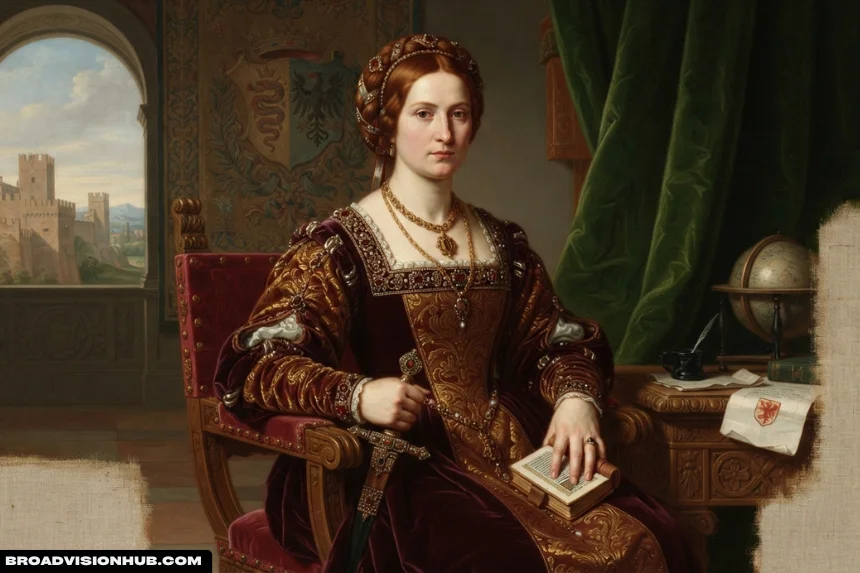
Caterina Sforza was one of the most remarkable political figures of Renaissance Italy. Born into Milan’s powerful Sforza dynasty around 1463, she became closely connected to papal politics through her marriage to Girolamo Riario and later emerged as a force in the government of Imola and Forlì. Although later generations often remembered her mainly as a fearless warrior, Caterina’s story was also shaped by dynastic strategy, diplomacy, government, family alliances, and the unstable politics of fifteenth-century Italy.
Moreover, her reputation did not develop from a single battle or famous legend. Long before her later resistance to conspirators and Cesare Borgia, Caterina had already shown an unusual willingness to act directly in political crises. Her occupation of Castel Sant’Angelo in 1484, for example, demonstrated how quickly she could turn dynastic connections into practical political power.
Who Was Caterina Sforza?
Caterina Sforza was an Italian Renaissance noblewoman who became associated with the rule of Imola and Forlì through her marriage to Girolamo Riario. She was the legitimized daughter of Galeazzo Maria Sforza, Duke of Milan, and Lucrezia Landriani. Over time, she became known not only for political leadership and military resistance but also for her later medical, cosmetic, and experimental interests.
Her life connected several of Renaissance Italy’s most influential political worlds, including the Sforza dynasty of Milan, the papal court in Rome, the rulers of Romagna, and eventually the Medici family of Florence.
Caterina Sforza Quick Facts
| Detail | Information |
|---|---|
| Full name | Caterina Sforza |
| Born | Around 1463 |
| Possible birthplace | Milan or Pavia |
| Father | Galeazzo Maria Sforza |
| Mother | Lucrezia Landriani |
| Dynasty | House of Sforza |
| First husband | Girolamo Riario |
| Associated territories | Imola and Forlì |
| Known for | Political rule, military resistance, diplomacy, and later experimental recipes |
| Major fortress associated with her | Rocca di Ravaldino |
| Famous Roman episode | Occupation of Castel Sant’Angelo in 1484 |
| Died | Florence, 1509 |
The precise details of Caterina’s birth require some caution. Treccani places her birth at about 1463, probably in Milan or Pavia, while EBSCO gives the year as 1462 or 1463. Therefore, presenting an exact birth date as certain would go beyond the available evidence.
Caterina Sforza’s Early Life and Sforza Family
Born Into the Powerful Sforza Dynasty
Caterina Sforza was born around 1463 to Galeazzo Maria Sforza and Lucrezia Landriani. Galeazzo Maria later became Duke of Milan in 1466. Although Caterina was born outside her father’s marriage, Galeazzo Maria recognized and legitimized her. As a result, she grew up within the political world of one of northern Italy’s most powerful ruling families.
The Sforza dynasty had risen to prominence through military leadership and political ambition. Francesco Sforza, Caterina’s grandfather, had become Duke of Milan, and the family remained deeply involved in the shifting alliances that shaped fifteenth-century Italy. Consequently, Caterina’s childhood was surrounded by discussions of dynastic survival, diplomacy, territorial control, and war.
Her father’s position also meant that Caterina could become useful in the marriage diplomacy practiced by Renaissance ruling houses. Noble marriages were rarely only personal arrangements. Instead, they could transfer territory, settle political disputes, create military alliances, and strengthen relationships between ruling families.
For Caterina, that reality would define much of her early adult life.
Childhood and Education at the Milanese Court
During her earliest years, Caterina spent time with her paternal grandmother, Bianca Maria Visconti. She later received an education alongside two other acknowledged children of Galeazzo Maria, Carlo and Alessandro. Treccani notes that records survive concerning books provided for their studies, offering unusually concrete evidence that Caterina received formal instruction within the ducal environment.
Therefore, it would be misleading to describe Caterina simply as an instinctive warrior who learned everything through experience. Her upbringing also exposed her to the habits, expectations, and intellectual culture of a Renaissance court.
In 1471, Caterina accompanied her father to Florence, where they visited the court of Lorenzo de’ Medici, better known as Lorenzo the Magnificent. She was still a child at the time. Nevertheless, the journey placed her directly within the network of elite Italian courts that would later become central to her political life.
How Caterina Sforza’s Family Background Shaped Her Future
Caterina’s Sforza heritage mattered for more than prestige.
First, it gave her access to powerful relatives who could provide diplomatic or military support. Second, it made her a valuable participant in dynastic marriage negotiations. Finally, it placed her within a ruling culture where maintaining political power often required quick decisions and shifting alliances.
These advantages did not guarantee security. Renaissance Italian politics could change rapidly, particularly when a ruler died or a powerful patron disappeared. Still, Caterina’s background gave her resources that later helped her survive crises that might otherwise have ended her political career.
Her identity as a Sforza remained especially important because her marriage would move her from Milanese politics into the orbit of the papacy.
Caterina Sforza and Girolamo Riario
An Arranged Political Marriage
One of the most important events of Caterina’s childhood occurred on January 20, 1473, when an agreement was concluded promising her in marriage to Girolamo Riario. Caterina was about ten years old, while Riario was approximately thirty. He was a nephew of Pope Sixtus IV, whose election in 1471 had dramatically increased the Riario family’s political influence.
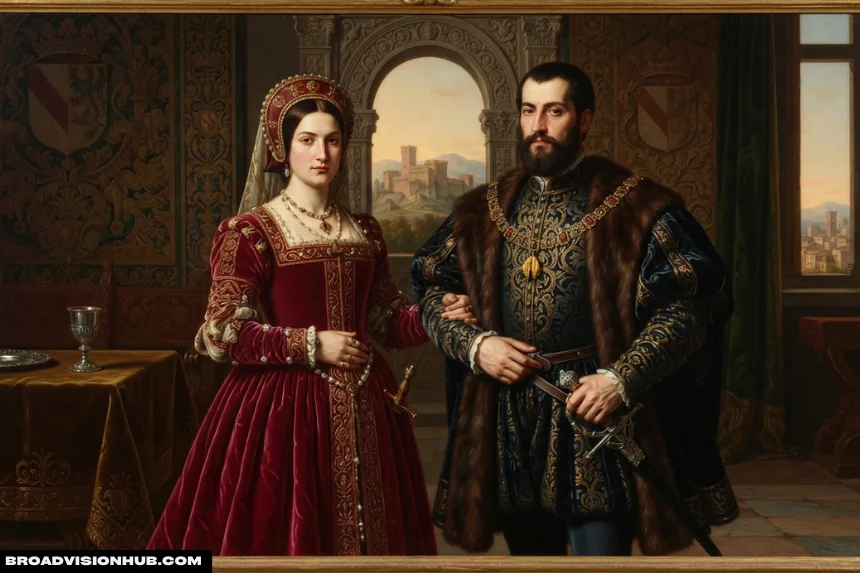
The arrangement was closely connected to the transfer of Imola.
According to Treccani, Galeazzo Maria Sforza agreed to sell the lordship of Imola to the Church for 50,000 ducats. However, 10,000 ducats of that amount effectively formed Caterina’s dowry. Therefore, the marriage agreement and the political future of Imola were directly connected.
This distinction is important for historical accuracy: 1473 marks the marriage agreement, not the beginning of Caterina’s married life with Riario. Treccani places the marriage itself in 1477.
Girolamo’s political fortunes depended heavily on Sixtus IV. The pope used close relatives as part of a broader effort to reinforce papal influence, and Girolamo became one of the important beneficiaries of that system.
For Caterina, therefore, marriage meant entering both the Riario household and the highly competitive political world surrounding the papal court.
Arrival in Imola and Life in Rome
In 1477, Caterina and Girolamo entered Imola, beginning a much more public stage of her life. EBSCO describes their entry into the city as a significant event, while Treccani confirms that Riario became lord of Imola and subsequently acquired Forlì as well.
However, Caterina did not remain permanently in Romagna. The couple also spent considerable time within the political environment of Rome because Girolamo’s power depended on his uncle, Pope Sixtus IV.
This created an unusual political geography for Caterina. Milan represented her birth family and dynastic support. Rome represented the source of Riario influence. Meanwhile, Imola and Forlì became the territories in which the couple sought to establish lasting rule.
As a result, Caterina developed experience across several political centers instead of remaining confined to a single court.
Becoming Lady of Forlì and Imola
Girolamo Riario was already lord of Imola, but in 1480 papal support expanded his authority to include Forlì. Treccani identifies him as lord of Imola and, from 1480, of Forlì.
The two cities were located in Romagna, an area whose strategic position made it important to larger Italian powers. Control of territory in this region could affect military movement and political influence between northern and central Italy.
Therefore, Forlì and Imola were more than decorative noble titles. Holding them required managing local elites, securing fortifications, maintaining relationships with the papacy, and watching the ambitions of neighboring powers.
Caterina increasingly participated in this political world. Over time, her involvement would become much more direct, particularly when Girolamo’s authority came under pressure.
The couple also invested in their territories. Treccani records Caterina’s later interest in strengthening the military defenses of both Forlì and Imola and notes her patronage of religious and artistic projects.
Those activities help correct the popular image of Caterina as someone concerned only with fighting. Political survival in Renaissance Italy also depended on administration, patronage, fortification, family alliances, and public authority.
Why Caterina Sforza Seized Castel Sant’Angelo
The first episode that clearly established Caterina Sforza’s reputation for bold political action came in 1484.
At the center of the crisis was the death of Pope Sixtus IV.
The Death of Pope Sixtus IV
Sixtus IV died on August 12, 1484. His death immediately threatened the Riario family because much of Girolamo’s power had depended on the pope’s protection.
The danger was not theoretical.
Treccani records that the Riario family’s Roman property was attacked and looted following the pope’s death. Even a property rented by Caterina north of Rome suffered destruction. The disappearance of Sixtus IV had therefore created both a political and physical threat to the family’s position.
In Renaissance Rome, the death of a pope could create a temporary power vacuum. Rival families, cardinals, soldiers, and political factions all had reasons to influence what happened next.
Caterina responded almost immediately.
Caterina Sforza’s Occupation of Castel Sant’Angelo
While Girolamo moved with papal forces toward Ponte Milvio, Caterina entered Castel Sant’Angelo with Paolo Orsini. Girolamo had previously held the office connected with the fortress, and Caterina acted in his name.
The decision was extraordinary for several reasons.
Most notably, Caterina was heavily pregnant at the time. Nevertheless, she began preparing the fortress for defense. During the night of August 24–25, she brought approximately 250 additional soldiers into the stronghold. Meanwhile, Girolamo had become more willing to leave Rome. Caterina, by contrast, continued to resist.
Castel Sant’Angelo was not an ordinary residence. The massive fortress stood beside the Tiber and played an important role in the defense of papal Rome. Controlling it during a papal transition gave Caterina leverage at a moment when the College of Cardinals was preparing for the conclave.
Therefore, her action should not be reduced to a colorful story about personal bravery. It was a calculated political intervention.
By holding the fortress, Caterina was attempting to protect her family’s interests while Rome decided what would happen after the death of the pope who had made the Riario rise possible.
How the Castel Sant’Angelo Crisis Ended
Caterina could not hold the fortress indefinitely.
Cardinal Ascanio Sforza, Caterina’s relative, arrived in Rome and participated in negotiations with her on behalf of a group of cardinals. Eventually, Caterina agreed to end her occupation after seeking assurances concerning her family’s future.
Meanwhile, the conclave elected Innocent VIII on August 29, 1484.
Caterina and Girolamo entered Forlì on September 4. Soon afterward, they received confirmation that their vicariates would be maintained and that Girolamo could retain his position as captain general of the Church without remaining permanently in Rome.
In that sense, Caterina’s gamble did not restore the political world that had existed under Sixtus IV. However, the Riario-Sforza family did preserve its territorial position.
What the 1484 Crisis Revealed About Caterina Sforza
The Castel Sant’Angelo episode matters because it occurred years before the events that later made Caterina famous.
By 1484, she had already demonstrated several characteristics that would define the rest of her political career.
First, she understood the importance of fortresses. Control of a strong defensive position could provide political leverage even when circumstances outside the walls were uncertain.
Second, she was willing to act independently during a crisis. Although she entered Castel Sant’Angelo in connection with her husband’s authority, her determination eventually exceeded Girolamo’s willingness to remain in confrontation with the Roman political establishment.
Moreover, Caterina showed that she understood negotiation as well as confrontation. She ultimately left the fortress after securing political reassurances rather than turning the crisis into a hopeless military fight.
This combination of defiance and calculation would appear repeatedly throughout her life.
However, the years after Castel Sant’Angelo became increasingly dangerous. The political protection that Girolamo had enjoyed under Sixtus IV weakened, opposition inside Forlì intensified, and conspiracies against Riario continued.
By 1488, those tensions would explode into an assassination and a struggle for control of Forlì that transformed Caterina Sforza from an influential ruler’s wife into a regent fighting to preserve her family’s power.
The Assassination of Girolamo Riario in 1488
The political tensions surroundiApril 14, 1488**. By then, opposition to his government in Forlì had grown considerably. Financial problems, taxation, disputes with influential local families, and dissatisfaction among officials had weakened his position. A reform of the local tax assessment in early 1488 further increased resentment among important property owners. ntly, several men close enough to Riario to gain access to him joined a conspiracy. Among the most prominent were members of the Orsi family, particularly Checco and Lodovico Orsi, together with Giacomo Ronchi and Lodovico Pansecchi. vening of April 14, the conspirators entered the Palazzo della Signoria under false pretences and attacked Riario. He was stabbed to death, and the palace was subsequently looted amid widespread disorder. Caterina Sforza and her children were taken prisoner. , therefore, the assassination appeared to have destroyed the Riario family’s hold on Forlì.
However, the conspirators had made a serious strategic mistake.
They controlled Caterina and her children, but they did not securely control the most important fortress in the city: the Rocca di Ravaldino.
That distinction changed everything.
Why Opposition to Girolamo Riario Had Grown
Riario’s assassination was not simply an unpredictable act of personal violence. Instead, it emerged from a wider political crisis.
After the death of Pope Sixtus IV in 1484, Girolamo had lost the powerful patron whose support had helped establish his authority. Meanwhile, his government faced financial difficulties. Moreover, sections of Forlì’s elite resented the Riario regime and the taxation associated with it. also had a political history that predated the Riario family. The Ordelaffi had previously ruled Forlì, and the transfer of power to Girolamo had not erased older loyalties or rivalries.
Therefore, Caterina and Girolamo governed a territory in which authority depended on far more than possessing a papal title. They needed local cooperation, military security, outside alliances, and control of the city’s fortifications.
When those relationships broke down, the consequences were immediate.
Following Girolamo’s murder, local authorities moved quickly toward placing Forlì under papal authority. Bernardino Savelli, the governor of nearby Cesena, took possession of the city on behalf of the Church on April 15, 1488. rina had not surrendered.
Caterina Sforza and the Ravaldino Crisis
Caterina and her children initially remained prisoners following Girolamo’s assassination. Nevertheless, she soon saw an opportunity to regain control of the situation.
The conspirators needed possession of Ravaldino, the principal fortress protecting Forlì.
Caterina persuaded them that she could convince the fortress commander, Tommaso Feo, to surrender it. To make the arrangement credible, she left her children behind as hostages and entered the fortress herself. ely inside, however, she refused to deliver Ravaldino.
Instead, Caterina took command.
By April 19, artillery from the fortress was firing on the city. The woman whom the conspirators believed they could use to obtain Ravaldino had transformed the fortress into the centre of resistance against them. sode became one of the defining moments of Caterina Sforza’s historical reputation.
Yet the documented strategy itself is more important than the legend later attached to it.
Caterina understood that controlling the fortress gave her time. As long as Ravaldino remained outside the conspirators’ hands, their victory was incomplete. Moreover, she could hope that her Sforza relatives and other allies would intervene before the fortress fell.
That calculation proved correct.
Caterina’s Children as Hostages
The most emotionally powerful element of the crisis was the position of Caterina’s children.
They remained in the hands of her opponents while their mother controlled Ravaldino. According to later narratives, the conspirators brought the children beneath the fortress walls and threatened them in an effort to force Caterina to surrender.
Caterina refused.
Her decision has often been presented as evidence of extraordinary ruthlessness. However, it should also be understood within the political realities of the crisis.
If Caterina surrendered Ravaldino, she could lose not only the fortress but also the political future of those same children. In particular, her eldest son Ottaviano Riario was the heir in whose name the family’s claims to Forlì and Imola could be preserved.
Therefore, possession of the fortress represented the strongest remaining protection for the Riario children’s dynastic position.
It was an extraordinary gamble, but it worked.
Did Caterina Sforza Really Expose Herself at Ravaldino?
One story from the Ravaldino crisis has overshadowed almost every other detail of Caterina Sforza’s life.
According to the famous version, the conspirators threatened to kill Caterina’s children while she stood on the fortress walls. Caterina supposedly responded that they could do so because she still possessed the means to produce more children. Some versions add that she lifted her clothing and exposed herself to emphasize the point.
The episode has been repeated for centuries.
However, it needs to be treated with considerable historical caution.
What Machiavelli Said About Caterina Sforza
Niccolò Machiavelli included the dramatic exposure story in his Discourses on Livy. His account says that Caterina responded to the threats against her children by displaying her genitals, thereby emphasizing that she could have other children. lem is chronology.
Machiavelli was not standing beneath Ravaldino as an eyewitness in April 1488. He met Caterina personally years later, during a Florentine diplomatic mission to Forlì in 1499. , scholarly discussion of Caterina’s later reputation emphasizes just how influential Machiavelli’s writings became in shaping the image that subsequent generations inherited. Oxford Academic notes that his telling of the 1488 events played a major role in promoting her reputation as a sexually bold and merciless ruler. ory Versus Legend
The safest historical conclusion is therefore straightforward:
Caterina’s defiance at Ravaldino and her refusal to surrender are well established. The literal exposure episode comes through Machiavelli’s later account and should not be presented as an independently verified eyewitness fact.
This distinction matters.
The story is valuable because it shows how Caterina’s historical reputation developed. Nevertheless, repeating the most sensational version as unquestioned fact risks confusing later literary memory with documented events.
In reality, Caterina did not need the legendary gesture to demonstrate extraordinary determination.
She had already entered a fortress while leaving her children as hostages, turned its weapons against her opponents, and waited for military relief while the conspirators controlled much of the surrounding city.
Those actions alone explain why the episode became famous.
How Caterina Sforza Became Regent of Forlì and Imola
Caterina’s strategy at Ravaldino succeeded because she was not completely isolated.
Her relatives in the House of Sforza responded to the crisis. By the end of April 1488, a large allied force was approaching Forlì, including Milanese troops and forces associated with the Bentivoglio rulers of Bologna. Treccani describes an army numbering more than 10,000 men arriving within a short distance of the city. th that intervention, the conspirators’ position collapsed.
Caterina emerged from Ravaldino and formally assumed power in the name of her eldest son, Ottaviano, on April 30, 1488. Several months later, on August 15, papal authority formally recognized her regency. e, the assassination that was supposed to end Riario rule instead produced a different political arrangement.
Girolamo was dead.
Ottaviano was still a child.
Caterina became the effective ruler.
Governing for Her Son Ottaviano
Technically, Caterina governed as regent on behalf of Ottaviano. In practice, however, she became the dominant political figure in the territories.
Her position required balancing several competing interests.
She needed to protect Ottaviano’s claims. At the same time, she had to maintain relations with Milan, Florence, the papacy, and neighbouring rulers. Furthermore, she needed money to support military forces and strengthen the defenses of Forlì and Imola.
The financial situation was difficult.
By 1490, Caterina was already seeking financial support from Milan. Nevertheless, she continued to reinforce her authority and defend the territories that she governed. tical choices also changed as the wider Italian balance of power shifted.
This adaptability became especially important in the 1490s, when foreign invasion transformed the political landscape of the Italian peninsula.
Caterina Sforza as a Ruler, Not Just a Warrior
Popular accounts frequently describe Caterina as a warrior first and a ruler second.
That interpretation is too narrow.
Military defense certainly mattered to her. However, her survival depended just as much on diplomacy, financial management, family alliances, patronage, appointments, intelligence, and negotiation.
She also invested in fortifications and religious institutions within her territories. Meanwhile, surviving evidence indicates that she was deeply involved in political correspondence and in decisions concerning her children’s careers and marriages. less, Caterina’s government also had a violent side.
After recovering power in 1488, she carried out severe reprisals against those she considered responsible for Girolamo’s murder. Treccani records public executions and the destruction of the Orsi family palace. e, a balanced biography should avoid two extremes.
Caterina was neither simply a helpless Renaissance widow nor an idealized heroic ruler who relied only on courage. She could act strategically, negotiate effectively, cultivate alliances, and defend her territories. Yet she could also use harsh retaliation against political enemies.
That combination helps explain both the loyalty and fear that surrounded her reputation.
Caterina Sforza and Giacomo Feo
Political life and Caterina’s private relationships became closely intertwined during her regency.
One of the most important figures in this period was Giacomo Feo, sometimes rendered as Jacopo Feo.
Giacomo was the brother of Tommaso Feo, the commander associated with Ravaldino. In 1490, Caterina replaced Tommaso as fortress commander with Giacomo. By then, Giacomo had also become personally close to Caterina. Giacomo Feo Caterina Sforza’s Husband?
This relationship requires more careful wording than it often receives in simplified biographies.
Treccani’s modern biographical treatment states that Caterina secretly married Giacomo Feo, in part because publicly acknowledging another marriage could have threatened her position as regent for Ottaviano and therefore endangered the Riario succession. reason, referring to Feo only as an “affair” can understate the relationship, while presenting an openly recognized public marriage would also be misleading.
The safest description is:
Giacomo Feo was Caterina’s intimate partner and, according to Treccani’s biographical reconstruction, her secret husband.
Keeping the marriage hidden protected a crucial political distinction. Caterina continued ruling as the widow of Girolamo Riario and as regent for their son rather than openly establishing a competing household around a new husband.
Giacomo Feo’s Political Influence
Feo eventually gained substantial influence at Caterina’s court.
As a result, his growing position attracted hostility. Political rivals and members of the extended Riario circle could view his influence as a threat, particularly because Caterina’s government officially rested on her role as regent for Ottaviano.
Meanwhile, Italy itself was moving toward a much larger crisis.
In 1494, King Charles VIII of France invaded Italy while pursuing his claim to the Kingdom of Naples. Forlì and Imola suddenly became even more important because armies moving through the peninsula needed routes, food, lodging, and political cooperation.
Initially, Caterina moved toward the anti-French side. However, as the military situation shifted, she adapted and eventually reached an understanding allowing French troops passage and provisions through her territories. ode illustrates an important part of Caterina’s political method.
She was capable of changing direction when circumstances demanded it.
Rather than treating alliances as permanent expressions of personal loyalty, she often approached them as instruments for preserving her territories.
The Assassination of Giacomo Feo
Caterina suffered another violent personal and political shock on August 27, 1495, when Giacomo Feo was assassinated. h again produced severe retaliation.
Treccani describes Caterina’s response as extraordinarily violent. She punished not only people directly implicated in the killing but also supporters and members of their families. sode complicates the romanticized image that sometimes surrounds Caterina.
Her courage was real. Her political intelligence was substantial. Yet her methods of vengeance could also be brutal.
Therefore, the killing of Feo belongs in any serious assessment of Caterina Sforza because it demonstrates how personal loyalty, dynastic politics, and coercive power could overlap in Renaissance government.
After Feo’s death, however, another relationship would connect Caterina to one of the most famous families in Italian history.
Caterina Sforza and Giovanni de’ Medici
In 1496, Florence sent Giovanni di Pierfrancesco de’ Medici, known as il Popolano, to Caterina’s court as an ambassador.
The diplomatic relationship became a personal one.
Caterina and Giovanni entered into a secret marriage, generally dated to 1496 or 1497. ecrecy was politically useful.
Caterina’s legitimacy as regent depended on her continuing identification with the Riario succession. Publicly replacing that political identity with a new marriage could create difficulties over the government of Imola and Forlì.
Nevertheless, her union with Giovanni had enormous long-term significance.
Birth of Giovanni delle Bande Nere
On April 6, 1498, Caterina gave birth in Forlì to a son.
Originally, he was named Ludovico, but the child’s name was later changed to Giovanni following his father’s death. He became known to history as Giovanni delle Bande Nere. Unfortunately, Pierfrancesco de’ Medici did not live long enough to raise his son. Only months after the child’s birth, he died from illness in September 1498. As a result, Caterina was widowed again. The child born from that marriage would eventually become one of the most celebrated Italian military leaders.
Even more importantly for dynastic history, his descendants would transform Caterina’s place in the history of Florence.
That connection will become especially important when examining Caterina Sforza’s later Medici legacy.
Caterina Sforza and Machiavelli
Another famous Renaissance figure entered Caterina’s story in 1499: Niccolò Machiavelli.
Unlike the later generations who knew Caterina primarily through stories, Machiavelli actually met her.
In July 1499, Florence sent him to Forlì on a diplomatic mission. One important issue involved renewing the military contract, or condotta, connected with Caterina’s son Ottaviano. Florence also wanted political and military cooperation as it dealt with its war against Pisa and the changing strategic situation in Romagna. iavelli’s Diplomatic Mission to Forlì
Machiavelli arrived in Forlì during the third week of July 1499.
The negotiations were not simple.
Caterina wanted greater guarantees that Florence would help protect her territories. Florence, meanwhile, had its own military priorities and did not want to make commitments that exceeded its interests. The discussions therefore reveal Caterina acting not as a legendary battlefield heroine but as an experienced political negotiator. itive agreement on Ottaviano’s contract emerged from that particular mission. Nevertheless, the encounter made a lasting impression because Machiavelli later referred to Caterina repeatedly in his political and historical writings. Machiavelli Later Wrote About Caterina Sforza
Caterina appears in several works associated with Machiavelli’s political thought.
His discussions include:
- The Prince
- Discourses on Livy
- The Art of War
- Florentine Histories
- his Decennale
Treccani’s Enciclopedia Machiavelliana identifies two episodes that particularly interested him: Caterina’s recovery of power following the conspiracy of 1488 and her later struggle against Cesare Borgia. iavelli, therefore, Caterina offered more than a dramatic historical character.
Her life provided material for thinking about:
- conspiracies,
- fortresses,
- political survival,
- military power,
- strategic deception,
- and the vulnerability of rulers.
In his treatment of the 1488 conspiracy, she could appear as a ruler who survived because her enemies failed to eliminate every possible source of resistance. Meanwhile, her reliance on fortresses became relevant to his broader discussion of whether defensive strongholds truly protect political power. Machiavelli Helped Shape Caterina Sforza’s Reputation
Machiavelli’s importance extends beyond the fact that he met Caterina.
His writings became highly influential in shaping how later readers understood her.
In particular, the Ravaldino story helped construct an image of Caterina as extraordinarily defiant, sexually transgressive, fearless, and ruthless. Later historians and writers frequently inherited elements of that portrayal. ntly, modern readers encounter two Caterinas at once.
The first is the historical ruler documented in political correspondence, diplomatic records, marriages, military decisions, and administrative actions.
The second is the legendary Caterina, shaped by Machiavelli and later retellings.
A strong biography needs both.
However, it must keep them separate.
Caterina Sforza’s Position by 1499
By the time Machiavelli arrived in Forlì, Caterina had survived extraordinary political upheaval.
Her first husband had been assassinated.
After escaping captivity, she reclaimed Ravaldino.
As regent, she governed Forlì and Imola.
Despite these challenges, she survived the violence surrounding Giacomo Feo’s assassination.
Later, she secretly married Giovanni de’ Medici and was widowed again.
Moreover, she had navigated the first stages of the Italian Wars while balancing relationships with Milan, Florence, France, Naples, and the papacy.
Nevertheless, her greatest military challenge was approaching.
In March 1499, Pope Alexander VI declared the Riario-Sforza family deprived of its rights in Imola and Forlì and transferred his political backing to his son Cesare Borgia. Meanwhile, France’s new king, Louis XII, entered Italy with ambitions of his own and alliances that left Caterina increasingly isolated. n, Caterina understood that diplomacy was unlikely to save her territories.
Therefore, she returned to the strategy that had protected her once before.
She prepared the fortifications.
She gathered forces.
And once again, Rocca di Ravaldino became the centre of Caterina Sforza’s resistance.
This time, however, she would face Cesare Borgia backed by the military power of France—a challenge far greater than the conspiracy she had defeated in 1488.
Caterina Sforza vs. Cesare Borgia
By late 1499, Cathreat far greater than the conspirators she had defeated eleven years earlier.
On March 9, 1499, Pope Alexander VI declared the Riario-Sforza family deprived of its rights to Imola and Forlì. He then supported the territorial ambitions of his son, Cesare Borgia, who was attempting to establish control over much of Romagna. At the same time, the new French king, Louis XII, had entered Italy and provided crucial military support to Borgia. sequently, Caterina could no longer rely on the political balance that had previously protected her.
She tried to find outside support. However, neither diplomacy nor her earlier alliances produced enough help to stop the approaching Franco-papal army.
Therefore, Caterina prepared for war.
Why Cesare Borgia Targeted Forlì and Imola
Cesare Borgia’s campaign was larger than a personal conflict with Caterina.
Alexander VI wanted to bring territories nominally connected with papal authority under more direct control while building a powerful state for his son. Romagna contained numerous semi-independent rulers whose authority depended on papal vicariates, family alliances, and local military strength.
Forlì and Imola were particularly valuable because of their strategic positions.
Moreover, Caterina’s political isolation made her increasingly vulnerable. France had become an ally of Alexander VI, while Milan had fallen to Louis XII. The political network that once gave Caterina room to maneuver was therefore collapsing around her. she did not simply abandon her territories.
Instead, she placed her confidence in the defensive system she knew best.
Once again, Rocca di Ravaldino became the center of Caterina Sforza’s resistance.
The Fall of Imola and Forlì
The Borgia campaign moved quickly.
Imola surrendered on November 25, 1499. Several weeks later, Cesare Borgia entered Forlì. Caterina, however, withdrew into Ravaldino and continued the fight. s distinction matters.
Cesare’s occupation of the city did not immediately mean that Caterina had surrendered. As she had demonstrated in 1488, control of the fortress could allow resistance to continue even after political authority outside its walls had collapsed.
Nevertheless, the circumstances were dramatically different.
In 1488, Caterina had been able to wait for substantial Sforza and Bentivoglio military assistance.
In 1499, no comparable rescue army was coming.
Determined to protect her stronghold, Caterina personally participated in the defense of the fortress.
Caterina Sforza’s Defense of Ravaldino
Caterina personally participated in the defense of the fortress.
Treccani records her active involvement in fighting and even describes mounted sorties during the resistance. Therefore, her reputation for military courage did not arise solely from later literary legend. Her conduct during the Borgia siege provides substantial evidence for it. ll, courage could not overcome the difference in military power forever.
After weeks of resistance, Ravaldino finally fell in January 1500.
Sources differ slightly on the precise day of the fortress’s fall. For that reason, the safest formulation is that Caterina’s defense ended in mid-January 1500, rather than treating one disputed date as universally established.
Who Defeated Caterina Sforza?
The straightforward answer is Cesare Borgia’s Franco-papal forces.
However, saying simply that “Cesare Borgia defeated Caterina Sforza” removes important context.
Caterina faced a campaign backed not only by the Borgia political machine but also by French military power. Her former network of support had weakened, Milan had undergone a political transformation, and Florence was unwilling or unable to provide the kind of assistance needed to save her territories.
Therefore, her defeat reflected a major shift in the political balance of Italy as much as an individual contest between two famous Renaissance personalities.
Caterina Sforza’s Capture and Imprisonment in Rome
Following Ravaldino’s fall, Caterina surrendered to Antoine de Bessay, a commander associated with the French and Swiss forces supporting Borgia.
However, she was soon transferred into Cesare Borgia’s custody. gia then sent her to Rome.
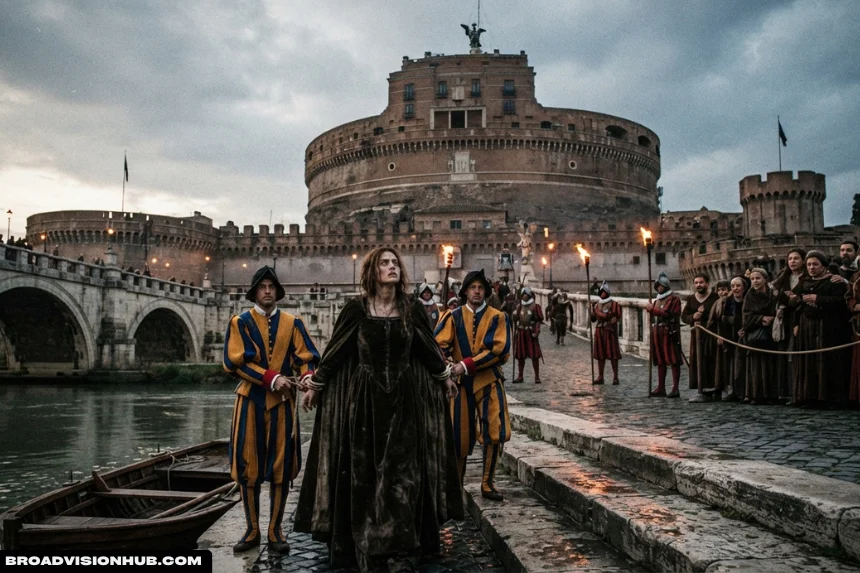
Initially, Caterina was held in the Vatican’s Belvedere. Later, she was imprisoned in Castel Sant’Angelo.
The location carried remarkable historical irony.
Sixteen years earlier, Caterina had occupied Castel Sant’Angelo herself during the political crisis following the death of Sixtus IV. Now the same fortress became her prison.
Nevertheless, her French connections continued to matter.
King Louis XII’s representatives pressed for her release. Eventually, Caterina renounced her claims to the Romagna territories she had ruled.
She was freed at the end of June 1501. Shortly afterward, she traveled to Tuscany and reached Florence in July. career as ruler of Forlì and Imola had effectively ended.
Did Caterina Sforza Try to Regain Forlì and Imola?
Yes.
Her release did not immediately destroy her desire to recover the territories.
After Pope Alexander VI died in 1503, the political landscape changed again. Caterina saw the possibility of restoring the Riario family’s position and explored the prospect of returning.
However, the plan failed.
Local opposition in Imola remained strong, while the new pope, Julius II, did not provide the support Caterina needed. By November 1504, Imola had returned directly to papal authority. thermore, Caterina’s financial resources were increasingly limited.
Consequently, the political world she had dominated for years was no longer recoverable.
Her later life therefore shifted increasingly toward Florence, family affairs, legal disputes, religious concerns, and the intellectual interests that reveal another side of her personality.
Caterina Sforza’s Experimenti, Medicine and Alchemy
Caterina Sforza’s reputation as a warrior has often overshadowed one of the most fascinating parts of her life: her sustained interest in medicine, cosmetics, alchemy, and practical experimentation.
She assembled a substantial collection of recipes known as the Experimenti.
Treccani describes the collection as evidence of interests that Caterina cultivated throughout her life. Her knowledge came from several sources, including learned texts, practical traditions, correspondence, suppliers, and direct or reported experimentation. National Endowment for the Humanities reports that the surviving Experimenti contains 454 recipes. Most concern medicines, while others address cosmetics or alchemical processes. refore, Caterina should not be remembered only for fortresses and political conspiracies.
Her recipe collection places her within another important Renaissance tradition: the exchange and testing of practical knowledge.
What Were Caterina Sforza’s Experimenti?
The Experimenti was essentially a collection of formulas, remedies, preparations, and experimental procedures accumulated over many years.
The material included:
- medicinal preparations,
- treatments for illnesses and injuries,
- cosmetic recipes,
- preparations involving herbs and botanical ingredients,
- alchemical processes,
- and chemical techniques.
The collection crossed boundaries that modern readers usually separate.
Today, medicine, chemistry, cosmetics, pharmacy, and household remedies belong to different fields. In Renaissance Europe, however, these categories frequently overlapped.
Therefore, the Experimenti should be understood within the intellectual culture of Caterina’s own period rather than judged entirely by modern scientific classifications.
Medicine and Practical Remedies
Many recipes in Caterina’s collection focused on health.
Moreover, she communicated with suppliers of substances and appears to have developed enough of a reputation for practical knowledge that people sought her assistance. Treccani specifically notes both her correspondence with suppliers and requests for her intervention based on her expertise. erina also maintained a significant relationship with the world of apothecaries.
The NEH identifies Ludovico Albertini as an important apothecary in her experimental work and notes that she still owed him a substantial sum at the time of her death. s evidence suggests that Caterina’s interest was not merely decorative collecting. She invested time, money, ingredients, and attention in practical experimentation.
Cosmetics and Beauty Recipes
The Experimenti also contained cosmetic preparations.
Renaissance cosmetics could involve skin treatments, perfumes, hair preparations, and other formulas that blended beauty practices with contemporary medical ideas.
Consequently, describing Caterina’s collection simply as a “medical book” would be incomplete.
Likewise, describing it only as a “beauty secrets” collection would trivialize its much wider range.
The manuscript demonstrates how knowledge could move between the household, apothecary, medical tradition, workshop, and court.
Alchemy and Renaissance Experimentation
Alchemy also formed part of Caterina’s interests.
For modern readers, the word sometimes suggests only attempts to manufacture gold. Renaissance alchemy, however, encompassed a wider range of practices involving substances, transformations, distillation, preparation, and experimentation.
The NEH notes that Caterina’s collection even preserved a method for producing false gold alongside numerous other chemical recipes. ll, calling Caterina a scientist in exactly the modern professional sense would be anachronistic.
A more historically accurate description is that she was a Renaissance experimenter with sustained interests in medicine, alchemy, cosmetics, and practical chemistry.
That phrasing recognizes the significance of her work without forcing a twenty-first-century professional category onto a fifteenth-century figure.
Caterina Sforza’s Children and Family
Caterina’s family life connected several powerful Renaissance dynasties.
With Girolamo Riario, she had six children:
- Ottaviano Riario
- Cesare Riario
- Bianca Riario
- Giovanni Livio Riario
- Galeazzo Riario
- Francesco Riario
With Giacomo Feo, Caterina had a son named Bernardino, later also known as Carlo. Treccani’s biography of Giacomo Feo confirms that the child was born in 1489. ally, Caterina and Giovanni di Pierfrancesco de’ Medici had one son, Giovanni, born in Forlì on April 6, 1498.
Therefore, the available biographical evidence supports eight children in total.
However, one of those children would eventually become especially important to Italian history.
Caterina Sforza and Giovanni delle Bande Nere
Caterina’s youngest son was originally baptized Ludovico.
After his father died in 1498, Caterina changed his name to Giovanni in his father’s memory. He later became famous as Giovanni delle Bande Nere, one of the notable military commanders of early sixteenth-century Italy. vanni continued the military tradition associated with both sides of his family.
However, his greatest importance to Caterina’s long-term dynastic legacy came through his own son.
Giovanni married Maria Salviati, and their son was Cosimo de’ Medici.
That lineage created one of the most consequential connections in Caterina Sforza’s family history.
How Caterina Sforza Became an Ancestor of Cosimo I de’ Medici
The family relationship is straightforward:
Caterina Sforza
↓
Giovanni delle Bande Nere
↓
Cosimo I de’ Medici
Treccani confirms that Giovanni delle Bande Nere was Caterina’s son and that his son Cosimo became the future grand duke. imo rose to power in Florence in 1537 and eventually became the first Grand Duke of Tuscany.
Therefore, although Caterina permanently lost Forlì and Imola, her descendants eventually reached a level of dynastic power far beyond the territories she had struggled to preserve.
Her relationship with Giovanni de’ Medici consequently became one of the most historically significant marriages of her life.
Caterina Sforza’s Final Years in Florence
After arriving in Florence in 1501, Caterina no longer ruled a territorial state.
Nevertheless, her life did not become entirely quiet.
At first, she became involved in legal disputes concerning the custody of her young son Giovanni and the inheritance left by his father. Later, she continued trying to protect the interests of her children and occasionally considered ways to restore her family’s political position in Romagna. ever, those ambitions gradually became unrealistic.
Financial limitations restricted her options. Furthermore, political control over her former territories had shifted decisively.
Caterina therefore spent her remaining years primarily in Florence.
Her intellectual interests continued as well. The Experimenti demonstrates that medicine, alchemy, cosmetics, and practical preparations were not passing curiosities but subjects she cultivated over a long period. ntually, her health began to fail.
How Did Caterina Sforza Die?
Caterina became ill during 1508–1509.
Before her death, she prepared a will addressing her children and grandchildren, with particular attention to her youngest son, Giovanni de’ Medici. aterina Sforza died in Florence on May 28, 1509.**
She was about 46 years old.
Her body was buried according to her wishes in the church of the Monastery of Le Murate in Florence. However, nineteenth-century alterations to the former monastery led to the exhumation of remains, and Caterina’s bones were subsequently lost. original burial therefore no longer survives as an identifiable tomb containing her remains.
Why Is Caterina Sforza Still Famous?
Caterina Sforza remains famous because her life combined several aspects of Renaissance history rarely concentrated in a single biography.
Born into Through her marriage to During a period of political turmoil Despite the attack As regent On two separate occasions Later Throughout her campaign Beyond politics and warfare
Finally, through Giovanni delle Bande Nere, she became an ancestor of the Medici grand-ducal line.
Yet her continuing fame also comes from the tension between history and legend.
Warrior, Regent and Political Strategist
The image of Caterina as a fearless warrior has a genuine historical foundation.
She personally participated in political crises and defensive operations. Moreover, her ability to retain power after Girolamo Riario’s assassination demonstrated remarkable strategic judgment.
However, focusing exclusively on warfare creates an incomplete picture.
Caterina also negotiated alliances, administered territories, arranged dynastic relationships, managed fortifications, dealt with ambassadors, supported artistic and religious projects, and protected her children’s political interests.
Therefore, regent and political strategist are just as important to understanding her as warrior.
How Legend Changed Caterina Sforza’s Image
Machiavelli played a major role in shaping Caterina’s later reputation.
His famous version of the 1488 Ravaldino confrontation transformed an already extraordinary political episode into one of the Renaissance’s most memorable stories.
Over time, Caterina became an ideal subject for dramatists, novelists, filmmakers, and other storytellers.
Treccani notes that her life continued to inspire theatrical, cinematic, and fictional reinterpretations into the modern period. a result, modern portrayals often blend documented events with later storytelling.
For readers, the best approach is therefore to appreciate the legend while still distinguishing it from evidence.
Caterina Sforza Timeline
| Year | Event |
|---|---|
| c. 1463 | Caterina Sforza is born in Milan or Pavia |
| 1473 | Marriage agreement links her to Girolamo Riario |
| 1477 | Marriage is completed and Caterina enters Imola |
| 1480 | Girolamo receives authority over Forlì |
| 1484 | Caterina occupies Castel Sant’Angelo after Sixtus IV dies |
| 1488 | Girolamo Riario is assassinated |
| 1488 | Caterina takes refuge in Ravaldino and recovers power |
| 1488 | She begins governing as regent for Ottaviano |
| 1489 | Bernardino, her son with Giacomo Feo, is born |
| 1495 | Giacomo Feo is assassinated |
| 1496–1497 | Caterina secretly marries Giovanni de’ Medici |
| 1498 | Giovanni delle Bande Nere is born |
| 1498 | Giovanni de’ Medici dies |
| 1499 | Machiavelli visits Caterina on a diplomatic mission |
| 1499 | Alexander VI removes the Riario-Sforza claims to Forlì and Imola |
| November 1499 | Imola surrenders to Cesare Borgia |
| December 1499 | Cesare Borgia enters Forlì |
| January 1500 | Ravaldino falls and Caterina is captured |
| 1500–1501 | Caterina is held in Rome |
| June 1501 | She is released after renouncing her former territories |
| July 1501 | Caterina reaches Florence |
| 1503–1504 | Attempts to recover her former territories fail |
| May 28, 1509 | Caterina dies in Florence |
Frequently Asked Questions About Caterina Sforza
Who was Caterina Sforza?
Caterina Sforza was an Italian Renaissance noblewoman, regent, political ruler, and experimenter. Born into Milan’s Sforza dynasty around 1463, she governed Forlì and Imola, survived several political crises, resisted Cesare Borgia, and collected hundreds of medicinal, cosmetic, and alchemical recipes.
What was Caterina Sforza famous for?
Caterina Sforza became famous for ruling Forlì and Imola, defending the fortress of Ravaldino, surviving the assassination of Girolamo Riario, resisting Cesare Borgia, and developing an enduring reputation for political and military courage. Her Experimenti also reveals extensive interests in medicine, cosmetics, and alchemy.
Why was Caterina Sforza called the Lioness of Forlì?
“Lioness of Forlì” is a later epithet associated with Caterina’s reputation for courage and resistance. It reflects the historical memory of her defenses of Forlì and Ravaldino. However, it should not be presented as though it were necessarily an official title routinely used during her lifetime.
Did Caterina Sforza really expose herself from Ravaldino?
The famous story comes principally through Machiavelli’s later account. Caterina’s refusal to surrender Ravaldino while her children remained hostages is well established. However, the literal exposure episode should be treated as a famous historical tradition rather than an independently verified eyewitness fact.
Who defeated Caterina Sforza?
Cesare Borgia’s Franco-papal army defeated Caterina Sforza during the campaign of 1499–1500. Imola surrendered first, followed by Forlì, while Caterina continued resisting from Ravaldino until the fortress fell in January 1500.
Did Caterina Sforza meet Machiavelli?
Yes. Niccolò Machiavelli personally met Caterina Sforza while serving on a Florentine diplomatic mission to Forlì in July 1499. He later discussed her in several writings, helping shape how later generations remembered her.
Who were Caterina Sforza’s husbands?
Caterina first married Girolamo Riario. Treccani also identifies Giacomo Feo as a secret husband, although the relationship was deliberately concealed for political reasons. Later, she secretly married Giovanni di Pierfrancesco de’ Medici, father of Giovanni delle Bande Nere.
How many children did Caterina Sforza have?
The available biographical evidence supports eight children: six with Girolamo Riario, one with Giacomo Feo, and one with Giovanni de’ Medici. Her youngest son, Giovanni delle Bande Nere, became the best known historically.
Was Caterina Sforza related to the Medici family?
Yes. Caterina secretly married Giovanni di Pierfrancesco de’ Medici. Their son was Giovanni delle Bande Nere, whose son Cosimo I de’ Medici eventually became the first Grand Duke of Tuscany.
Was Caterina Sforza a scientist?
Calling Caterina a modern professional scientist would be anachronistic. However, she was a serious Renaissance experimenter. Her Experimenti contains hundreds of medicinal, cosmetic, chemical, and alchemical recipes, showing a sustained interest in practical investigation and preparation. The National Endowment for the Humanities has described her as an early scientist. What were Caterina Sforza’s Experimenti?
The Experimenti was Caterina’s collection of medicinal, cosmetic, and alchemical formulas. The surviving manuscript contains 454 recipes, most concerning medicines, with additional preparations involving cosmetics and alchemical processes. When and where did Caterina Sforza die?
Caterina Sforza died in Florence on May 28, 1509, after becoming ill during 1508–1509. She was buried at the Monastery of Le Murate, although her remains were later exhumed and eventually lost. Caterina Sforza’s Place in Renaissance History
Caterina Sforza deserves to be remembered as more than the fearless woman of a famous fortress legend.
Her life reveals the instability of Renaissance Italian politics and the extraordinary pressures facing rulers whose survival depended on dynastic alliances, local loyalty, military force, diplomacy, and personal reputation.
Caterina repeatedly adapted to those pressures. She occupied Castel Sant’Angelo during a papal crisis, recovered power after her husband’s assassination, governed Forlì and Imola as regent, navigated the opening stages of the Italian Wars, and resisted Cesare Borgia even after her political allies had weakened.
At the same time, her Experimenti reveals another dimension of her life. She actively gathered and tested knowledge involving medicine, cosmetics, alchemy, and chemical preparations.
Ultimately, Caterina lost the territories she fought to preserve. Nevertheless, her dynastic legacy continued. Through Giovanni delle Bande Nere and Cosimo I de’ Medici, her descendants became central figures in the later history of Tuscany.
For that reason, Caterina Sforza remains one of the Renaissance’s most compelling figures: a ruler, strategist, experimenter, mother, survivor, and historical personality whose documented life is every bit as remarkable as the legends that followed it.