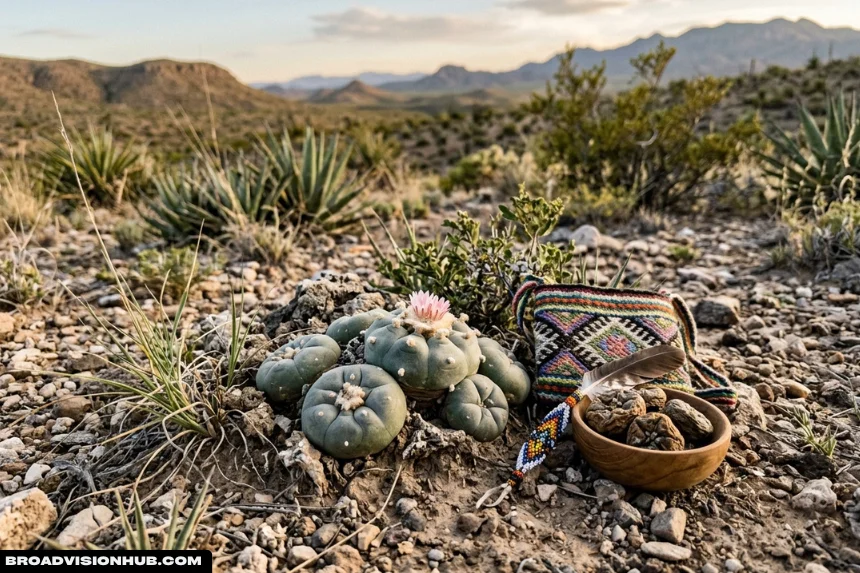
Lophophora williamsii is a small, low-growing cactus best known by the common name peyote. It belongs to the cactus family, Cactaceae, and occurs naturally in parts of southern and southwestern Texas and Mexico. Unlike the familiar image of a tall, heavily spined desert cactus, this species has a compact, rounded to flattened body and is often nearly level with the surrounding ground.
Kew Science currently accepts Lophophora williamsii as a valid species in the genus Lophophora. Moreover, Kew records its native range from southwestern and southern Texas into northeastern Mexico, extending as far as Jalisco.
Although the plant is widely discussed because of its chemical and religious significance, understanding its botanical identity comes first. It is a distinctive North American cactus with a natural history that extends well beyond its better-known cultural associations.
Quick Answer: What Is Lophophora Williamsii?
Lophophora williamsii is the scientific name of peyote, a small perennial cactus in the family Cactaceae. It grows naturally in dry regions of southern Texas and Mexico and typically forms a low, rounded or somewhat flattened above-ground body.
The Integrated Taxonomic Information System, or ITIS, lists Lophophora williamsii as an accepted species and records peyote as its common name.
Therefore, peyote and Lophophora williamsii refer to the same botanical species when the common and scientific names are being used correctly.
Lophophora williamsii Quick Facts
| Feature | Information |
|---|---|
| Scientific name | Lophophora williamsii |
| Common name | Peyote |
| Plant family | Cactaceae |
| Order | Caryophyllales |
| Genus | Lophophora |
| Plant type | Succulent cactus |
| General form | Small, rounded to flattened |
| Typical colour | Blue-green to green |
| Natural spines | Mature plants are characteristically spineless |
| Flower position | Near the centre of the crown |
| Flower colour | Usually pale pink to whitish or greenish-pink |
| Native U.S. range | Southern and southwestern Texas |
| Native Mexican range | Northeastern Mexico extending toward Jalisco |
| Main habitat type | Desert and dry shrubland |
| Best-known common name | Peyote |
Kew classifies the species within the order Caryophyllales, family Cactaceae and genus Lophophora. World Flora Online also records botanical descriptions derived from the Flora of North America treatment.
Understanding the Scientific Name Lophophora williamsii
Scientific names help distinguish plants that may share similar common names.
In this case:
Genus: Lophophora
Species: williamsii
Together, the botanical name is written:
Lophophora williamsii
The genus name is capitalized, whereas the species epithet is written in lowercase. Both words are normally italicized.
Kew currently recognizes this scientific name as accepted rather than treating it as a synonym of another cactus species. ITIS likewise gives it accepted taxonomic standing.
That agreement is useful because plant names can change as botanical research develops.
Is Lophophora Williamsii the Same as Peyote?
Yes.
Peyote is the best-known common name for Lophophora williamsii.
ITIS specifically lists “peyote” among its common names, while Kew uses the same English common name in its species information.
However, an important distinction is necessary:
Not every plant in the genus Lophophora is Lophophora williamsii.
The genus contains other accepted species as well.
For example, Kew’s current taxonomic records include:
- Lophophora alberto-vojtechii;
- Lophophora diffusa;
- Lophophora fricii;
- Lophophora williamsii.
Therefore, using the genus name Lophophora as though it automatically meant peyote would be inaccurate.
This distinction becomes especially important when botanical collections or scientific literature discuss several members of the genus together.
What Kind of Plant Is Lophophora williamsii?
Botanically, the species is a cactus.
Kew describes it more specifically as a succulent subshrub adapted to desert or dry-shrubland environments.
Nevertheless, it looks very different from the stereotypical tall cactus.
Instead of producing large upright stems, the visible plant body remains compact and close to the ground.
World Flora Online, drawing on Flora of North America data, describes plants as occurring almost flush with the soil surface, with stems that are flattened or dome-shaped and commonly depressed near the centre.
As a result, its overall shape is more like a low rounded crown than a columnar desert cactus.
What Does Lophophora williamsii Look Like?
The plant’s compact form is one of its most recognizable botanical characteristics.
A mature specimen generally has:
- a low-growing body;
- a rounded or somewhat flattened crown;
- a blue-green to green surface;
- visible ribs or divisions;
- small woolly areoles;
- little or no obvious spination on mature growth;
- flowers developing near the centre.
World Flora Online records stems as blue-green and sometimes reddish-green, with a flattened upper surface and variable rib development.
However, appearance is not completely uniform.
Individual plants can vary because of:
- age;
- genetics;
- environmental conditions;
- natural geographic variation;
- growth stage.
Therefore, a photograph or general shape alone should not be treated as a foolproof botanical identification.
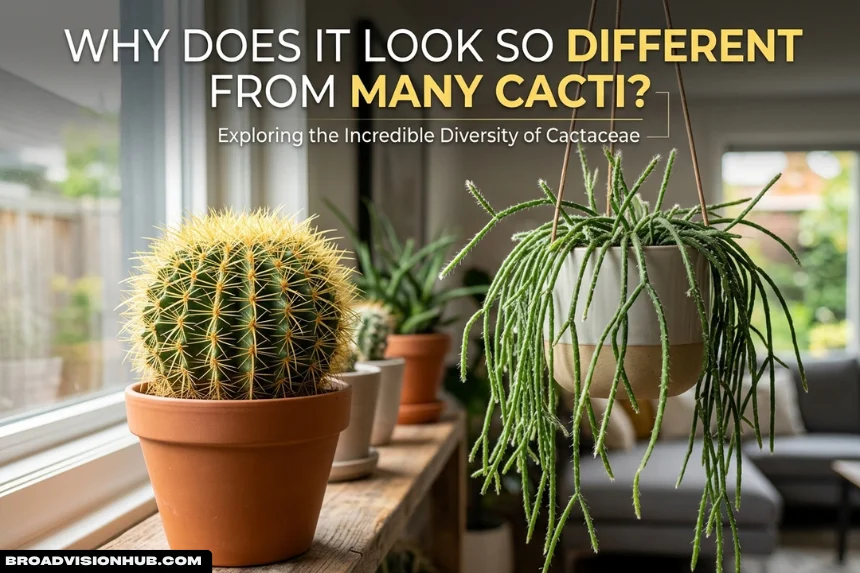
Why Does It Look So Different From Many Cacti?
Many people associate cactus species with prominent spines.
This species is unusual because mature plants are characteristically spineless or essentially spineless in appearance.
Instead, its growing points develop woolly structures at the areoles.
This gives mature plants a softer-looking surface than many other members of the cactus family.
Nevertheless, that appearance does not make the plant botanically unrelated to familiar spiny cacti.
It still belongs firmly within Cactaceae, the cactus family. Both Kew and ITIS place it there.
Therefore, the absence of conspicuous mature spines is a species characteristic rather than evidence that it is not a true cactus.
Understanding the Ribs and Crown of Lophophora williamsii
The visible body is often divided into ribs.
These ribs can give the crown a segmented appearance, especially as the plant develops.
World Flora Online notes considerable variation in the number and form of the ribs. It also describes the centre of the stem as commonly depressed.
Consequently, photographs of different specimens may not look identical.
Some may appear more rounded.
Others may appear flatter or show more obvious divisions across the crown.
For an informational article, the safest conclusion is that the plant has a compact, ribbed and often somewhat flattened body, rather than presenting one fixed number of ribs as though it applied to every individual.
What Do Lophophora williamsii Flowers Look Like?
The flowers provide one of the more delicate features of the plant.
According to the Flora of North America information incorporated into World Flora Online, flower colours generally fall within pale tones, including white, greenish-pink and pink.
The flowers emerge from the upper central region of the cactus.
Their relatively soft colours contrast with the compact blue-green or green plant body.
However, flower characteristics can vary.
Therefore, descriptions such as “always bright pink” would be unnecessarily restrictive. Pale pink and whitish tones can also occur within the botanical description.
Are All Lophophora williamsii Flowers the Same?
No.
This is another reason the genus should not be treated as though it contained only one species.
Several accepted Lophophora species can look broadly similar at first glance, while botanical differences become clearer when specialists examine multiple features.
Consequently, a general article should avoid claiming that colour or body shape alone can always distinguish one species reliably.
The purpose here is to explain the plant’s broad botanical appearance rather than provide a field guide for locating or collecting wild specimens.
The Lophophora Genus and Lophophora williamsii
The genus Lophophora belongs to Cactaceae.
Although L. williamsii is its most famous member, it is not the only accepted species.
Kew’s current database recognizes several names at species level, while some older names are now treated as synonyms. For example, Kew currently places names such as Lophophora jourdaniana and Lophophora lewinii under L. williamsii rather than accepting them as separate species.
This illustrates an important point about taxonomy.
Botanical classifications are not simply lists of traditional names. Instead, botanists revise relationships as evidence and taxonomic interpretations change.
Therefore, older cactus books, horticultural labels and websites may use names that do not match current accepted taxonomy.
How Lophophora Williamsii Differs From Lophophora Diffusa
One of the closest search-related comparisons is with Lophophora diffusa.
They belong to the same genus but are different accepted species.
Kew currently recognizes both names separately.
That distinction is more useful than oversimplifying the difference into one visual feature.
Because members of the genus can vary and resemble one another, scientific identification may involve combinations of floral, structural and geographic characteristics.
Therefore, the main point for a general reader is straightforward:
Lophophora williamsii and Lophophora diffusa are related cacti, but they are not the same species.
A more detailed comparison belongs later in the article rather than repeating taxonomic material here.
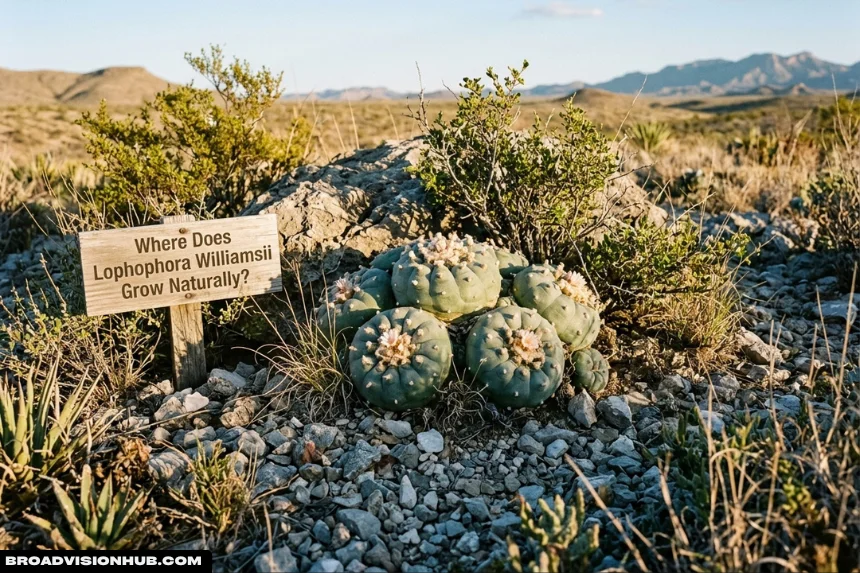
Where Does Lophophora Williamsii Grow Naturally?
The species is native to North America.
However, describing it simply as a “Mexican cactus” leaves out an important part of its natural distribution.
Kew records the native range as extending from:
southwestern and southern Texas → northeastern Mexico → portions of Mexico reaching toward Jalisco.
Therefore, the plant is genuinely native to the United States as well as Mexico.
Its U.S. distribution is concentrated in Texas rather than extending naturally across the entire American Southwest.
This matters for U.S. readers because the species is part of the native flora of southern Texas, not merely an imported cactus associated with Mexico.
The Native Habitat of Lophophora williamsii
Kew places the species primarily within desert and dry-shrubland biomes.
These environments are characterized broadly by:
- limited rainfall;
- seasonally dry conditions;
- sparse or shrub-dominated vegetation;
- strong sunlight;
- soils and landscapes adapted to aridity.
Nevertheless, this article intentionally avoids giving precise wild-collection locations or instructions for finding individual plants.
The broad ecological point is sufficient:
the species evolved as a low-growing succulent within dry environments of Texas and Mexico.
Its compact structure reflects that broader desert and semi-desert ecological setting.
Is Lophophora williamsii Native to Texas?
Yes.
Kew explicitly includes southwestern and southern Texas within the accepted native range.
NatureServe also treats the species as part of the native flora of Texas and currently tracks its conservation status there.
Therefore, statements saying the cactus occurs naturally only in Mexico are incorrect.
At the same time, being native to Texas does not mean it occurs commonly across the state.
Its natural distribution is much more geographically restricted.
That restricted range becomes especially important when considering conservation, which will be covered later.
Is Lophophora williamsii Native Across the American Southwest?
No.
The phrase “Southwestern cactus” can create the impression that the species occurs naturally across places such as Arizona, New Mexico, Nevada and California.
Current Kew distribution data instead places the native U.S. range specifically in southern and southwestern Texas.
Therefore, the most accurate U.S.-focused wording is:
Lophophora williamsii is native to parts of southern Texas and Mexico.
That is more precise than simply saying “the southwestern United States.”
Why the Low-Growing Form of Lophophora williamsii Matters
The compact shape is not merely an unusual visual feature.
It reflects the broader growth strategy of a small succulent living in dry environments.
Unlike tall columnar cacti that rise prominently above surrounding vegetation, this plant commonly stays very close to ground level.
World Flora Online’s botanical treatment even describes specimens as nearly flush with the soil surface.
As a result, the visible crown represents only one part of the plant’s overall structure.
However, this article will keep the discussion at the botanical level rather than turning those structural characteristics into instructions for wild collection or harvesting.
Why the Scientific Identity of Lophophora williamsii Matters
Using the correct scientific name helps separate several subjects that are often mixed together online.
Lophophora williamsii refers to a botanical species.
Peyote is its common name.
Lophophora refers to the broader genus.
Meanwhile, names such as Lophophora diffusa refer to related but distinct species.
Keeping those categories separate prevents several common errors:
- calling every Lophophora plant peyote;
- treating L. diffusa and L. williamsii as synonyms;
- assuming the plant grows naturally throughout the U.S. Southwest;
- confusing the botanical species with one of its chemical constituents.
That final distinction becomes particularly important in the next part of the article.
Lophophora williamsii Botanical Identity at a Glance
The simplest way to understand the plant is through this hierarchy:
Cactaceae
↓
Lophophora
↓
Lophophora williamsii
↓
Common name: peyote
This structure gives readers a clearer picture than beginning with its cultural or chemical associations alone.
Botanically, it is first and foremost a small North American cactus adapted to dry habitats in Texas and Mexico.
Its unusual appearance, low profile, limited native distribution and membership in a small genus make it scientifically interesting even before its much better-known cultural history is considered.
Why Lophophora williamsii Has Cultural and Legal Significance
The botanical identity of Lophophora williamsii tells only part of its story.
Beyond taxonomy, the species has profound cultural and religious importance for Indigenous peoples in North America. It is also federally regulated in the United States because it contains mescaline, a psychoactive compound.
These two aspects should not be collapsed into a single “psychedelic cactus” description.
For many Indigenous practitioners, peyote has a sacred ceremonial role. U.S. federal law itself recognizes that traditional ceremonial use has been integral to the religious practices and cultural continuity of many Native people for centuries.
Therefore, a reliable article needs to discuss botany, chemistry, culture and law separately.
Is Lophophora williamsii the Same as Mescaline?
No.
Peyote is the cactus. Mescaline is a psychoactive chemical compound found in the plant.
The U.S. Drug Enforcement Administration describes peyote as a small, spineless cactus and identifies mescaline as its psychoactive component.
The distinction can be summarized simply:
| Term | Meaning |
|---|---|
| Lophophora williamsii | Scientific name of the cactus |
| Peyote | Common name of the same species |
| Mescaline | Psychoactive chemical associated with the plant |
| Lophophora | The broader cactus genus |
Therefore:
peyote ≠ mescaline
in the same way that a plant and one of its chemical constituents are not identical things.
This distinction also matters legally because federal controlled-substance rules address both peyote and mescaline.
What Is Mescaline?
Mescaline is a naturally occurring psychoactive alkaloid associated with peyote.
The DEA classifies it as a hallucinogenic substance and currently places both peyote and mescaline in Schedule I under the federal Controlled Substances Act.
However, this article intentionally stays at the informational level.
There is no need to provide:
- preparation methods;
- extraction instructions;
- dosage information;
- consumption techniques;
- ways to intensify effects.
Those details are not necessary to explain the species and would distract from its botanical, cultural and conservation significance.
What Effects Are Associated With Mescaline?
Mescaline affects perception and consciousness.
The DEA reports effects associated with peyote and mescaline that can include altered perception of space and time, hallucinations, changes in body perception and emotional effects such as euphoria or anxiety. Physical effects reported by the agency include nausea, vomiting, increased heart rate and blood pressure, changes in body temperature, headache and impaired coordination.
However, those effects should not become the main focus of a botanical article.
More importantly, the ceremonial significance of peyote should not be reduced to its psychoactive chemistry.
For traditional practitioners, the plant exists within a much broader religious and cultural framework.
Does Schedule I Mean There Is No Research?
Not exactly.
This distinction is important.
Under current federal drug scheduling, Schedule I substances are defined as having no currently accepted medical use in treatment in the United States and a high potential for abuse. The DEA currently includes peyote in that schedule.
However, that legal classification should not be rewritten as:
“Scientists have never researched peyote.”
Those are two different statements.
Research can exist even when a substance has no federally accepted medical use in treatment.
Therefore, the most accurate wording for an informational article is:
Peyote and mescaline are federally classified as Schedule I substances; that classification does not mean scientific research on them does not exist.
The Sacred Role of Lophophora williamsii as Peyote
For many Indigenous people, peyote is not primarily understood as a recreational intoxicant.
It is a religious sacrament.
Congress formally acknowledged this point when it enacted the American Indian Religious Freedom Act Amendments of 1994.
The law states that, for many Indian people, traditional ceremonial peyote use has for centuries been integral to religious life and important to the continuation of tribal cultures.
That recognition is especially important for how an article should frame the subject.
Rather than describing the species with sensational phrases such as:
- “mystical drug cactus”;
- “hallucinogenic collector’s plant”;
- “legal high cactus”;
a respectful article should explain that its psychoactive chemistry exists alongside a long-established Indigenous ceremonial tradition.
Peyote and Indigenous Religious Traditions
Peyote traditions predate the modern United States.
Congress’s 1994 findings explicitly recognize centuries of traditional ceremonial use. Meanwhile, Smithsonian and National Park Service collections document peyote’s religious association with Native communities and the Native American Church.
However, Indigenous traditions should not be presented as though every tribe practises the same religion.
Native peoples in North America represent many distinct nations, communities and religious traditions.
Therefore, wording such as:
“Native Americans use peyote in their religion”
is too broad.
A better formulation is:
Peyote has sacred ceremonial importance within particular Indigenous religious traditions and is especially associated in the United States with the Native American Church.
That wording is both more accurate and more respectful.
What Is the Native American Church?
The Native American Church, often abbreviated NAC, is a religious tradition in which peyote has an important sacramental role.
Smithsonian’s National Museum of the American Indian documents Native American Church ceremonial objects from communities including Comanche and San Carlos Apache people. Its educational material also describes peyote as a sacred plant within Native American Church spirituality.
The church developed within a complex Indigenous religious history and should not be reduced simply to “a church that uses peyote.”
For practitioners, ceremony may involve prayer, community, songs and religious teachings.
The National Museum of the American Indian, for example, describes all-night ceremonies involving prayer and sacred songs in its discussion of Native American Church traditions among Comanche veterans.
Therefore, the plant’s place within the church is sacramental rather than recreational.
Why Religious Freedom Became a Legal Issue
The federal legal history surrounding peyote is closely connected with religious liberty.
An important turning point was the U.S. Supreme Court case Employment Division v. Smith in 1990.
Congress later stated in the American Indian Religious Freedom Act Amendments that the decision had created uncertainty about protection for Indigenous practitioners using peyote in religious ceremonies. Congress also found that uneven state protections had created hardship for practitioners.
In response, Congress enacted specific statutory protection in 1994.
The law became Public Law 103-344 on October 6, 1994.
This history explains why the current legal framework is more complicated than a simple statement that peyote is either “legal” or “illegal.”
Is Peyote Legal in the United States?
For a general U.S. audience, the safest short answer is:
Peyote is a Schedule I controlled substance under federal law, but federal law contains specific protections and exemptions for qualifying traditional Indigenous ceremonial use and Native American Church religious ceremonies.
Therefore, it would be inaccurate to write simply:
“Peyote is legal for religious use.”
That statement is too broad.
It would also be incomplete to say:
“Peyote is completely illegal in America.”
Federal law contains significant religious-use provisions that need to be acknowledged.
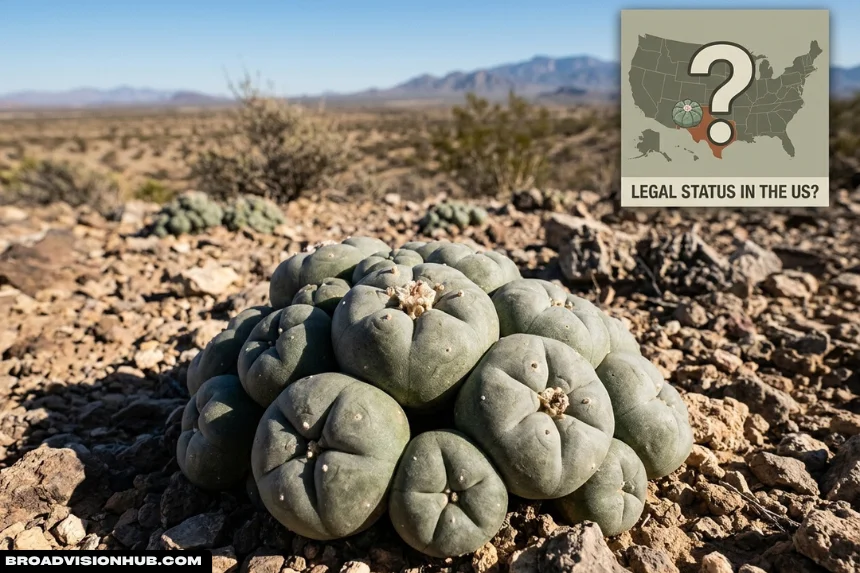
Federal Schedule I Status
The DEA currently lists peyote as a Schedule I controlled substance.
Its current drug-scheduling page specifically includes peyote among Schedule I examples, while the DEA’s January 2025 peyote and mescaline fact sheet states that both substances are Schedule I under the Controlled Substances Act.
This remains the general federal rule.
However, the religious protections discussed below create specific exceptions within that legal framework.
What Does the American Indian Religious Freedom Act Protect?
The relevant provision is 42 U.S.C. § 1996a.
It states that the use, possession or transportation of peyote by an Indian for bona fide traditional ceremonial purposes connected with the practice of a traditional Indian religion is lawful and may not be prohibited by the United States or a state, subject to the statute’s terms.
The statute also defines the relevant legal terms.
For purposes of this provision, “Indian” means a member of an Indian tribe, while “Indian tribe” is defined within the statute by reference to tribes, bands, nations, pueblos and other organized Indigenous groups meeting its federal criteria.
Therefore, this protection should not be rewritten as a blanket religious exemption available automatically to anyone who personally considers peyote spiritual.
The Native American Church Federal Regulation
A separate federal regulation appears at 21 CFR § 1307.31.
The regulation states that peyote’s Schedule I listing does not apply to its nondrug use in bona fide religious ceremonies of the Native American Church, and that members using it in that context are exempt from registration.
However, the regulation also states that people who manufacture peyote for or distribute it to the Native American Church must obtain the required registration and comply with other applicable legal requirements.
This is another reason broad statements such as “religious peyote is unregulated” would be incorrect.
Does the Religious Exemption Apply to Everyone?
No—not automatically.
The statutory and regulatory protections use specific legal language and apply within defined religious and Indigenous contexts.
For example, simply saying:
“I am using peyote spiritually”
does not by itself establish that a person falls within a federal exemption.
Likewise, joining an unrelated spiritual group should not be assumed to create the same legal protection.
Because individual situations can involve federal, state and tribal law, anyone needing legal guidance about possession, transportation or ceremonial use should consult a qualified attorney rather than relying on a general web article.
Does Federal Law Protect Traditional Ceremonial Use From State Bans?
Under 42 U.S.C. § 1996a, qualifying traditional ceremonial use, possession or transportation covered by the statute shall not be prohibited by the United States or any state.
That is a substantial federal protection.
However, the same law preserves room for certain forms of regulation.
For instance, Congress did not eliminate reasonable DEA regulation and registration of people involved in cultivation, harvest or distribution. It also preserved certain safety-related regulatory authority.
Therefore, protected ceremonial use should not be confused with unrestricted commercial activity.
Are Cultivation and Distribution Automatically Exempt?
No.
This is an important legal distinction.
The American Indian Religious Freedom Act provision expressly states that it does not prevent reasonable DEA regulation and registration of people who cultivate, harvest or distribute peyote.
Likewise, 21 CFR § 1307.31 states that someone manufacturing or distributing peyote to the Native American Church must obtain annual registration and comply with applicable law.
Therefore, an article should never imply:
“If the intended use is religious, anyone can legally grow or sell peyote.”
The actual federal framework is more restrictive and specific.
Can Anyone Legally Possess a Peyote Cactus?
This question cannot responsibly be answered with a universal yes.
Peyote itself remains federally listed in Schedule I, while specific statutory and regulatory protections apply to qualifying ceremonial contexts.
Additionally, state laws and the details of a person’s circumstances can matter.
Therefore, for a nationwide informational article, the most responsible answer is:
General possession should not be assumed legal simply because the plant is a cactus. Federal law controls peyote, while specific exemptions and protections apply in defined religious circumstances.
That answer is more accurate than treating a living plant as though it falls outside controlled-substance law.
Does “Peyote Is Schedule I” Override Indigenous Religious Rights?
No.
Both legal rules need to be understood together.
The general federal rule classifies peyote as Schedule I. At the same time, Congress enacted specific protections for traditional Indigenous ceremonial use, and federal regulations provide a Native American Church religious exemption.
Therefore, the accurate legal structure is:
General rule: Schedule I controlled substance.
Specific protection: qualifying traditional Indigenous ceremonial use.
Specific regulatory exemption: bona fide Native American Church religious ceremonies.
This is much clearer than describing the law simply as prohibition versus legalization.
Why the 1994 Law Matters
The American Indian Religious Freedom Act Amendments are significant beyond drug policy.
Congress framed the issue as one of religious liberty and cultural continuity.
Its findings recognized that traditional ceremonial peyote use has been important to the perpetuation of tribal cultures and that inadequate legal protection risked marginalizing and discriminating against Native religious practitioners.
Therefore, the law cannot be understood solely as a “drug exception.”
It is also part of the broader legal history of Indigenous religious freedom in the United States.
Respectful Terminology Matters
Writing about this species requires care with language.
Terms such as sacrament, ceremonial use, traditional Indigenous religious practice, and Native American Church provide context that “hallucinogenic drug” alone cannot.
At the same time, it is important not to romanticize or generalize Indigenous cultures.
Good wording should avoid implying that:
- every Native nation uses peyote;
- every Indigenous person belongs to the Native American Church;
- all ceremonial traditions are identical;
- psychoactive effects are the sole purpose of religious use;
- Indigenous peyote traditions are simply an early form of recreational drug culture.
Congress’s own statutory findings emphasize religious practice and cultural continuity rather than recreational intoxication.
Botanical, Chemical and Religious Terms Should Stay Separate
At this point, four concepts can be distinguished clearly.
The Species
Lophophora williamsii is the botanical species discussed throughout the article.
The Common Name
Peyote is the established common name for that cactus.
The Compound
Mescaline is a psychoactive compound found in the plant.
The Religious Context
Within particular Indigenous traditions, especially the Native American Church, peyote has a sacred ceremonial role protected in specific circumstances by U.S. federal law.
Keeping these categories separate prevents one of the biggest problems found in simplified articles about the plant.
The cactus is biologically more than its chemistry, while its Indigenous cultural importance cannot be reduced to pharmacology.

Why This Distinction Matters for Conservation
The cultural dimension also becomes important when considering the future of wild populations.
A conservation discussion that treats peyote only as a desirable collector cactus can miss the fact that access to the species is connected with living Indigenous religious practices.
Likewise, a discussion focused only on drug policy can overlook habitat loss and ecological pressures.
Therefore, the next stage of the article needs to ask a different set of questions:
- How secure are wild populations?
- Is the species actually endangered?
- What does Vulnerable mean?
- Is it protected under the U.S. Endangered Species Act?
- What pressures affect populations in Texas and Mexico?
- What role does CITES play?
Those issues require separating conservation status, federal endangered-species law and controlled-substance law, because they are three different regulatory subjects.
Is Lophophora williamsii Endangered?
The conservation status of Lophophora williamsii requires some careful terminology.
The species faces genuine conservation pressure. However, words such as vulnerable, endangered, federally listed, and CITES protected do not all mean the same thing.
Kew Science currently reports the species’ IUCN category as:
Vulnerable (VU).
Meanwhile, NatureServe currently assigns:
| Conservation system | Status |
|---|---|
| IUCN status reported by Kew | Vulnerable |
| NatureServe global rank | G3 |
| United States rank | N2 |
| Texas rank | S2 |
| U.S. Endangered Species Act | None |
| CITES | Appendix II |
NatureServe reports that the species is believed to be declining and identifies several continuing threats across its range.
Therefore, saying simply that peyote is “endangered” can create confusion.
A more accurate statement is:
Lophophora williamsii is currently reported as Vulnerable under the IUCN assessment referenced by Kew, while NatureServe ranks it G3 globally. It is not currently listed as endangered or threatened under the U.S. Endangered Species Act.
What Vulnerable Status Means for Lophophora williamsii
The IUCN Red List uses standardized categories to describe extinction risk.
Vulnerable is a threatened-category designation. It indicates that a species faces a sufficiently significant risk of extinction to meet IUCN criteria for that category.
However, an IUCN classification is not the same thing as a U.S. federal legal listing.
That distinction is especially important for American readers.
Kew’s current profile reports the species as VU — Vulnerable according to IUCN information.
Therefore:
IUCN Vulnerable ≠ U.S. federally endangered
The first is an international conservation assessment. The second refers to legal status under the U.S. Endangered Species Act.
What Does NatureServe G3 Mean?
NatureServe currently gives the species a G3 global conservation rank.
It also reports:
- N2 for the United States;
- S2 for Texas.
NatureServe’s current profile notes that the number of occurrences is uncertain but may be in the low hundreds. More importantly, it reports continuing pressures and concludes that the species is believed to be declining.
The different ranking systems should not be treated as contradictions.
IUCN and NatureServe use different assessment frameworks.
Therefore, it is normal for an article to report both, provided the systems are clearly identified.
Is Peyote Federally Endangered in the United States?
According to NatureServe’s current conservation profile, no.
It lists the species’ status under the U.S. Endangered Species Act as “None.”
The U.S. Fish and Wildlife Service explains that plants receive federal ESA protection when they are placed on the official lists of threatened or endangered species.
Therefore, readers should not confuse three different concepts:
Schedule I controlled substance status
relates to U.S. drug law.
IUCN Vulnerable status
relates to extinction-risk assessment.
Endangered Species Act listing
relates to federal wildlife and plant conservation law.
These systems address completely different legal or scientific questions.
Why Wild Lophophora williamsii Populations Face Pressure
NatureServe identifies several significant threats affecting the species across Texas and Mexico.
They include:
- land development;
- agricultural conversion;
- root-plowing to remove brush;
- legal wild harvest;
- illegal wild harvest.
NatureServe states that the species is believed to be declining because these threats remain active.
Therefore, conservation concerns are not attributable to one single cause.
Habitat change and collection pressure interact.
Habitat Development
One important challenge is the transformation of native habitat.
The species naturally occupies dry habitats in southern Texas and Mexico. As land is converted for development or agriculture, suitable habitat can be reduced or fragmented.
NatureServe specifically identifies development and conversion of land for agriculture among the threats to wild populations.
This matters because a plant with a geographically restricted range can be more sensitive to repeated habitat losses than a widespread species occurring across many regions.
Root-Plowing and Land Clearing
NatureServe also identifies root-plowing to remove brush as a threat.
This form of land modification can directly disturb low-growing native vegetation.
Because peyote grows close to the ground, large-scale mechanical disturbance can affect plants even when they are not deliberately targeted.
Therefore, conservation cannot focus exclusively on illegal collecting.
Maintaining suitable habitat is equally important.
Collection Pressure
Wild harvest represents another concern.
NatureServe identifies both legal and illegal wild harvest among the species’ continuing threats. It also notes that research has produced guidance for more sustainable harvest, although that guidance is not fully implemented.
This is particularly sensitive because collection is connected with several different contexts, including legally regulated ceremonial supply and unlawful collection.
For that reason, the subject should not be oversimplified into a claim that all harvest is illegal or that all harvest is sustainable.
The regulatory and cultural context matters.
Why Conservation Has Cultural Importance
Protecting wild populations is not only a botanical concern.
Peyote has sacred importance within particular Indigenous religious traditions and especially within the Native American Church.
Therefore, reductions in wild availability can have cultural as well as ecological consequences.
This is one reason conservation discussions should involve Indigenous religious interests rather than treating the plant merely as:
- a cactus specimen;
- a controlled substance;
- a commodity;
- a collector’s item.
The federal legal framework itself recognizes traditional ceremonial peyote use as an important part of Indigenous religious and cultural continuity.
Is Peyote Protected by CITES?
Yes.
Lophophora williamsii is covered by CITES Appendix II.
An official CITES document lists the species in Appendix II, while NatureServe reports the same international status.
CITES stands for the:
Convention on International Trade in Endangered Species of Wild Fauna and Flora.
Its purpose is to ensure that international trade in wild animals and plants does not threaten their survival.
What Does CITES Appendix II Mean?
Appendix II does not necessarily mean that a species is currently on the verge of extinction.
CITES explains that Appendix II includes species that may not presently be threatened with extinction but could become so unless international trade is strictly regulated. It can also include look-alike species whose regulation helps protect other listed taxa.
Therefore, the correct takeaway is:
CITES Appendix II regulates international trade; it is not identical to an IUCN endangered-species category.
In practical terms, CITES operates through a system of permits and certificates governing international movement of listed specimens.
This article intentionally does not provide instructions for importing, exporting, buying, or moving specimens across borders. Anyone dealing with an actual transaction should consult the relevant government authorities.
Does CITES Make All Trade Illegal?
No.
Appendix II generally means that international trade is controlled, not automatically prohibited.
CITES explains that Appendix II species are regulated so that trade does not become incompatible with their survival.
However, additional national laws can apply.
For Lophophora williamsii, the situation is particularly complicated because conservation controls exist alongside U.S. controlled-substance laws.
Therefore, CITES status should never be treated as the only law that matters.
Conservation Status vs. Drug Status
This distinction deserves special emphasis because search results often mix the two.
| Question | System |
|---|---|
| Is it a controlled substance? | U.S. Controlled Substances Act |
| Does qualifying Indigenous ceremonial use receive protection? | Federal religious-freedom law and regulation |
| Is it at risk of extinction? | IUCN / conservation assessments |
| What is its NatureServe rank? | NatureServe conservation ranking |
| Is it federally endangered? | Endangered Species Act |
| Is international trade regulated? | CITES |
A plant can simultaneously be:
- a controlled substance;
- religiously protected in defined circumstances;
- conservation-sensitive;
- internationally trade-regulated;
- and not federally listed under the ESA.
That is precisely why simplistic statements about legality or conservation can be misleading.
Common Misconceptions
“All Lophophora Species Are Peyote”
Incorrect.
Kew Science currently recognizes four accepted species in the genus Lophophora, including L. diffusa, L. fricii, L. alberto-vojtechii, and L. williamsii.
The name peyote is specifically associated with L. williamsii.
“Peyote and Mescaline Are the Same Thing”
No.
Peyote is the cactus, whereas mescaline is a psychoactive compound found in it.
Confusing the plant with one of its chemical constituents obscures both its botanical identity and cultural significance.
“It Only Grows in Mexico”
Incorrect.
Kew records the native range from southwestern and southern Texas into northeastern Mexico, extending toward Jalisco.
Therefore, it is genuinely native to the United States as well as Mexico.
“Vulnerable Means Federally Endangered”
No.
Kew reports an IUCN category of Vulnerable, while NatureServe currently lists its U.S. Endangered Species Act status as None.
These are separate conservation systems.
“Appendix II Means International Trade Is Completely Banned”
Incorrect.
CITES Appendix II generally regulates international trade to ensure it remains compatible with species survival; it does not automatically prohibit every international transaction.
“Religious Use Makes Peyote Legal for Anyone”
That is too broad.
Peyote remains federally controlled, while specific federal statutory and regulatory protections apply to defined traditional Indigenous ceremonial use and Native American Church ceremonies. The Native American Church regulation also retains registration requirements for manufacture or distribution to the church.
Anyone facing an actual legal question should consult a qualified attorney.
Frequently Asked Questions
What is Lophophora williamsii?
It is the accepted scientific name for peyote, a small cactus in the family Cactaceae. Its natural range extends from southern and southwestern Texas into Mexico.
Is Lophophora williamsii the same as peyote?
Yes. Peyote is the standard English common name associated with this species. Kew lists the species as accepted and records peyote among its common names.
Is it native to the United States?
Yes. Its natural U.S. range includes parts of southern and southwestern Texas. It does not naturally occur throughout the entire American Southwest.
What family does it belong to?
It belongs to Cactaceae, the cactus family, within the order Caryophyllales.
Does peyote have spines?
Mature plants are characteristically spineless or nearly spineless in appearance, which makes the species look different from many familiar desert cacti.
Does it contain mescaline?
Yes. Mescaline is the best-known psychoactive alkaloid associated with peyote. However, the plant and the chemical compound are not the same thing.
Is peyote legal in the United States?
Peyote remains a federally controlled Schedule I substance. However, federal law provides specific protections and regulatory exemptions for qualifying traditional Indigenous ceremonial use and bona fide Native American Church ceremonies.
This is general information, not legal advice.
Can anyone claim a religious exemption?
No. Federal protections are framed in specific statutory and regulatory terms and should not be interpreted as an automatic exemption for anyone claiming spiritual use.
Is the species endangered?
The most precise answer is that Kew currently reports its IUCN assessment as Vulnerable. NatureServe gives it a global G3 rank.
Is it protected by the Endangered Species Act?
NatureServe currently reports no U.S. Endangered Species Act status for the species.
Therefore, its IUCN Vulnerable status should not be confused with federal ESA listing.
Why are wild populations declining?
NatureServe identifies development, agricultural conversion, root-plowing, and legal and illegal wild harvest among the major continuing threats.
Is peyote protected by CITES?
Yes. Lophophora williamsii is listed in CITES Appendix II.
What does Appendix II mean?
It means international trade is controlled so that trade does not become incompatible with the species’ survival. Appendix II does not automatically mean the species is currently threatened with extinction.
Is Lophophora diffusa the same plant?
No. Lophophora diffusa and Lophophora williamsii are separate accepted species within the same genus. Kew currently recognizes both independently.
Why is peyote important to Native American religion?
Within particular Indigenous religious traditions, especially the Native American Church, the plant serves a sacred ceremonial role. U.S. federal regulations recognize bona fide Native American Church religious ceremonies involving peyote.
Conclusion
Lophophora williamsii is much more than an unusual spineless cactus.
Botanically, it is a native North American species in the family Cactaceae, occurring naturally from southern and southwestern Texas into Mexico. It is also the species commonly known as peyote.
Its significance extends into chemistry, Indigenous religious history, U.S. law and conservation.
The species contains mescaline and remains federally controlled. At the same time, U.S. law contains specific protections and exemptions surrounding qualifying traditional Indigenous ceremonial use and bona fide Native American Church ceremonies.
From a conservation perspective, Kew currently reports the species as Vulnerable under the IUCN assessment it references. NatureServe ranks it G3 globally, N2 nationally in the United States, and S2 in Texas, while also identifying development, agricultural conversion and harvest pressure among continuing threats.
Furthermore, international trade is regulated under CITES Appendix II.
These overlapping botanical, cultural, legal and conservation dimensions explain why the plant should not be reduced to a single label such as “psychedelic cactus.”
A more accurate understanding recognizes it simultaneously as a distinctive native cactus, a culturally sacred plant within particular Indigenous traditions, a federally regulated substance and a species facing meaningful conservation pressure.
READ MORE ABOUT : Coon Dogs