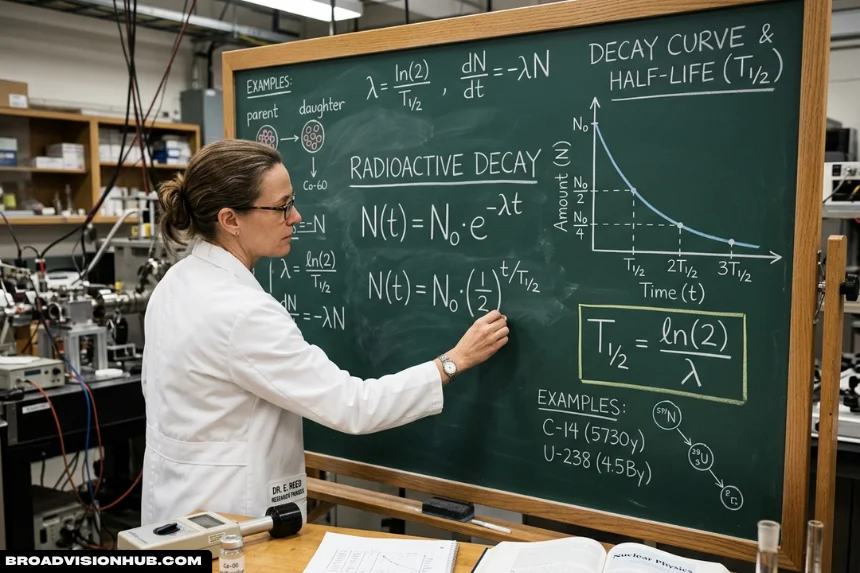
The radioactive decay formula describes how the number of unstable radioactive nuclei decreases with time. Because radioactive decay follows an exponential pattern, scientists can calculate how much of a radionuclide remains after a certain period.
The standard radioactive decay equation is:
[
\boxed{N(t)=N_0e^{-\lambda t}}
]
In this equation, (N_0) represents the initial number of radioactive nuclei, while (N(t)) represents the number that remain after time (t). Meanwhile, (\lambda) is the decay constant, which describes how quickly the radionuclide decays.
However, many problems provide a half-life instead of a decay constant. In that situation, the same physical law can be written as:
[
\boxed{N(t)=N_0\left(\frac12\right)^{t/t_{1/2}}}
]
Therefore, choosing the correct equation depends largely on whether the problem gives you the decay constant or the half-life.
What Is the Radioactive Decay Formula?
The main radioactive decay formula is:
[
\boxed{N=N_0e^{-\lambda t}}
]
It calculates the number of radioactive parent nuclei remaining after a specified amount of time.
Radioactive Decay Formula Symbols
| Symbol | Meaning |
|---|---|
| (N) or (N(t)) | Number of undecayed radioactive nuclei after time (t) |
| (N_0) | Initial number of radioactive nuclei |
| (e) | Euler’s number, approximately 2.71828 |
| (\lambda) | Radioactive decay constant |
| (t) | Elapsed time |
The negative sign in the exponent is essential:
[
e^{-\lambda t}
]
Because the exponent is negative, the amount decreases as time increases.
In contrast, a positive exponent would describe exponential growth rather than radioactive decay.
Radioactive Decay Formula Quick Answer
The radioactive decay formula is (N=N_0e^{-\lambda t}). Here, (N_0) is the initial number of radioactive nuclei, (N) is the number remaining after time (t), and (\lambda) is the decay constant. If half-life is known instead, use (N=N_0(1/2)^{t/t_{1/2}}).
The decay constant and half-life are connected by:
[
\boxed{\lambda=\frac{\ln2}{t_{1/2}}}
]
Since:
[
\ln2\approx0.693
]
the relationship is also commonly written as:
[
\boxed{\lambda\approx\frac{0.693}{t_{1/2}}}
]
Radioactive Decay Formula Quick Reference
The following table brings the most useful radioactive decay equations together.
| What You Need to Calculate | Formula |
|---|---|
| Number of nuclei remaining | (N=N_0e^{-\lambda t}) |
| Amount remaining from half-life | (N=N_0(1/2)^{t/t_{1/2}}) |
| Half-life | (t_{1/2}=\ln2/\lambda) |
| Decay constant | (\lambda=\ln2/t_{1/2}) |
| Activity | (A=\lambda N) |
| Activity after time (t) | (A=A_0e^{-\lambda t}) |
| Elapsed time | (t=\frac{1}{\lambda}\ln(N_0/N)) |
| Decay constant from initial and final amounts | (\lambda=\frac{1}{t}\ln(N_0/N)) |
| Amount after (n) half-lives | (N=N_0/2^n) |
Therefore, you do not need to memorize every equation separately.
Most of them come directly from the basic exponential decay law.
How Does the Radioactive Decay Formula Work?
Radioactive decay starts with a simple physical relationship:
[
\boxed{\frac{dN}{dt}=-\lambda N}
]
This equation says that the rate at which radioactive nuclei disappear depends on how many undecayed nuclei are still present.
More specifically:
[
-\frac{dN}{dt}\propto N
]
Therefore, when many radioactive nuclei remain, more decays occur per unit time.
As the number of radioactive nuclei falls, fewer nuclei are available to decay.
Solving the differential equation produces:
[
\boxed{N=N_0e^{-\lambda t}}
]
Consequently, radioactive decay follows an exponential curve rather than a straight line.

Why Is Radioactive Decay Exponential?
Radioactive decay does not remove the same number of nuclei during every equal time interval.
Instead, approximately the same fraction of a large radioactive population decays during comparable intervals.
For example, suppose a radionuclide has a half-life of 10 years.
If a sample begins with 1,000 radioactive nuclei, approximately:
- 500 remain after one half-life;
- 250 remain after two half-lives;
- 125 remain after three half-lives.
Notice that the sample does not lose 500 nuclei during every 10-year period.
Instead, it loses half of whatever radioactive population remains.
Therefore, radioactive decay is exponential.
Constant Fraction vs. Constant Amount
This distinction is important.
A linear process might look like:
[
1000\rightarrow750\rightarrow500\rightarrow250
]
where the same quantity disappears each time.
Radioactive decay instead follows a pattern such as:
[
1000\rightarrow500\rightarrow250\rightarrow125
]
where the same fraction disappears.
That is why exponential mathematics describes radioactive decay so well.
Can You Predict When One Radioactive Atom Will Decay?
Not normally.
The decay of an individual unstable nucleus is probabilistic.
Therefore, scientists generally cannot predict the exact moment when one particular radioactive nucleus will decay.
However, a large collection of identical radioactive nuclei behaves statistically in a highly predictable way.
Consequently, equations such as:
[
N=N_0e^{-\lambda t}
]
can accurately describe the average behaviour of a large radioactive population.
This distinction between individual randomness and population-level predictability is fundamental to radioactive decay.
What Is the Radioactive Decay Constant?
The decay constant, represented by the Greek letter lambda:
[
\lambda
]
describes how rapidly a particular radionuclide decays.
A larger decay constant means the radioactive population decreases more quickly.
Therefore:
[
\text{large }\lambda
]
means:
[
\text{fast decay and short half-life}
]
Meanwhile:
[
\text{small }\lambda
]
means:
[
\text{slow decay and long half-life}
]
The decay constant is specific to a particular radionuclide.
Decay Constant Formula
If the half-life is known, calculate the decay constant with:
[
\boxed{\lambda=\frac{\ln2}{t_{1/2}}}
]
Because:
[
\ln2\approx0.693147
]
the formula can also be written as:
[
\boxed{\lambda\approx\frac{0.693}{t_{1/2}}}
]
Example
Suppose a radionuclide has a half-life of 20 years.
Then:
[
\lambda=\frac{0.693}{20}
]
Therefore:
[
\lambda\approx0.0347\text{ yr}^{-1}
]
A relatively small decay constant corresponds to a comparatively long half-life.
What Are the Units of the Decay Constant?
The decay constant has units of inverse time.
That means its unit depends on the time unit used in the calculation.
| Half-Life Measured In | Decay Constant Unit |
|---|---|
| Seconds | s(^{-1}) |
| Minutes | min(^{-1}) |
| Hours | h(^{-1}) |
| Days | day(^{-1}) |
| Years | yr(^{-1}) |
For example:
[
\lambda=0.05\text{ yr}^{-1}
]
should be paired with time measured in years.
Likewise:
[
\lambda=0.05\text{ day}^{-1}
]
requires time in days unless you first convert the units.
Why Matching Units Matters
Consider:
[
N=N_0e^{-\lambda t}
]
The quantity:
[
\lambda t
]
must be dimensionless.
For example:
[
(\text{yr}^{-1})(\text{yr})=1
]
Therefore, using a decay constant in year(^{-1}) with time measured in days without conversion would give an incorrect result.

What Is Half-Life?
Half-life is the time required for half of the radioactive parent nuclei in a sample to decay.
It is written as:
[
t_{1/2}
]
After one half-life:
[
N=\frac{N_0}{2}
]
After another half-life:
[
N=\frac{N_0}{4}
]
After three:
[
N=\frac{N_0}{8}
]
Therefore, half-life provides an intuitive way to describe radioactive decay without working directly with the decay constant.
Half-Life Formula for Radioactive Decay
The relationship between half-life and decay constant is:
[
\boxed{t_{1/2}=\frac{\ln2}{\lambda}}
]
or approximately:
[
\boxed{t_{1/2}=\frac{0.693}{\lambda}}
]
This equation follows directly from the main radioactive decay formula.
Deriving the Half-Life Formula
At one half-life:
[
N=\frac{N_0}{2}
]
Start with:
[
N=N_0e^{-\lambda t}
]
Substitute:
[
\frac{N_0}{2}=N_0e^{-\lambda t_{1/2}}
]
Divide both sides by (N_0):
[
\frac12=e^{-\lambda t_{1/2}}
]
Take the natural logarithm:
[
\ln\left(\frac12\right)=-\lambda t_{1/2}
]
Since:
[
\ln\left(\frac12\right)=-\ln2
]
we get:
[
\ln2=\lambda t_{1/2}
]
Finally:
[
\boxed{t_{1/2}=\frac{\ln2}{\lambda}}
]
Therefore, half-life and decay constant are simply two different ways of describing the same decay rate.
Decay Constant vs. Half-Life
| Decay Constant | Half-Life |
|---|---|
| Symbol: (\lambda) | Symbol: (t_{1/2}) |
| Describes decay rate | Describes time for half to decay |
| Units: inverse time | Units: time |
| Large value means faster decay | Large value means slower decay |
| (\lambda=\ln2/t_{1/2}) | (t_{1/2}=\ln2/\lambda) |
Thus, the relationship is inverse.
A radionuclide with a very large decay constant has a short half-life.
Meanwhile, a radionuclide with a small decay constant may remain radioactive for a much longer period.
Radioactive Decay Formula Using Half-Life
When half-life is given directly, you can avoid calculating the decay constant first.
Use:
[
\boxed{N=N_0\left(\frac12\right)^{t/t_{1/2}}}
]
where:
- (N_0) = initial amount;
- (N) = amount remaining;
- (t) = elapsed time;
- (t_{1/2}) = half-life.
This version is especially useful for classroom calculations.
Example
Suppose a radioactive isotope has:
[
t_{1/2}=4\text{ years}
]
and the elapsed time is:
[
t=12\text{ years}
]
Then:
[
\frac{t}{t_{1/2}}=\frac{12}{4}=3
]
Therefore:
[
N=N_0\left(\frac12\right)^3
]
So:
[
N=\frac{N_0}{8}
]
Only 12.5% of the original radioactive parent nuclei remain.
Exponential Form vs. Half-Life Form
Both equations describe exactly the same physical process.
Exponential form
[
\boxed{N=N_0e^{-\lambda t}}
]
Use this when the decay constant is known.
Half-life form
[
\boxed{N=N_0\left(\frac12\right)^{t/t_{1/2}}}
]
Use this when half-life is known.
Comparison
| Exponential Form | Half-Life Form |
|---|---|
| (N=N_0e^{-\lambda t}) | (N=N_0(1/2)^{t/t_{1/2}}) |
| Requires (\lambda) | Requires (t_{1/2}) |
| Standard mathematical form | Often easier for simple problems |
| Works for any elapsed time | Also works for any elapsed time |
Therefore, neither equation is more scientifically correct.
They are mathematically equivalent.
How Much Radioactive Material Remains After Each Half-Life?
The amount remaining follows a predictable sequence.
| Half-Lives Elapsed | Fraction Remaining | Percentage Remaining |
|---|---|---|
| 0 | 1 | 100% |
| 1 | 1/2 | 50% |
| 2 | 1/4 | 25% |
| 3 | 1/8 | 12.5% |
| 4 | 1/16 | 6.25% |
| 5 | 1/32 | 3.125% |
| 6 | 1/64 | 1.5625% |
For an integer number of half-lives:
[
\boxed{N=\frac{N_0}{2^n}}
]
where (n) represents the number of half-lives that have elapsed.
Does Radioactive Material Disappear After Several Half-Lives?
Not according to the ideal exponential model.
After every half-life, half of the radioactive parent nuclei remain.
For example:
[
100%\rightarrow50%\rightarrow25%\rightarrow12.5%\rightarrow6.25%
]
Therefore, the mathematical value becomes increasingly small but approaches zero asymptotically.
In practical measurements, however, the remaining amount may eventually become too small to detect or relevant activity may fall close to background levels.
Still, the radioactive decay formula itself does not suddenly set the number of parent nuclei to zero after a fixed number of half-lives.
Part A Takeaway
The most important radioactive decay formula is:
[
\boxed{N=N_0e^{-\lambda t}}
]
It describes exponential reduction in the number of undecayed radioactive parent nuclei.
Meanwhile, when half-life is known, the equivalent equation is:
[
\boxed{N=N_0\left(\frac12\right)^{t/t_{1/2}}}
]
The decay constant and half-life are linked through:
[
\boxed{\lambda=\frac{\ln2}{t_{1/2}}}
]
and:
[
\boxed{t_{1/2}=\frac{\ln2}{\lambda}}
]
Therefore, the best radioactive decay equation depends on the information supplied in the problem.
The crucial rules are straightforward:
- use consistent time units;
- keep the exponent negative;
- distinguish half-life from decay constant;
- remember that radioactive decay removes a constant fraction rather than a constant amount.
How to Calculate Radioactive Decay Step by Step
Once you understand the radioactive decay formula, most problems become a matter of identifying the known values and selecting the correct equation.
The standard equation is:
[
\boxed{N=N_0e^{-\lambda t}}
]
However, when half-life is supplied directly, this version may be easier:
[
\boxed{N=N_0\left(\frac12\right)^{t/t_{1/2}}}
]
A reliable calculation usually follows four steps.
Step 1: Identify the Known Values
Look for quantities such as:
- initial number of nuclei (N_0);
- remaining number (N);
- elapsed time (t);
- decay constant (\lambda);
- half-life (t_{1/2}).
Do not substitute values until you know what each number represents.
Step 2: Choose the Correct Formula
If the problem gives (\lambda), use:
[
N=N_0e^{-\lambda t}
]
If the problem gives half-life, use:
[
N=N_0\left(\frac12\right)^{t/t_{1/2}}
]
Meanwhile, if you need to calculate time or the decay constant, rearrange the exponential equation.
Step 3: Check the Units
The units of (t) and (\lambda) must match.
For example:
[
\lambda=0.08\text{ yr}^{-1}
]
requires time to be expressed in years.
Similarly:
[
\lambda=0.08\text{ day}^{-1}
]
requires time in days unless you convert one of the quantities first.
Step 4: Substitute and Calculate
Finally, insert the values and evaluate the equation.
Afterward, check whether the result makes physical sense.
The number of undecayed parent nuclei should decrease with time, not increase.
Worked Example 1 — Calculate the Amount Remaining
Suppose a radioactive sample initially contains:
[
N_0=1000
]
radioactive nuclei.
Its decay constant is:
[
\lambda=0.10\text{ yr}^{-1}
]
and five years pass:
[
t=5\text{ yr}
]
Use the standard radioactive decay equation:
[
N=N_0e^{-\lambda t}
]
Substitute the known values:
[
N=1000e^{-(0.10)(5)}
]
Therefore:
[
N=1000e^{-0.5}
]
Since:
[
e^{-0.5}\approx0.60653
]
we obtain:
[
N\approx1000(0.60653)
]
Thus:
[
\boxed{N\approx607}
]
Approximately 607 of the original 1,000 radioactive nuclei remain after five years.
What Percentage Remains?
Calculate:
[
\frac{607}{1000}\times100%\approx60.7%
]
Therefore, approximately 60.7% remains, while about 39.3% has decayed.
Worked Example 2 — Calculate Radioactive Decay Using Half-Life
Suppose a radioactive parent isotope initially has a mass of:
[
m_0=80\text{ g}
]
Its half-life is:
[
t_{1/2}=5\text{ years}
]
How much of the parent radionuclide remains after:
[
t=15\text{ years}?
]
Use:
[
m=m_0\left(\frac12\right)^{t/t_{1/2}}
]
Substitute:
[
m=80\left(\frac12\right)^{15/5}
]
First, calculate the number of half-lives:
[
\frac{15}{5}=3
]
Therefore:
[
m=80\left(\frac12\right)^3
]
Since:
[
\left(\frac12\right)^3=\frac18
]
we get:
[
m=80\times\frac18
]
Thus:
[
\boxed{m=10\text{ g}}
]
After 15 years, 10 grams of the original parent radionuclide remain.
The progression is:
[
80\text{ g}\rightarrow40\text{ g}\rightarrow20\text{ g}\rightarrow10\text{ g}
]
Each arrow represents one five-year half-life.
Worked Example 3 — Find the Decay Constant
Suppose a radionuclide has a half-life of:
[
t_{1/2}=8\text{ days}
]
The decay constant is:
[
\lambda=\frac{\ln2}{t_{1/2}}
]
Substitute:
[
\lambda=\frac{0.693147}{8}
]
Therefore:
[
\lambda\approx0.08664\text{ day}^{-1}
]
So:
[
\boxed{\lambda\approx0.0866\text{ day}^{-1}}
]
Notice the unit.
Because half-life was measured in days, the decay constant is measured in inverse days.
Worked Example 4 — Find the Elapsed Time
Suppose a sample begins with:
[
N_0=800
]
radioactive nuclei.
Later, only:
[
N=200
]
remain.
The decay constant is:
[
\lambda=0.05\text{ day}^{-1}
]
How much time has passed?
Start with:
[
N=N_0e^{-\lambda t}
]
The rearranged time formula is:
[
\boxed{t=\frac{1}{\lambda}\ln\left(\frac{N_0}{N}\right)}
]
Substitute:
[
t=\frac{1}{0.05}\ln\left(\frac{800}{200}\right)
]
Since:
[
\frac{800}{200}=4
]
we have:
[
t=20\ln4
]
and:
[
\ln4\approx1.38629
]
Therefore:
[
t\approx20(1.38629)
]
So:
[
\boxed{t\approx27.7\text{ days}}
]
Approximately 27.7 days are required for the radioactive population to decrease from 800 to 200 nuclei at this decay rate.
How to Rearrange the Radioactive Decay Formula
The main equation:
[
N=N_0e^{-\lambda t}
]
can be rearranged depending on the unknown quantity.
Finding the Remaining Number (N)
Use the standard form:
[
\boxed{N=N_0e^{-\lambda t}}
]
Finding the Initial Number (N_0)
Start with:
[
N=N_0e^{-\lambda t}
]
Divide by:
[
e^{-\lambda t}
]
Therefore:
[
\boxed{N_0=Ne^{\lambda t}}
]
Finding the Elapsed Time (t)
Starting with:
[
N=N_0e^{-\lambda t}
]
divide by (N_0):
[
\frac{N}{N_0}=e^{-\lambda t}
]
Take the natural logarithm:
[
\ln\left(\frac{N}{N_0}\right)=-\lambda t
]
Therefore:
[
\boxed{t=\frac{1}{\lambda}\ln\left(\frac{N_0}{N}\right)}
]
Finding the Decay Constant (\lambda)
From:
[
\ln\left(\frac{N}{N_0}\right)=-\lambda t
]
solve for (\lambda):
[
\boxed{\lambda=\frac{1}{t}\ln\left(\frac{N_0}{N}\right)}
]

Radioactive Decay Formula Rearrangement Table
| Unknown | Formula |
|---|---|
| Remaining amount (N) | (N=N_0e^{-\lambda t}) |
| Initial amount (N_0) | (N_0=Ne^{\lambda t}) |
| Elapsed time (t) | (t=\frac{1}{\lambda}\ln(N_0/N)) |
| Decay constant (\lambda) | (\lambda=\frac{1}{t}\ln(N_0/N)) |
These equations all come from the same exponential decay law.
Therefore, understanding how to rearrange one equation is more useful than memorizing several unrelated formulas.
Why Do We Use the Natural Logarithm in Radioactive Decay?
The radioactive decay equation contains an exponential with base (e):
[
N=N_0e^{-\lambda t}
]
To isolate the exponent, we use the natural logarithm, written:
[
\ln
]
This works because:
[
\ln(e^x)=x
]
For example:
[
\frac{N}{N_0}=e^{-\lambda t}
]
Taking the natural logarithm of both sides gives:
[
\ln\left(\frac{N}{N_0}\right)=\ln(e^{-\lambda t})
]
Therefore:
[
\ln\left(\frac{N}{N_0}\right)=-\lambda t
]
This allows either (t) or (\lambda) to be isolated.
Natural Log vs. Common Log
The natural logarithm has base:
[
e\approx2.71828
]
Meanwhile, the common logarithm usually has base 10.
Because the standard radioactive decay formula uses (e), the most direct logarithm to use when rearranging it is:
[
\boxed{\ln}
]
Therefore, writing the natural logarithm explicitly avoids ambiguity.
Why Does (\ln(N_0/N)) Appear Instead of (\ln(N/N_0))?
Either form can arise during the algebra.
Starting with:
[
\ln\left(\frac{N}{N_0}\right)=-\lambda t
]
we could write:
[
t=-\frac{1}{\lambda}\ln\left(\frac{N}{N_0}\right)
]
However:
[
-\ln\left(\frac{N}{N_0}\right)
\ln\left(\frac{N_0}{N}\right)
]
Therefore, the cleaner positive form is:
[
\boxed{t=\frac{1}{\lambda}\ln\left(\frac{N_0}{N}\right)}
]
Since (N_0>N) during decay, the ratio (N_0/N) is greater than 1.
Consequently, its natural logarithm is positive, which gives a positive elapsed time.
Radioactive Activity Formula
The activity of a radioactive sample measures how rapidly nuclear decays occur.
It is represented by:
[
A
]
The activity is related to the number of undecayed nuclei by:
[
\boxed{A=\lambda N}
]
More formally:
[
\boxed{A=-\frac{dN}{dt}}
]
Since:
[
\frac{dN}{dt}=-\lambda N
]
we obtain:
[
A=\lambda N
]
Activity is written as a positive decay rate even though (N) itself is decreasing.
Activity Over Time
Because:
[
N=N_0e^{-\lambda t}
]
and:
[
A=\lambda N
]
activity also decreases exponentially.
Therefore:
[
\boxed{A=A_0e^{-\lambda t}}
]
where:
- (A_0) = initial activity;
- (A) = activity after time (t);
- (\lambda) = decay constant.
This means activity has the same half-life as the number of radioactive parent nuclei.
After one half-life:
[
A=\frac{A_0}{2}
]
After two:
[
A=\frac{A_0}{4}
]
and so on.
Activity vs. Number of Radioactive Nuclei
These two quantities are closely related but should not be confused.
| Quantity | Symbol | Meaning |
|---|---|---|
| Number of nuclei | (N) | Undecayed parent nuclei remaining |
| Activity | (A) | Number of decay events per unit time |
| Decay constant | (\lambda) | Decay probability rate |
| Half-life | (t_{1/2}) | Time for half of the parent nuclei to decay |
Their connection is:
[
\boxed{A=\lambda N}
]
Therefore, two samples containing the same number of radioactive nuclei can have different activities if their decay constants differ.
Example — Calculate Radioactive Activity
Suppose a sample contains:
[
N=5.0\times10^{12}
]
radioactive nuclei.
Its decay constant is:
[
\lambda=1.5\times10^{-6}\text{ s}^{-1}
]
Use:
[
A=\lambda N
]
Substitute:
[
A=(1.5\times10^{-6})(5.0\times10^{12})
]
Therefore:
[
A=7.5\times10^6\text{ s}^{-1}
]
Thus:
[
\boxed{A=7.5\times10^6\text{ Bq}}
]
The sample undergoes approximately 7.5 million radioactive decays per second.
What Is a Becquerel?
The SI unit of radioactive activity is the becquerel, abbreviated:
[
\text{Bq}
]
One becquerel means:
[
\boxed{1\text{ Bq}=1\text{ decay per second}}
]
Therefore:
[
1000\text{ Bq}
]
means an average of approximately 1,000 nuclear decays per second.
Larger activities are often expressed using prefixes such as:
- kilobecquerel (kBq);
- megabecquerel (MBq);
- gigabecquerel (GBq).
For example:
[
7.5\times10^6\text{ Bq}=7.5\text{ MBq}
]
Becquerel vs. Amount of Radioactive Material
A becquerel does not measure mass.
Instead, it measures the rate of radioactive decay.
For example, two radionuclides could each have a mass of 1 gram yet have very different activities because their half-lives are different.
A radionuclide with a short half-life generally has a larger decay constant.
Therefore, the same number of its radioactive nuclei would produce greater activity.
In contrast, a very long-lived radionuclide may decay much more slowly.
Can the Radioactive Decay Formula Use Mass?
Yes, under the appropriate conditions.
The fundamental equation:
[
N=N_0e^{-\lambda t}
]
describes the number of undecayed radioactive nuclei.
However, for a sample consisting of a particular parent radionuclide, the number of those nuclei is proportional to their mass.
Therefore, the mass of the undecayed parent radionuclide follows the same exponential relationship:
[
\boxed{m=m_0e^{-\lambda t}}
]
where:
- (m_0) = initial mass of the parent radionuclide;
- (m) = remaining mass of that parent radionuclide.
Likewise, if half-life is known:
[
\boxed{m=m_0\left(\frac12\right)^{t/t_{1/2}}}
]
Example — Calculate Radioactive Decay From Mass
Suppose a sample initially contains:
[
m_0=40\text{ g}
]
of a radioactive parent isotope.
Its half-life is:
[
6\text{ years}
]
After:
[
18\text{ years}
]
three half-lives have elapsed:
[
\frac{18}{6}=3
]
Use:
[
m=40\left(\frac12\right)^3
]
Therefore:
[
m=40\times\frac18
]
So:
[
\boxed{m=5\text{ g}}
]
After 18 years, 5 grams of the original radioactive parent isotope remain.
Does the Radioactive Material Actually Disappear?
Not in the everyday sense of matter simply vanishing.
Radioactive decay changes an unstable parent nucleus into another nuclear state or a different nuclide, depending on the decay process.
Therefore, when we say that:
“only 5 grams remain,”
we mean:
5 grams of the original radioactive parent radionuclide remain.
The atoms that decayed produced daughter products and emitted radiation according to the relevant decay mode.
Consequently, the total mass of a sealed physical sample does not simply follow the parent-isotope equation in the same way.
The equation tracks the remaining parent population.
Number of Nuclei vs. Mass in Radioactive Decay
The original radioactive decay law is fundamentally:
[
N=N_0e^{-\lambda t}
]
For one radionuclide:
[
N\propto m
]
because the number of nuclei depends directly on the amount of that isotope present.
Therefore:
[
\frac{N}{N_0}=\frac{m}{m_0}
]
under the appropriate assumptions.
As a result:
[
m=m_0e^{-\lambda t}
]
follows naturally.
Important Limitation
You should not automatically apply the parent-isotope mass formula to:
- the total mass of a mixed sample;
- radioactive daughter products;
- unrelated stable material;
- an entire decay chain.
The equation describes the quantity of the particular radionuclide being modeled.

What Is a Parent Nuclide?
A parent nuclide is the radioactive nucleus that undergoes decay.
For example:
[
\text{Parent}\rightarrow\text{Daughter}+\text{radiation}
]
The radioactive decay formula:
[
N=N_0e^{-\lambda t}
]
usually tracks the number of parent nuclei remaining.
Therefore, (N) decreases over time.
What Is a Daughter Nuclide?
A daughter nuclide is the nuclear product formed when the parent decays.
Depending on the radioactive process, the daughter may be:
- stable;
- radioactive itself.
If the daughter is radioactive, it can undergo additional decay and create another daughter nuclide.
This produces a radioactive decay chain.
Therefore, although the basic radioactive decay formula works perfectly for tracking one parent population, a complete multi-stage decay chain may require additional mathematical treatment.
Why Parent and Daughter Amounts Are Not Always Simple Mirror Images
It might seem logical to assume:
[
\text{daughter amount}
N_0-N
]
This can work in a highly simplified one-step situation when every parent decay produces one stable daughter and the system is closed.
However, real decay systems may involve:
- radioactive daughters;
- branching decay pathways;
- multiple intermediate radionuclides;
- daughters already present initially.
Therefore, the parent exponential formula should not automatically be used as a complete daughter-product model.
That more advanced issue is particularly important in radioactive decay chains.
Which Equation Should You Use in a Calculation?
Before solving a problem, identify what information you have.
| Given Information | Recommended Equation |
|---|---|
| (N_0,\lambda,t) | (N=N_0e^{-\lambda t}) |
| (N_0,t,t_{1/2}) | (N=N_0(1/2)^{t/t_{1/2}}) |
| Half-life | (\lambda=\ln2/t_{1/2}) |
| Decay constant | (t_{1/2}=\ln2/\lambda) |
| (N_0,N,\lambda) | (t=\ln(N_0/N)/\lambda) |
| (N_0,N,t) | (\lambda=\ln(N_0/N)/t) |
| (N,\lambda) | (A=\lambda N) |
| Initial activity | (A=A_0e^{-\lambda t}) |
| Parent-isotope mass + half-life | (m=m_0(1/2)^{t/t_{1/2}}) |
Therefore, the fastest way to solve most radioactive decay problems is not to memorize more formulas.
Instead:
identify the unknown, identify the values supplied, and choose the equation that connects them directly.
Part B Takeaway
The radioactive decay formula can be rearranged to solve far more than simply the number of nuclei remaining.
Starting from:
[
\boxed{N=N_0e^{-\lambda t}}
]
you can determine elapsed time with:
[
\boxed{t=\frac{1}{\lambda}\ln\left(\frac{N_0}{N}\right)}
]
or determine the decay constant with:
[
\boxed{\lambda=\frac{1}{t}\ln\left(\frac{N_0}{N}\right)}
]
Meanwhile, radioactive activity follows:
[
\boxed{A=\lambda N}
]
and decreases according to:
[
\boxed{A=A_0e^{-\lambda t}}
]
The SI unit of activity is the becquerel, where:
[
\boxed{1\text{ Bq}=1\text{ decay per second}}
]
Additionally, the same exponential law can describe the mass of an undecayed parent radionuclide because the mass of that isotope is proportional to its number of nuclei.
However, the equation should not be confused with the total mass of a complex sample or an entire radioactive decay chain.
The four worked examples above also demonstrate the central calculation strategy:
Does the Simple Radioactive Decay Formula Work for Decay Chains?
The standard radioactive decay formula:
[
\boxed{N=N_0e^{-\lambda t}}
]
works directly for a single radioactive parent population.
However, some radionuclides decay into daughter products that are themselves radioactive.
A simplified chain may look like:
[
\text{Parent}\rightarrow\text{Daughter}\rightarrow\text{Stable product}
]
In that situation, the number of daughter nuclei depends on two competing processes:
- production from parent decay;
- loss through the daughter’s own radioactive decay.
Therefore, one simple exponential equation is not always enough to describe every nuclide in the chain.
Example of a Radioactive Decay Chain
The U.S. Environmental Protection Agency explains that uranium-238 progresses through a series of radioactive daughter products before eventually reaching stable lead-206.
Consequently, a decay-chain calculation may need to track several radionuclides separately.
For a beginner-level calculation, however, the standard formula remains the correct starting point when the question asks how much of one parent radionuclide remains.
Parent Decay vs. Daughter Growth
Consider a parent nuclide that decays into a radioactive daughter.
The parent follows:
[
N_P=N_{P0}e^{-\lambda_Pt}
]
where:
- (N_P) = parent nuclei remaining;
- (N_{P0}) = initial parent nuclei;
- (\lambda_P) = parent decay constant.
Meanwhile, the daughter population can increase because the parent creates new daughter nuclei.
However, if that daughter is also radioactive, some daughter nuclei disappear through their own decay.
Therefore, the daughter population does not necessarily follow:
[
N_D=N_{P0}-N_P
]
That simple subtraction only applies under limited assumptions, such as a one-step decay into a stable daughter with no daughter initially present.
Do You Need the Bateman Equations?
Advanced nuclear-physics calculations often use the Bateman equations to describe radioactive decay chains.
However, a full derivation is beyond the main search intent for someone looking for the basic radioactive decay formula.
For most introductory calculations, focus on:
[
N=N_0e^{-\lambda t}
]
and clearly identify which radionuclide is being tracked.
That keeps the calculation accurate without introducing unnecessary complexity.
What Is Mean Lifetime in Radioactive Decay?
Another quantity related to radioactive decay is the mean lifetime, usually represented by:
[
\tau
]
The mean lifetime is:
[
\boxed{\tau=\frac{1}{\lambda}}
]
It represents the average lifetime of a radioactive nucleus in a statistical population.
Because:
[
t_{1/2}=\frac{\ln2}{\lambda}
]
and:
[
\tau=\frac1\lambda
]
we can write:
[
\boxed{t_{1/2}=\tau\ln2}
]
Since:
[
\ln2\approx0.693
]
the relationship becomes:
[
\boxed{t_{1/2}\approx0.693\tau}
]
Therefore, mean lifetime is longer than half-life.
Mean Lifetime vs. Half-Life
| Quantity | Formula | Meaning |
|---|---|---|
| Mean lifetime | (\tau=1/\lambda) | Average statistical lifetime of a nucleus |
| Half-life | (t_{1/2}=\ln2/\lambda) | Time for half the population to decay |
| Decay constant | (\lambda) | Rate parameter for radioactive decay |
The quantities describe the same underlying decay process in different ways.
Radioactive Decay Formula vs. General Exponential Decay
The standard mathematical form of exponential decay is:
[
y=y_0e^{-kt}
]
Radioactive decay is a specific physical example:
[
N=N_0e^{-\lambda t}
]
Therefore:
| General Exponential Decay | Radioactive Decay |
| (y=y_0e^{-kt}) | (N=N_0e^{-\lambda t}) |
| (y_0) = initial quantity | (N_0) = initial nuclei |
| (k) = decay-rate constant | (\lambda) = radioactive decay constant |
| Used in many fields | Used for radionuclides |
This explains why radioactive decay problems often resemble mathematical exponential-decay problems.
However, radioactive decay has a physical interpretation involving unstable nuclei and nuclear transformations.
Common Radioactive Decay Formula Mistakes
Most calculation errors come from a small number of recurring problems.
Mistake 1: Forgetting the Negative Sign
The correct equation is:
[
N=N_0e^{-\lambda t}
]
not:
[
N=N_0e^{+\lambda t}
]
A positive exponent predicts increasing numbers of radioactive parent nuclei.
Therefore, it represents growth rather than decay.
Mistake 2: Mixing Time Units
Suppose:
[
\lambda=0.02\text{ day}^{-1}
]
and:
[
t=3\text{ years}
]
You cannot substitute 3 directly for (t).
First, convert years to days or convert (\lambda) into year(^{-1}).
The product:
[
\lambda t
]
must be dimensionless.
Mistake 3: Confusing Half-Life With Decay Constant
Half-life has units of time.
Decay constant has units of inverse time.
They are related through:
[
\lambda=\frac{\ln2}{t_{1/2}}
]
Therefore, they should not be treated as interchangeable numerical values.
Mistake 4: Using the Wrong Logarithm
When rearranging:
[
N=N_0e^{-\lambda t}
]
use:
[
\ln
]
because the original exponential has base (e).
For example:
[
t=\frac1\lambda\ln\left(\frac{N_0}{N}\right)
]
Writing “log” without specifying the base can create unnecessary confusion.
Mistake 5: Reversing (N) and (N_0)
For a decaying sample:
[
N_0>N
]
Therefore:
[
\frac{N_0}{N}>1
]
and:
[
\ln\left(\frac{N_0}{N}\right)>0
]
This gives a positive elapsed time.
If you accidentally reverse the ratio without keeping the negative sign, you may obtain an impossible negative time.
Mistake 6: Confusing Activity With Amount Remaining
The number of undecayed nuclei is:
[
N
]
Activity is:
[
A=\lambda N
]
Therefore:
N tells you how many radioactive nuclei remain, while A tells you how quickly they are decaying.
They are related, but they are not the same quantity.
Mistake 7: Assuming Half-Life Means Everything Is Gone
After one half-life:
[
50%
]
remains.
After two:
[
25%
]
remains.
After three:
[
12.5%
]
remains.
Therefore, half-life is not a countdown until the radioactive material suddenly reaches zero.
Mistake 8: Treating the Entire Sample Mass as Parent Radionuclide Mass
The formula:
[
m=m_0e^{-\lambda t}
]
applies to the mass of the particular radioactive parent isotope being modeled.
It does not automatically describe:
- stable material mixed into the sample;
- daughter products;
- container mass;
- unrelated isotopes.
Therefore, always identify exactly what (m) represents.
Mistake 9: Assuming Daughter Products Are Always Stable
Some daughter nuclides are radioactive.
Consequently, they may undergo additional decay.
This creates radioactive decay chains and can require more advanced calculations.
Mistake 10: Ignoring Significant Figures and Units
A good calculation should include:
- correct units;
- sensible significant figures;
- a physically reasonable result.
For example:
[
\lambda=0.0866\text{ day}^{-1}
]
is more informative than reporting:
[
0.0866
]
without units.
Which Radioactive Decay Formula Should I Use?
The easiest way to select the correct equation is to identify what the problem gives you and what you need to find.
| Information Given | Quantity Needed | Best Formula |
| (N_0,\lambda,t) | Remaining nuclei | (N=N_0e^{-\lambda t}) |
| (N_0,t,t_{1/2}) | Remaining nuclei | (N=N_0(1/2)^{t/t_{1/2}}) |
| (t_{1/2}) | Decay constant | (\lambda=\ln2/t_{1/2}) |
| (\lambda) | Half-life | (t_{1/2}=\ln2/\lambda) |
| (N_0,N,\lambda) | Time | (t=\ln(N_0/N)/\lambda) |
| (N_0,N,t) | Decay constant | (\lambda=\ln(N_0/N)/t) |
| (N,\lambda) | Activity | (A=\lambda N) |
| (A_0,\lambda,t) | Activity later | (A=A_0e^{-\lambda t}) |
| Initial parent mass + half-life | Remaining parent mass | (m=m_0(1/2)^{t/t_{1/2}}) |
| Number of elapsed half-lives | Remaining amount | (N=N_0/2^n) |
Fast Decision Rule
Use:
[
\boxed{N=N_0e^{-\lambda t}}
]
when the decay constant is given.
Use:
[
\boxed{N=N_0\left(\frac12\right)^{t/t_{1/2}}}
]
when half-life is given.
Use logarithms when the unknown appears in the exponent.
Radioactive Decay Formula Cheat Sheet
Main decay law
[
\boxed{N=N_0e^{-\lambda t}}
]
Half-life version
[
\boxed{N=N_0\left(\frac12\right)^{t/t_{1/2}}}
]
Decay constant
[
\boxed{\lambda=\frac{\ln2}{t_{1/2}}}
]
Half-life
[
\boxed{t_{1/2}=\frac{\ln2}{\lambda}}
]
Find elapsed time
[
\boxed{t=\frac1\lambda\ln\left(\frac{N_0}{N}\right)}
]
Find decay constant from observations
[
\boxed{\lambda=\frac1t\ln\left(\frac{N_0}{N}\right)}
]
Activity
[
\boxed{A=\lambda N}
]
Activity over time
[
\boxed{A=A_0e^{-\lambda t}}
]
Mean lifetime
[
\boxed{\tau=\frac1\lambda}
]
After (n) half-lives
[
\boxed{N=\frac{N_0}{2^n}}
]
How to Check Whether Your Answer Is Reasonable
A quick reasonableness check can catch many mistakes.
Check 1: Is the Remaining Amount Smaller?
For (t>0):
[
N<N_0
]
If your answer gives more parent nuclei than you started with, check the sign of the exponent.
Check 2: Is Time Positive?
Elapsed time should generally be positive.
A negative answer often indicates that the logarithm ratio was reversed incorrectly.
Check 3: Do the Units Match?
Check:
[
\lambda t
]
The time units must cancel.
Check 4: Compare With the Half-Life
If one half-life has passed, roughly 50% should remain.
If two have passed, roughly 25% should remain.
This provides a fast estimate before using a calculator.
Frequently Asked Questions About the Radioactive Decay Formula
What is the radioactive decay formula?
The standard radioactive decay formula is:
[
\boxed{N=N_0e^{-\lambda t}}
]
where (N_0) is the initial number of radioactive nuclei, (N) is the number remaining, (\lambda) is the decay constant, and (t) is elapsed time.
What does (N=N_0e^{-\lambda t}) mean?
It means that the number of undecayed radioactive parent nuclei decreases exponentially with time.
The negative exponent ensures that (N) becomes smaller as time increases.
What is the radioactive half-life formula?
The half-life formula is:
[
\boxed{t_{1/2}=\frac{\ln2}{\lambda}}
]
or approximately:
[
\boxed{t_{1/2}=\frac{0.693}{\lambda}}
]
What is the decay constant formula?
If half-life is known:
[
\boxed{\lambda=\frac{\ln2}{t_{1/2}}}
]
The unit of (\lambda) is inverse time.
How do you calculate radioactive decay using half-life?
Use:
[
\boxed{N=N_0\left(\frac12\right)^{t/t_{1/2}}}
]
First determine how many half-lives have elapsed, then raise (1/2) to that power.
How do you calculate time in radioactive decay?
Rearrange the exponential formula:
[
\boxed{t=\frac1\lambda\ln\left(\frac{N_0}{N}\right)}
]
This requires the initial amount, final amount, and decay constant.
Why is radioactive decay exponential?
The rate of decay is proportional to the number of undecayed radioactive nuclei still present.
Therefore:
[
\frac{dN}{dt}=-\lambda N
]
which produces an exponential solution.
What does lambda mean in radioactive decay?
The symbol:
[
\lambda
]
is the decay constant.
It describes how rapidly a radionuclide decays.
A larger (\lambda) means faster decay and a shorter half-life.
What are the units of the decay constant?
Decay constant has units of inverse time, such as:
[
\text{s}^{-1},\quad\text{day}^{-1},\quad\text{yr}^{-1}
]
depending on the time scale being used.
Can radioactive decay be calculated using mass?
Yes.
For the mass of one radioactive parent radionuclide:
[
m=m_0e^{-\lambda t}
]
or:
[
m=m_0\left(\frac12\right)^{t/t_{1/2}}
]
can be used because the mass of that isotope is proportional to its number of nuclei.
What is radioactive activity?
Activity is the number of radioactive decays occurring per unit time.
It is calculated using:
[
\boxed{A=\lambda N}
]
What is the SI unit of activity?
The SI unit is the becquerel (Bq).
[
1\text{ Bq}=1\text{ decay per second}
]
Does activity have the same half-life as the radioactive nuclei?
Yes.
Because:
[
A=\lambda N
]
and (\lambda) is constant for a given radionuclide, activity decreases according to the same exponential law:
[
A=A_0e^{-\lambda t}
]
How much remains after three half-lives?
After three half-lives:
[
N=N_0\left(\frac12\right)^3
]
Therefore:
[
N=\frac{N_0}{8}
]
or:
[
\boxed{12.5%}
]
remains.
How much remains after five half-lives?
After five half-lives:
[
\left(\frac12\right)^5=\frac1{32}
]
Therefore:
[
\boxed{3.125%}
]
of the original parent radionuclide remains.
Does radioactive material ever reach exactly zero?
In the ideal mathematical exponential model, the amount approaches zero continuously rather than suddenly reaching zero after a fixed number of half-lives.
However, practical measurements may eventually become too small to detect.
Why do radioactive decay equations use (\ln)?
The standard formula contains:
[
e^{-\lambda t}
]
Therefore, the natural logarithm is the direct inverse operation used to isolate the exponent.
What is the difference between half-life and mean lifetime?
Half-life is:
[
t_{1/2}=\frac{\ln2}{\lambda}
]
while mean lifetime is:
[
\tau=\frac1\lambda
]
Therefore:
[
t_{1/2}=\tau\ln2
]
Does the basic formula work for every radioactive decay chain?
It works directly for the population of one radionuclide.
However, if radioactive daughter products also decay, additional equations may be needed to describe the entire chain.
Conclusion: Which Radioactive Decay Formula Should You Remember?
The most important radioactive decay formula is:
[
\boxed{N=N_0e^{-\lambda t}}
]
It describes how the number of radioactive parent nuclei decreases exponentially with time.
If the half-life is given instead of the decay constant, use:
[
\boxed{N=N_0\left(\frac12\right)^{t/t_{1/2}}}
]
The two forms are connected through:
[
\boxed{\lambda=\frac{\ln2}{t_{1/2}}}
]
Therefore, both equations describe the same underlying physical law.
For calculations involving activity, use:
[
\boxed{A=\lambda N}
]
Meanwhile, if time is unknown, rearrange the main formula:
[
\boxed{t=\frac1\lambda\ln\left(\frac{N_0}{N}\right)}
]
Ultimately, most radioactive decay problems can be solved by following four rules:
- identify the quantity being tracked;
- choose the equation that matches the known information;
- keep time units consistent;
- check that the result makes physical sense.
Once those principles are understood, the radioactive decay formula becomes a practical tool rather than simply an equation to memorize.
LEARN MORE ABOUT : Biggest Jellyfish in the World