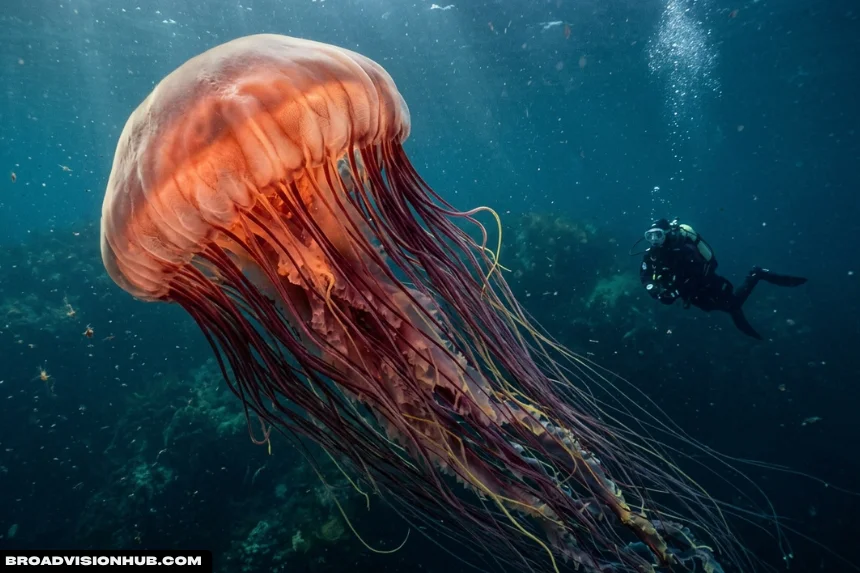
The biggest jellyfish in the world is generally recognized as the lion’s mane jellyfish (Cyanea capillata). This cold-water species can develop an enormous bell and extraordinarily long tentacles. In fact, the most famous recorded specimen had tentacles stretching about 120 feet (36.5 metres)—longer than many large whales.
That record came from a lion’s mane jellyfish that washed ashore in Massachusetts Bay in 1870. Guinness World Records lists its bell at 7 feet 6 inches (2.28 metres) across and its tentacles at 120 feet long.
However, there is an important distinction. A 120-foot lion’s mane is an exceptional specimen, not the normal size of the species. Smithsonian Ocean says lion’s mane jellyfish average around 3 feet across, while rare individuals can exceed 6 feet in bell diameter and develop tentacles longer than 100 feet.
Therefore, understanding the world’s largest jellyfish requires comparing record size, typical size, bell diameter, tentacle length, and body mass rather than relying on one spectacular number.
What Is the Biggest Jellyfish in the World?
The lion’s mane jellyfish (Cyanea capillata) is the largest jellyfish species commonly recognized by marine-science sources. The largest widely cited specimen measured 7 feet 6 inches across its bell and approximately 120 feet from the bell to the ends of its tentacles.
Smithsonian Ocean also identifies the lion’s mane as the largest jellyfish species and reports that exceptionally large individuals can have tentacles extending beyond 100 feet.
The animal gets its common name from the thick mass of trailing tentacles beneath its bell. When viewed underwater, these tentacles can resemble the flowing mane of a lion.
Nevertheless, size varies dramatically between individual lion’s mane jellyfish. Therefore, a giant measuring more than 100 feet from bell to tentacle tip should be viewed as exceptional.
Biggest Jellyfish in the World Quick Facts
| Fact | Answer |
|---|---|
| Largest commonly recognized jellyfish | Lion’s mane jellyfish |
| Scientific name | Cyanea capillata |
| Famous record location | Massachusetts Bay, United States |
| Record year | 1870 |
| Record bell diameter | 7 ft 6 in / 2.28 m |
| Record tentacle length | 120 ft / 36.5 m |
| Average bell width | Around 3 ft according to Smithsonian |
| Rare giant bell width | More than 6 ft |
| Rare tentacle length | More than 100 ft |
| Main habitat | Cold northern oceans |
| Giant rival | Nomura’s jellyfish |
| Can it sting? | Yes |
Guinness World Records supplies the benchmark measurements for the 1870 Massachusetts specimen, while Smithsonian provides valuable context about normal and exceptional lion’s mane sizes.
How Big Was the Biggest Jellyfish in the World Ever Recorded?
The most famous historical measurement belongs to a lion’s mane jellyfish discovered in Massachusetts Bay in 1870.
Guinness World Records currently records the animal as an Arctic lion’s mane, Cyanea capillata arctica, with two extraordinary measurements:
Bell diameter: 2.28 metres / 7 feet 6 inches
Tentacle length: 36.5 metres / 120 feet
To put 120 feet into perspective, the animal’s extended tentacles would span roughly the length of several cars placed end to end.
However, almost all of that extraordinary length came from its thin trailing tentacles rather than from a 120-foot solid body.
That distinction is critical.
A lion’s mane jellyfish has a relatively compact umbrella-shaped bell, while hundreds of slender tentacles extend far beneath it.
Biggest Jellyfish in the World: The 1870 Record
The Massachusetts discovery is especially relevant for U.S. readers because the most widely cited biggest jellyfish ever recorded was found in American waters.
According to Guinness:
- species: Arctic lion’s mane jellyfish;
- location: Massachusetts Bay, USA;
- year: 1870;
- bell: 2.28 metres across;
- tentacles: 36.5 metres long.
Smithsonian Ocean independently cites the lion’s mane jellyfish as reaching a maximum known overall length of approximately 120 feet.
Therefore, the Massachusetts specimen remains the best-known benchmark when people ask how large the biggest jellyfish in the world can become.
Was the Biggest Jellyfish in the World Really 120 Feet Long?
Yes, but the measurement needs context.
The 120-foot figure refers to the distance from the jellyfish’s bell through its longest extended tentacles.
It does not mean that its central body was 120 feet long.
The bell measured about 7.5 feet across.
Moreover, jellyfish tentacles are soft, flexible, and capable of stretching or contracting. As a result, comparing the total length of a jellyfish directly with the rigid body length of a whale, shark, or fish can be misleading.
The 120-foot figure is still remarkable. However, it should be described specifically as overall length including the tentacles.
How Big Is the World’s Largest Jellyfish Normally?
Most lion’s mane jellyfish are nowhere near the size of the Massachusetts record-holder.
Smithsonian Ocean says the species averages approximately 3 feet in width. Rare individuals can grow beyond 6 feet across, with tentacles extending more than 100 feet.
Another Smithsonian overview notes that larger individuals exist but emphasizes that they are not typical.
Therefore, it is better to think of the famous 120-foot specimen as an extreme example.
Biggest Jellyfish in the World: Typical vs. Record Size
| Measurement | More Typical Size | Exceptional Record |
|---|---|---|
| Bell diameter | Around 3 ft average | 7 ft 6 in |
| Tentacle length | Highly variable | 120 ft |
| Overall size | Large jellyfish | Extraordinary giant |
| Frequency | Normal population | Extremely unusual |
This difference matters for readers who encounter headlines claiming that “lion’s mane jellyfish grow to 120 feet.”
A more accurate statement is:
Lion’s mane jellyfish can reach extraordinary lengths, but the famous 120-foot measurement comes from an exceptional historical specimen.
Why Do Some Sources Give Different Maximum Sizes?
Lion’s mane size estimates can look confusing because respected sources sometimes publish different maxima.
For example, Smithsonian’s general jellyfish-size guide says rare animals can exceed 100 feet in tentacle length. Meanwhile, a Smithsonian museum page describing a lion’s mane model mentions possible tentacles as long as 190 feet.
However, the specifically documented Guinness record remains 120 feet for the 1870 Massachusetts specimen.
Therefore, this article will use:
120 feet as the historical recorded benchmark,
while treating larger theoretical or species-maximum figures separately.
This prevents different kinds of measurements from being mixed together.

What Does “Biggest Jellyfish in the World” Actually Mean?
Calling something the biggest jellyfish in the world sounds simple.
In reality, scientists and readers can measure size in several different ways.
Total Length
For a lion’s mane jellyfish, this means measuring from the top of its bell to the end of its longest tentacle.
This is where the species becomes extraordinary.
Its record total length reaches about 120 feet.
Bell Diameter
The bell is the umbrella-shaped main body of the jellyfish.
The Massachusetts specimen had a bell approximately 2.28 metres, or 7 feet 6 inches, across.
Therefore, the animal was not merely long because of its tentacles. Its central bell was also enormous.
Body Weight
Weight creates a more complicated comparison.
Jellyfish consist largely of water and are difficult to weigh accurately. Guinness notes that reliable jellyfish weights are challenging to obtain because of their gelatinous structure. Nevertheless, Guinness estimates that exceptionally large lion’s mane jellyfish could exceed one metric tonne based on their body volume and tentacle mass.
This is an important correction to a common online claim that Nomura’s jellyfish is automatically the “heaviest jellyfish.”
Nomura’s jellyfish is certainly one of the most massive well-documented giant jellyfish, but the weight record is less straightforward than many listicles suggest.
Biggest Jellyfish in the World vs. Nomura’s Jellyfish
The Nomura’s jellyfish (Nemopilema nomurai) is the lion’s mane jellyfish’s most famous giant rival.
Nomura’s jellyfish can grow to around 2 metres across and 200 kilograms (440 pounds), according to Penn State educational material.
That makes it an astonishingly bulky animal.
However, its overall tentacle length does not approach the famous 120-foot lion’s mane record.

| Feature | Lion’s Mane Jellyfish | Nomura’s Jellyfish |
|---|---|---|
| Scientific name | Cyanea capillata | Nemopilema nomurai |
| Best known for | Extreme overall length | Massive body and weight |
| Maximum documented bell comparison | Record 2.28 m | Around 2 m |
| Record overall length | About 36.5 m / 120 ft | Far shorter |
| Reported/estimated mass | Difficult to measure; extreme lion’s mane mass is estimated | Up to ~200 kg documented in references |
| Main habitat | Cold northern oceans | Northwest Pacific |
| Main “giant” feature | Long bell-to-tentacle measurement | Huge, heavy body |
Is Nomura’s Jellyfish Bigger Than a Lion’s Mane?
Not by total recorded length.
The lion’s mane wins dramatically when its longest tentacles are included.
However, Nomura’s jellyfish has an exceptionally large, dense-looking bell and a well-known body mass of up to around 200 kilograms.
Therefore, a useful way to distinguish them is:
Lion’s mane jellyfish = record-setting overall length.
Nomura’s jellyfish = one of the most massive and bulky giant jellyfish commonly encountered and measured.
The comparison also demonstrates why the word “biggest” needs context.
Is the World’s Biggest Jellyfish Also the Heaviest?
This question requires more caution than many online articles provide.
Guinness currently lists the lion’s mane jellyfish under its heaviest-jellyfish record and estimates that the largest individuals could exceed one tonne. However, Guinness explicitly notes that accurate jellyfish weights are difficult to obtain because these animals are almost entirely soft, watery tissue.
Meanwhile, Nomura’s jellyfish has widely cited measurements of approximately 200 kilograms for giant individuals.
Therefore, it is misleading to state simply:
“Nomura’s jellyfish is the heaviest jellyfish in the world.”
A more defensible conclusion is:
Nomura’s jellyfish is famous for enormous measured body mass, while Guinness estimates that extreme lion’s mane jellyfish may become even heavier. Because weighing giant jellyfish accurately is difficult, comparisons should be treated cautiously.
That distinction is one of the reasons the lion’s mane jellyfish remains the strongest overall answer to the question “What is the biggest jellyfish in the world?”
Its combination of a giant bell and extraordinarily long tentacles gives it a scale few other jellyfish can match.
Is the Biggest Jellyfish Bigger Than a Blue Whale?
In one specific sense, the biggest jellyfish in the world can be longer than a blue whale.
The famous lion’s mane jellyfish found in Massachusetts Bay in 1870 measured about 120 feet (36.5 metres) from the top of its bell to the ends of its longest tentacles.
By comparison, Smithsonian Ocean says blue whales can reach approximately 100 feet (30 metres) in length.
Therefore, when only maximum linear length is compared:
Record lion’s mane jellyfish: about 120 feet
Large blue whale: about 100 feet
However, that comparison can be misleading without context.
A blue whale has a massive muscular body. In contrast, most of the lion’s mane jellyfish’s extraordinary measurement comes from extremely thin trailing tentacles.
Moreover, Smithsonian notes that blue whales can weigh more than 190 tons and remain the largest vertebrates—and the largest animals known to have existed—by overall body mass.
So, the best answer is:
A record lion’s mane jellyfish can be longer than a blue whale when its tentacles are included, but the blue whale is vastly larger and heavier as an animal.
Biggest Jellyfish in the World vs. Blue Whale
| Feature | Lion’s Mane Jellyfish | Blue Whale |
|---|---|---|
| Famous maximum length | About 120 ft including tentacles | Up to about 100 ft |
| Main source of length | Long, thin tentacles | Massive body |
| Body mass | Far lower and difficult to compare | Can exceed 190 tons |
| Body structure | Gelatinous invertebrate | Marine mammal |
| Main size distinction | Extreme linear length | Largest animal by overall mass |
Therefore, saying that a jellyfish is “bigger than a blue whale” is not quite accurate.
Longer is the better word.
Is the Lion’s Mane Jellyfish the Longest Animal in the World?
The lion’s mane jellyfish is often described online as the longest animal in the world.
However, that statement needs qualification.
Its famous historical record reaches approximately 120 feet, which makes the animal extraordinarily long when its tentacles are fully extended.
Nevertheless, Monterey Bay Aquarium notes that some giant siphonophores can reach around 130 feet (39.6 metres), longer than the famous lion’s mane record.
Siphonophores are gelatinous relatives of jellyfish, but they are biologically unusual because what looks like one animal is actually a colony of specialized organisms working together.
Therefore, the safest wording is:
The lion’s mane jellyfish is one of the longest jellyfish and one of the longest marine animals commonly cited in size comparisons, but it should not automatically be called the longest animal on Earth.
This distinction also prevents the article from repeating an oversimplified record claim.
What Does the Biggest Jellyfish in the World Look Like?
The lion’s mane jellyfish is visually impressive even when it is nowhere near record size.
Its body has a broad, umbrella-shaped bell with a dense mass of tentacles hanging beneath it.
Those thin tentacles create the hair-like appearance behind the name lion’s mane jellyfish.
Nausicaá explains that the scientific name Cyanea capillata reflects the same feature because capillata refers to a hairy or hair-like appearance.
The species also changes color as it grows.
Young individuals may appear:
- pale pink;
- yellow;
- or relatively light in color.
Older lion’s mane jellyfish can become much darker, ranging from:
- reddish tones;
- orange;
- to orange-brown.
Nausicaá also notes that the bell is divided into eight lobes, alternating with eight sensory structures known as rhopalia.
Why Is It Called a Lion’s Mane Jellyfish?
The name comes from the enormous collection of fine tentacles hanging beneath the bell.
Viewed underwater, these tentacles spread around the animal like long strands of hair.
Therefore, the animal can resemble a floating mane.
The appearance becomes especially dramatic in larger adults, where hundreds of tentacles form a thick curtain underneath the bell.
How Long Are Lion’s Mane Jellyfish Tentacles?
The most spectacular feature of the lion’s mane jellyfish is its tentacle length.
Smithsonian Ocean says rare individuals can develop tentacles longer than 100 feet (30 metres).
Meanwhile, the famous historical record reaches roughly 120 feet.
However, the majority of animals have much shorter tentacles.
The difference between average and extreme specimens is therefore enormous.
Why Are the Tentacles So Long?
Long tentacles dramatically increase the area through which the jellyfish can encounter prey.
Instead of chasing fish in the way a shark might, a lion’s mane can drift through the water while spreading a large network of stinging tentacles.
As a result, prey swimming into that network can be captured without the jellyfish needing high-speed pursuit.
This feeding strategy helps explain why tentacle length is such an important adaptation.
How Many Tentacles Does a Lion’s Mane Jellyfish Have?
A lion’s mane jellyfish can have hundreds of tentacles.
Nausicaá reports that some individuals may have around 800 fine tentacles, positioned around four large oral arms beneath the bell.
However, it is better not to say that every lion’s mane has exactly 800.
Tentacle numbers can vary depending on:
- age;
- size;
- development;
- and how structures are counted.
Therefore, the most accurate wording is:
Large lion’s mane jellyfish can carry hundreds of long stinging tentacles, with some descriptions citing roughly 800.

What Are Lion’s Mane Jellyfish Tentacles Made For?
The tentacles have two major purposes:
capturing prey
and
defense
They contain specialized stinging cells called cnidocytes.
Inside these cells are structures known as nematocysts.
When triggered, a nematocyst rapidly fires a tiny thread-like structure capable of injecting venom into prey.
Nausicaá describes millions of cnidocytes on the lion’s mane tentacles.
Meanwhile, Monterey Bay Aquarium explains that nematocysts help jellyfish sting and immobilize prey before food is transferred toward the digestive system.
Therefore, the enormous tentacles are not simply decorative.
They form an active feeding system.
Anatomy of the Biggest Jellyfish in the World
Despite their enormous potential size, lion’s mane jellyfish have relatively simple bodies.
Like other true jellyfish, they belong to the phylum Cnidaria.
Their major body structures include:
Bell
The umbrella-shaped upper body.
Muscles in the bell contract rhythmically, pushing water and helping the jellyfish move.
Tentacles
Long structures containing stinging cells.
These capture prey and discourage predators.
Oral Arms
Structures beneath the bell that help move captured food toward the mouth.
Nausicaá reports four wavy oral arms in lion’s mane jellyfish.
Rhopalia
Sensory structures around the bell.
They help jellyfish detect environmental information such as orientation and light.
Monterey Bay Aquarium explains that jellies use rhopalia to detect light, gravity, and other signals while coordinating swimming movements.
Mesoglea
The gelatinous material that makes up much of the jellyfish’s body.
This watery tissue helps give the animal its familiar translucent structure.
How Can a Jellyfish Grow So Big?
One reason a jellyfish can develop such an enormous body is that it is built very differently from a whale, shark, or other large vertebrate.
NOAA explains that jellyfish are approximately 95% water.
Only about 5% of the body consists of solid material.
Consequently, jellyfish do not need:
- heavy bones;
- a large skeleton;
- thick muscles throughout the body;
- or the dense internal organs found in vertebrates.
Instead, their soft tissues are naturally supported by the surrounding seawater.
Why 95% Water Matters
A watery body has several advantages.
First, it reduces the amount of dense tissue needed to create a large structure.
Second, buoyancy from the ocean helps support the animal.
Finally, the jellyfish can build a very large bell and extremely long tentacles without carrying the same structural weight that a land animal would need.
However, being 95% water does not automatically explain every aspect of the lion’s mane’s giant size.
Its unusual dimensions also reflect:
- species biology;
- food availability;
- environmental conditions;
- habitat;
- and individual growth.
Therefore, body composition is part of the explanation rather than the entire answer.
How Does the World’s Largest Jellyfish Move?
Despite its huge tentacle array, a lion’s mane jellyfish is not a powerful long-distance swimmer like a tuna or whale.
Like other jellyfish, it moves partly by contracting its bell.
Monterey Bay Aquarium explains that jellyfish use radial muscle fibers to squeeze the bell, creating a wave-like movement that pushes the animal through the water.
However, ocean currents also play an important role in where jellyfish travel.
Therefore, lion’s mane jellyfish can drift over considerable distances while using bell contractions to adjust their movement and orientation.
This partly explains why enormous individuals may suddenly appear in coastal waters.
Where Does the Biggest Jellyfish in the World Live?
The lion’s mane jellyfish is primarily associated with cold northern waters.
Its range includes parts of:
- the Arctic;
- North Atlantic Ocean;
- North Pacific Ocean;
- North Sea;
- and other cool-water regions.
Animal Diversity Web lists the species across cooler Atlantic and Pacific waters, as well as the North Sea and Baltic.
Monterey Bay Aquarium specifically lists its Pacific range from the Arctic and Alaska south through Washington, with occasional observations farther south toward California.
Therefore, someone hoping to encounter an exceptionally large lion’s mane is much more likely to find one in cold northern water than in a tropical sea.
Are Lion’s Mane Jellyfish Found in the United States?
Yes.
Lion’s mane jellyfish occur in U.S. waters.
On the Pacific side, Monterey Bay Aquarium documents their range from Alaska through Washington and notes that they are occasionally seen farther south.
NOAA records also document Cyanea capillata in Alaskan waters.
Meanwhile, lion’s mane jellyfish are also documented off New England.
A NOAA-hosted scientific report describes an interaction between a humpback whale and a large lion’s mane jellyfish in coastal waters off New England.
Most famously, of course, the historical 1870 record specimen came from Massachusetts Bay.
Therefore, U.S. readers can think of the main American range as concentrated around colder northern waters rather than warm southern beaches.
U.S. Regions Associated With Lion’s Mane Jellyfish
Relevant areas include:
- Alaska;
- Washington;
- New England;
- Massachusetts waters;
- and other cold northern coastal environments.
Their presence can shift seasonally and locally depending on water conditions.
What Is the Biggest Jellyfish Ever Found in the United States?
The answer remains the famous 1870 Massachusetts Bay lion’s mane jellyfish discussed in Part A.
Its approximately 120-foot tentacle measurement makes it the most widely cited U.S. record and one of the most famous jellyfish measurements in history.
That means the world’s best-known record specimen did not come from a remote tropical island.
It came from the northeastern United States.
For a U.S.-focused article, this is one of the strongest geographical facts surrounding the keyword biggest jellyfish in the world.
Why Are the Largest Lion’s Mane Jellyfish Associated With Cold Water?
The largest lion’s mane jellyfish are strongly associated with cold northern environments.
Monterey Bay Aquarium states that the largest specimens are found in Arctic waters.
Nausicaá similarly reports that the bell may reach around 2 metres in colder waters, while more ordinary specimens are generally smaller.
This gives us a clear observed pattern:
Colder populations tend to include the largest lion’s mane jellyfish.
However, it is important not to oversimplify this into the claim that “cold water automatically makes jellyfish bigger.”
Body size can also be influenced by:
- food availability;
- genetics;
- life-cycle timing;
- water conditions;
- predation;
- and other ecological factors.
Therefore, cold-water habitat is strongly associated with giant specimens, but it should not be treated as the only cause.
What Does the Biggest Jellyfish in the World Eat?
The lion’s mane jellyfish is a predator.
Its diet includes:
- zooplankton;
- tiny crustaceans;
- small fish;
- and other jellyfish.
Monterey Bay Aquarium specifically lists tiny crustaceans, zooplankton, small fishes, and moon jellies among its foods.
Nausicaá also reports that the species eats fish, crustaceans, and other jellyfish.
Therefore, a lion’s mane is not simply drifting passively through the ocean without feeding.
Its giant tentacle network is an effective predatory system.
How Does the Biggest Jellyfish in the World Hunt?
The lion’s mane jellyfish does not chase prey in the traditional sense.
Instead, it can spread its tentacles through the surrounding water.
Animal Diversity Web describes the jellyfish slowly sinking while spreading its tentacles in a broad circle.
Prey that encounter this tentacle “net” can become trapped and stunned by nematocysts.
The process can be summarized as:
1. Tentacles spread through the water
2. Fish or other prey contact the tentacles
3. Nematocysts fire
4. Venom immobilizes or weakens the prey
5. Tentacles and oral arms move food toward the mouth
6. Digestion takes place beneath the bell
Monterey Bay Aquarium explains the same general feeding mechanism in jellyfish: nematocysts immobilize prey, after which oral arms guide the food toward the digestive chambers.
Why Such Long Tentacles Are Useful
Long tentacles dramatically increase the jellyfish’s feeding area.
In effect, the animal carries a large drifting net.
Therefore, an individual does not need to make direct body contact with a fish to capture it.
Instead, prey can encounter tentacles many feet away from the bell itself.
This also helps explain why swimmers should never assume they are safe merely because they can see the jellyfish’s bell at a distance.
Do Other Animals Live Among Lion’s Mane Tentacles?
Interestingly, some smaller marine animals can use the lion’s mane jellyfish as shelter.
Nausicaá reports that shrimp and juvenile fish may live among its tentacles, where they gain protection from predators and can consume food scraps.
Monterey Bay Aquarium likewise notes that some fishes can tolerate the lion’s mane’s toxins and may feed around the jellyfish.
Therefore, a giant lion’s mane can function as more than a single predator.
It may also create a small moving habitat for other animals.
What Eats the Biggest Jellyfish in the World?
Yes.
Being enormous does not place the lion’s mane jellyfish beyond predation.
Monterey Bay Aquarium identifies leatherback sea turtles as major jellyfish predators and notes that jellies form an important part of their diet.
Smithsonian also reports that more than 150 animal species consume jellyfish, including:
- fish;
- sea turtles;
- crustaceans;
- and other jellyfish.
Therefore, even the biggest jellyfish in the world remains part of a larger marine food web.
Its enormous tentacles provide a powerful defense and feeding mechanism, but they do not make the species invulnerable.
Can the Biggest Jellyfish in the World Sting Humans?
Yes. The biggest jellyfish in the world, the lion’s mane jellyfish, has stinging tentacles capable of injuring people.
Its tentacles contain specialized cells called cnidocytes. Inside each cnidocyte is a microscopic stinging structure called a nematocyst. When triggered, the nematocyst rapidly fires and can deliver venom into whatever touched it.
Smithsonian Ocean explains that human contact with lion’s mane tentacles can cause effects ranging from a skin rash to more serious reactions involving respiratory function.
However, this does not mean every encounter becomes a medical emergency.
Monterey Bay Aquarium describes the lion’s mane as having a powerful sting but notes that reports of human fatalities are few.
Therefore, the best description is:
Lion’s mane jellyfish can produce painful and occasionally serious stings, but they should not be portrayed as routinely deadly to humans.
What Does a Lion’s Mane Jellyfish Sting Feel Like?
Reactions vary.
Possible effects can include:
- burning or painful skin;
- redness;
- rash-like marks;
- swelling;
- and, in more serious cases, wider systemic reactions.
The severity depends on factors such as how much tentacle contacted the skin and the individual’s response to the venom.
Because reactions can differ considerably, swimmers should avoid intentionally touching any lion’s mane jellyfish, regardless of its size.

Can a Dead Lion’s Mane Jellyfish Still Sting?
Yes. A stranded or apparently dead jellyfish can still sting.
This is one of the most important practical facts about jellyfish.
NOAA warns beachgoers to remain cautious around jellyfish washed onto sand because wet tentacles may still sting. Moreover, tentacles separated from the main jellyfish can continue firing their stinging structures.
Therefore, never assume a jellyfish is safe simply because:
- it is lying on the beach;
- it appears dead;
- the bell is damaged;
- or the tentacles have broken away.
Should You Touch a Washed-Up Lion’s Mane Jellyfish?
No.
Do not touch either the bell or tentacles with bare skin.
This becomes particularly important with a lion’s mane because its fine tentacles may spread over an area much larger than the visible bell.
As a result, someone may encounter a detached tentacle without realizing that it came from a jellyfish nearby.
What Should You Do After a Jellyfish Sting?
First-aid recommendations can vary depending on the jellyfish species and location.
Therefore, the safest general approach is to seek assistance from a lifeguard or medical professional and follow local guidance rather than experimenting with popular home remedies.
NOAA specifically advises caution around remaining tentacles and recommends seeking medical attention if a serious or allergic reaction develops.
Difficulty breathing, loss of consciousness, severe chest symptoms, or another rapidly worsening reaction warrants emergency medical attention.
Is the Biggest Jellyfish Also the Most Dangerous Jellyfish?
No.
The biggest jellyfish and the most venomous jellyfish are different animals.
The lion’s mane jellyfish holds the strongest claim to being the largest jellyfish by extreme overall length.
However, NOAA identifies the Australian box jellyfish (Chironex fleckeri) as the most venomous marine animal.
Therefore:
Biggest jellyfish: Lion’s mane jellyfish
Most venomous marine jellyfish: Australian box jellyfish
This distinction is important because size does not determine venom potency.
A smaller jellyfish can pose a much greater medical threat than an enormous lion’s mane.
Lion’s Mane Jellyfish vs. Box Jellyfish
The two animals differ dramatically in size, habitat, appearance, and danger.
| Feature | Lion’s Mane Jellyfish | Australian Box Jellyfish |
|---|---|---|
| Scientific name | Cyanea capillata | Chironex fleckeri |
| Main distinction | Extreme size and tentacle length | Extremely potent venom |
| Famous record length | About 120 ft including tentacles | Much shorter |
| Preferred waters | Cold northern seas | Warm Indo-Pacific waters |
| Body shape | Rounded bell with dense trailing tentacles | More box-shaped bell |
| Human sting risk | Painful and occasionally serious | Can cause life-threatening poisoning |
| World record relevance | Largest jellyfish | Among the most dangerous jellyfish |
NOAA explains that severe Chironex fleckeri envenomation can cause paralysis, cardiac arrest, and death, although only some box jellyfish species have venom capable of killing humans.
Meanwhile, Monterey Bay Aquarium identifies the lion’s mane as a giant species whose tentacles can grow beyond 100 feet.
Consequently, biggest does not mean most dangerous.
What Is the Most Venomous Jellyfish in the World?
The Australian box jellyfish (Chironex fleckeri) is widely considered the most venomous marine animal.
Its tentacles contain enormous jellyfish in the world numbers of nematocysts capable of rapidly injecting venom.
NOAA notes that severe stings can affect the cardiovascular and nervous systems within minutes.
The comparison reinforces an important lesson:
Jellyfish danger should be judged by species and venom, not simply by physical size.
Other Giant Jellyfish Compared With the World’s Biggest Jellyfish
The lion’s mane may hold the most famous size record, but it is far from the only giant jellyfish in the ocean.
Several species can reach impressive dimensions.
Nomura’s Jellyfish
Nomura’s jellyfish (Nemopilema nomurai) is one of the most massive jellyfish species.
As discussed earlier, giant individuals can approach roughly 2 metres across and 200 kilograms (440 pounds).
Its large rounded bell gives it a much bulkier appearance than the long, tentacled lion’s mane.
Therefore, Nomura’s jellyfish remains one of the most important species in any discussion about the world’s biggest jellies.
Black Sea Nettle
The black sea nettle (Chrysaora achlyos) is another genuine giant.
Monterey Bay Aquarium reports that its dark bell can grow beyond 3 feet (0.9 metres) in diameter, while its tentacles may extend 25 feet (7.6 metres) or more.
It occurs primarily along the Pacific coast of Mexico and the United States and is occasionally seen as far north as Monterey Bay.
Although large, it remains dramatically shorter than the record lion’s mane.
Big Red Jelly
The unusual big red jelly (Tiburonia granrojo) lives in the deep sea.
NOAA Ocean Exploration reports that these deep-water jellyfish can exceed 1 metre (3 feet) in diameter. Unlike many familiar jellyfish, they use thick feeding arms rather than long stinging tentacles for capturing food.
Scientists have observed the species thousands of feet below the ocean surface.
Its unusual anatomy makes it impressive, although it does not rival the lion’s mane in total length.
Egg-Yolk Jelly
The egg-yolk jelly (Phacellophora camtschatica) is also large.
Monterey Bay Aquarium reports a bell up to about 2 feet (61 cm) across and tentacles extending approximately 20 feet (6 metres).
Despite its impressive dimensions, it remains far below the lion’s mane record.
Giant Jellyfish Compared
| Jellyfish | Approximate Giant Size | Famous For |
| Lion’s mane | Record ~120 ft overall | Longest widely cited jellyfish record |
| Nomura’s jellyfish | Bell ~2 m; up to ~200 kg reported | Extraordinary mass and bulk |
| Black sea nettle | Bell >3 ft; tentacles 25+ ft | Giant Pacific sea nettle |
| Big red jelly | Bell >3 ft | Deep-sea giant with feeding arms |
| Egg-yolk jelly | Bell ~2 ft; tentacles ~20 ft | Large Pacific jelly |
| Australian box jellyfish | Smaller than the giants above | Extreme venom |
This table illustrates why “largest,” “heaviest,” and “most dangerous” are different categories.
Why Do Sources Give Different Sizes for the Biggest Jellyfish in the World?
Anyone researching the biggest jellyfish in the world will quickly notice that different websites give different maximum sizes.
For example, Smithsonian Ocean’s general size guide says lion’s mane jellyfish average around 3 feet across, while rare individuals exceed 6 feet across and have tentacles longer than 100 feet.
Another Smithsonian educational page discusses a museum model and mentions a possible tentacle length of up to 190 feet.
Meanwhile, Guinness World Records gives a much more specific historical measurement:
36.5 metres / 120 feet for the 1870 Massachusetts Bay specimen.
These numbers are not necessarily describing the same thing.
Record Specimen vs. Possible Species Maximum
A record specimen refers to a particular individual with a documented measurement.
A maximum species size may instead represent:
- an estimate;
- an exceptional observation;
- historical reporting;
- or an upper biological range.
Therefore, this article uses the 120-foot Massachusetts specimen as the clearest recorded benchmark.
Possible larger estimates should be described separately rather than presented as equally documented world records.
Why Are Giant Jellyfish Difficult to Measure?
Jellyfish create unusual measurement challenges because their bodies are nothing like those of mammals, fish, or reptiles.
Their Bodies Are Mostly Water
NOAA states that jellyfish are about 95% water.
Once removed from the ocean, they lose the surrounding water support that maintains their shape.
Consequently, a stranded jelly can collapse into a gelatinous mass.
Tentacles Stretch and Contract
A lion’s mane jellyfish can extend its tentacles while drifting or feeding.
However, those same tentacles can contract.
Therefore, measurements may differ depending on:
- the condition of the animal;
- how fully the tentacles are extended;
- water movement;
- and how the specimen is measured.
Tentacles Break Easily
The tentacles are thin and delicate.
They can be:
- torn by currents;
- damaged by predators;
- broken during stranding;
- or separated during collection.
Consequently, a specimen may already have lost part of its maximum length before scientists or observers measure it.
Giant Individuals Are Rare
Smithsonian emphasizes that the enormous specimens attracting headlines are not typical.
Therefore, scientists do not have an endless supply of 100-foot lion’s mane jellyfish available for controlled measurement.
This helps explain why a specimen documented more than 150 years ago remains so important in modern descriptions.
Can the Biggest Jellyfish in the World Really Reach 120 Feet?
Yes—but most of that length consists of tentacles.
The central bell of the famous Massachusetts specimen was about 7 feet 6 inches across, while the longest tentacles extended the overall measurement to approximately 120 feet.
Therefore, imagining a solid 120-foot gelatinous body would be incorrect.
A better mental picture is:
a very large bell + an enormous curtain of exceptionally thin trailing tentacles.
That unusual anatomy allows the lion’s mane to achieve extreme linear length without resembling a whale-sized solid mass.
How Rare Is a 100-Foot Lion’s Mane Jellyfish?
Very rare.
Smithsonian identifies the average lion’s mane bell as approximately 3 feet across and says that individuals exceeding 6 feet with tentacles beyond 100 feet are unusual.
Monterey Bay Aquarium also places ordinary adult bell sizes between roughly 19 inches and 3 feet while acknowledging tentacles longer than 100 feet in exceptional giants.
Therefore, seeing a lion’s mane jellyfish does not mean seeing a 100-foot animal.
Most are dramatically smaller.
Biggest Jellyfish in the World: Size Categories Compared
The clearest way to understand giant jellyfish is to separate different kinds of records.
| Category | Best Example | Key Fact |
| Biggest jellyfish by famous overall-length record | Lion’s mane | 120-ft historical specimen |
| Largest typical lion’s mane bell | Lion’s mane | Rare giants exceed 6 ft |
| Extremely massive giant jellyfish | Nomura’s jellyfish | Up to ~200 kg commonly cited |
| Giant U.S. Pacific jelly | Black sea nettle | Tentacles 25+ ft |
| Deep-sea giant | Big red jelly | Bell over 3 ft |
| Most venomous marine animal | Australian box jellyfish | Powerful, potentially lethal venom |
| Longest gelatinous relative | Giant siphonophore | Can exceed lion’s mane record length |
This comparison answers an important semantic question:
There is no single definition of “biggest” that works for every marine animal.
However, when people specifically ask for the biggest jellyfish in the world, the lion’s mane remains the standard answer. Smithsonian explicitly identifies it as the largest among jellyfish species.
Frequently Asked Questions About the Biggest Jellyfish in the World
What is the biggest jellyfish in the world?
The lion’s mane jellyfish (Cyanea capillata) is generally recognized as the biggest jellyfish species.
Smithsonian identifies the lion’s mane as the largest jellyfish, while Guinness records an exceptional specimen with tentacles measuring approximately 120 feet.
How big is the biggest jellyfish ever recorded?
The famous record lion’s mane jellyfish had:
- a 7 ft 6 in (2.28 m) bell;
- and 120 ft (36.5 m) tentacles.
It was found in Massachusetts Bay in 1870.
Where was the biggest jellyfish ever found?
The best-known record specimen washed ashore in Massachusetts Bay, United States, in 1870.
Was the largest jellyfish ever recorded found in America?
Yes.
The famous 120-foot lion’s mane record came from Massachusetts Bay.
Therefore, the United States is directly connected with one of the most extraordinary jellyfish measurements ever reported.
Are all lion’s mane jellyfish 100 feet long?
No.
Most are much smaller.
Smithsonian reports an average bell width of roughly 3 feet, with only rare specimens reaching the extreme dimensions associated with 100-foot-plus tentacles.
How long can lion’s mane jellyfish tentacles get?
The most famous recorded tentacles measured approximately 120 feet.
Some institutional sources discuss larger possible maxima, but 120 feet remains the strongest specific historical benchmark.
How wide can a lion’s mane jellyfish get?
The famous Massachusetts specimen measured approximately 7 feet 6 inches across its bell.
Smithsonian says rare lion’s mane jellyfish can exceed 6 feet in bell width.
Is a lion’s mane jellyfish bigger than a blue whale?
It can be longer when its tentacles are fully included.
However, a blue whale is vastly more massive.
Therefore, saying the jellyfish is longer than some blue whales is more accurate than saying it is physically bigger overall.
Is the lion’s mane the longest animal in the world?
Not necessarily.
Monterey Bay Aquarium notes that giant siphonophores can reach about 130 feet, exceeding the famous 120-foot lion’s mane record.
Moreover, a siphonophore is a colonial organism rather than the same type of animal as a true jellyfish.
What is the heaviest jellyfish in the world?
The answer is less certain than the length record because jellyfish are extraordinarily difficult to weigh accurately.
Nomura’s jellyfish is famous for individuals weighing around 200 kilograms, while very large lion’s mane weight estimates may be higher.
Therefore, claims about the single heaviest jellyfish should be presented more cautiously than the 120-foot length record.
Is Nomura’s jellyfish bigger than a lion’s mane jellyfish?
Not by overall recorded length.
Nomura’s jellyfish is extraordinarily bulky and heavy, whereas the lion’s mane achieves much greater overall length because of its trailing tentacles.
What is the most dangerous jellyfish?
The Australian box jellyfish (Chironex fleckeri) is considered the most venomous marine animal by NOAA.
Is a box jellyfish bigger than a lion’s mane?
No.
A box jellyfish is far smaller than an extreme lion’s mane.
However, its venom can be substantially more dangerous to humans.
Can a lion’s mane jellyfish kill a human?
Severe reactions are possible, although reported human fatalities are uncommon.
Monterey Bay Aquarium notes that the sting can potentially be serious while reports of human deaths are few.
Anyone experiencing serious symptoms after a jellyfish sting should seek urgent medical attention.
Can a dead lion’s mane jellyfish sting?
Yes.
NOAA warns that washed-up jellyfish may still sting when tentacles remain wet, while detached tentacles can also remain capable of stinging.
Where do lion’s mane jellyfish live?
They are primarily associated with cold northern waters, including Arctic and northern Pacific and Atlantic regions.
Monterey Bay Aquarium records their Pacific range from Arctic waters and Alaska through Washington, with occasional sightings farther south.
Are lion’s mane jellyfish found in the United States?
Yes.
They occur in colder U.S. waters, including parts of Alaska, the Pacific Northwest, and New England.
The famous world-record specimen itself was found in Massachusetts Bay.
What do lion’s mane jellyfish eat?
They eat small fish, zooplankton, crustaceans, and other jellyfish.
Monterey Bay Aquarium specifically lists tiny crustaceans, zooplankton, small fishes, and moon jellies among their prey.
Do lion’s mane jellyfish have brains?
No.
Like other jellyfish, they do not possess a centralized brain.
Instead, they have a simpler nerve network and sensory structures that help them respond to their surroundings.
NOAA notes that jellyfish lack brains, blood, and hearts while still possessing a simple nervous system.
Why are giant jellyfish mostly water?
The gelatinous body is largely composed of water-rich tissue called mesoglea.
NOAA estimates that approximately 95% of a jellyfish’s body is water.
Why Is It Called the Biggest Jellyfish in the World?
It combines an unusually large bell with extraordinarily long tentacles.
The famous historical specimen stretched approximately 120 feet from bell to tentacle tip, giving the species the strongest widely recognized claim to the title biggest jellyfish in the world.
What Makes the Lion’s Mane the World’s Biggest Jellyfish?
The lion’s mane jellyfish earns its giant reputation through an unusual combination of bell diameter and extreme tentacle length.
Most individuals never approach record dimensions.
Nevertheless, exceptional animals can become astonishingly large.
The best-known example remains the lion’s mane found in Massachusetts Bay in 1870. Its bell measured approximately 7 feet 6 inches across, while its longest tentacles extended about 120 feet.
That does not make a lion’s mane more massive than a blue whale.
Nor does it make the species the most venomous jellyfish.
Likewise, other giants such as Nomura’s jellyfish may rival it in bulk, while giant siphonophores can exceed its famous length despite belonging to a different kind of gelatinous marine organism.
However, among true jellyfish, the lion’s mane remains the standard answer to the question:
What is the biggest jellyfish in the world?
Its extraordinary tentacles, cold-water habitat, unusual anatomy, and record-setting dimensions make Cyanea capillata one of the ocean’s most remarkable invertebrates.
More importantly, the 120-foot record should be understood for what it represents: an exceptional individual, not the normal size of every lion’s mane jellyfish.
That distinction separates an accurate scientific explanation from a sensational headline.
READ MORE ABOUT : Mini Aussiedoodles