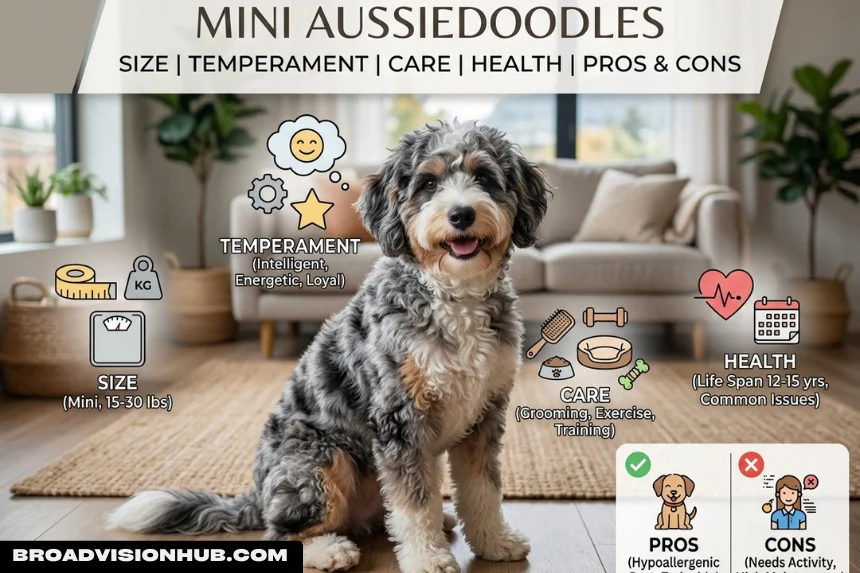
Mini Aussiedoodles are intelligent, affectionate, and energetic mixed-breed dogs commonly produced by crossing a smaller Australian Shepherd-type dog with a Miniature Poodle. Many adults weigh approximately 15 to 35 pounds. However, their final size, coat, shedding level, and personality can vary considerably.
These dogs often learn quickly and form close bonds with their families. In addition, their manageable size appeals to people who want an active companion without choosing a large dog. Still, Mini Aussiedoodles are not automatically easy or low-maintenance pets. They need daily exercise, mental stimulation, consistent training, and regular coat care.
Therefore, prospective owners should look beyond their fluffy appearance. This guide explains what living with one may involve, including size, temperament, family compatibility, grooming needs, and common ownership challenges.
Quick Facts About Mini Aussiedoodles
| Category | Practical details |
|---|---|
| Dog type | Australian Shepherd-type dog and Poodle mix |
| Common adult weight | Often about 15–35 pounds, although some dogs are smaller or larger |
| Common height | Usually small to medium in height, depending heavily on both parents |
| Coat types | Straight, loose-wavy, fleece-like, or tightly curled |
| Common colors | Black, red, chocolate, cream, blue merle, red merle, parti, sable, and tricolor |
| Temperament | Often intelligent, playful, affectionate, alert, and energetic |
| Shedding | May range from very low to moderate |
| Exercise needs | Usually moderate to high |
| Grooming needs | Regular brushing and, for many coats, professional trimming |
| Family suitability | Best for engaged households that can provide training, activity, and supervision |
| Official breed standard | None, because the Mini Aussiedoodle is a mixed-breed dog |
The term “mini” does not represent one universally enforced size standard. As a result, buyers should check the verified size and breed of both parents instead of relying only on a puppy’s marketing label.
What Are Mini Aussiedoodles?
Mini Aussiedoodles are smaller versions of the Aussiedoodle, a cross involving a Poodle and an Australian Shepherd-type dog. They may also be called Mini Aussiepoos, Mini Aussiepoodles, or Miniature Aussiedoodles.
The Australian Shepherd side may contribute athleticism, loyalty, alertness, and herding instincts. Meanwhile, the Poodle side may contribute intelligence, trainability, athletic ability, and a curly or low-shedding coat. PetMD describes the Aussiedoodle as an Australian Shepherd–Poodle cross and notes that miniature versions involving a Miniature Poodle may weigh up to about 30 pounds.
However, a mixed-breed puppy does not inherit exactly half of every visible or behavioral characteristic. One puppy may develop a curlier coat and a Poodle-like build. Another puppy from the same litter may have a straighter coat, heavier shedding, or stronger herding tendencies.
Consequently, Mini Aussiedoodles do not have the same level of predictability associated with a carefully established purebred standard.
The Australian Shepherd and Poodle Mix
Both sides of this mix come from active working backgrounds. Poodles are intelligent, athletic dogs that often respond well to positive, consistent training. Miniature American Shepherds are also bright and self-motivated working dogs with strong herding ancestry.
Therefore, many Mini Aussiedoodles enjoy activities that involve both movement and problem-solving. They may like:
- Learning tricks
- Playing fetch
- Exploring new walking routes
- Searching for hidden treats
- Completing food puzzles
- Participating in beginner agility
- Practicing obedience exercises
However, intelligence does not mean the dog will train itself. In fact, a clever dog may learn unwanted routines just as quickly as desired commands. Consistency remains essential.
Miniature American Shepherd Versus “Mini Australian Shepherd”
The names used in Mini Aussiedoodle breeding can be confusing. Some breeders refer to a parent as a “Mini Australian Shepherd.” However, the officially recognized smaller herding breed is the Miniature American Shepherd.
The American Kennel Club describes the Miniature American Shepherd as a compact breed that resembles a smaller Australian Shepherd. It remains a genuine herding dog and is known for being bright, lively, loyal, and self-motivated.
This distinction matters because not every breeder uses the same terminology. Before obtaining a puppy, ask for the exact registered breed, adult weight, height, health results, and identity of both parents.
Why Their Characteristics Can Vary
Mini Aussiedoodles can differ in several important ways:
- Adult height and weight
- Coat curl and thickness
- Shedding level
- Ear shape
- Body proportions
- Activity requirements
- Sociability
- Alert barking
- Herding behavior
- Confidence around strangers
Generation labels such as F1 or F1B may provide some information about a dog’s ancestry. Nevertheless, they cannot guarantee an exact coat, personality, size, or shedding level.
How Big Do Mini Aussiedoodles Get?
Most Mini Aussiedoodles grow into small-to-medium dogs. Many adults weigh around 15 to 35 pounds, although some fall outside that range. Published breed guides differ because there is no official Mini Aussiedoodle size standard. PetMD states that miniature Aussiedoodles can weigh up to approximately 30 pounds, while another veterinary-reviewed breed guide places many miniature dogs between 15 and 40 pounds.
Their height may also vary noticeably. More importantly, terms such as “mini,” “micro,” and “toy” do not always mean the same thing from one breeder to another.
Therefore, the most useful size estimate comes from the actual adult measurements of the puppy’s parents.

Mini Aussiedoodle Full-Grown Size
A full-grown Mini Aussiedoodle may be compact enough to lift when necessary. However, it may still have the strength, speed, and energy of a larger working dog.
A realistic general estimate is:
| Measurement | Common estimate |
|---|---|
| Adult weight | Approximately 15–35 pounds |
| General build | Small to medium, athletic, and proportionate |
| Physical maturity | Often develops gradually through the first year or longer |
| Behavioral maturity | May take longer than physical growth |
Some puppies sold as minis may eventually exceed the expected range. On the other hand, those produced from a particularly small Poodle parent may remain below it.
What Affects Adult Size?
Several factors influence a Mini Aussiedoodle’s final measurements.
Parental size: The adult weight and height of both parents provide the strongest practical clues.
Poodle variety: A Toy Poodle, Miniature Poodle, or smaller Standard Poodle can produce very different results.
Individual genetics: Siblings can inherit different combinations of size-related genes.
Sex: Males may sometimes mature larger than females, although this is not guaranteed.
Nutrition and health: Proper feeding supports healthy growth. However, overfeeding does not create a naturally larger, healthier dog.
Generation: Later-generation breeding may sometimes narrow certain characteristics, but it still cannot promise an exact adult weight.
For that reason, be cautious when a seller guarantees that a puppy will remain below a precise number of pounds.
When Do Mini Aussiedoodles Stop Growing?
Many Mini Aussiedoodles reach most of their adult height during their first year. However, they may continue filling out and developing muscle afterward. Some breed guides place full physical size at around 12 to 16 months, although growth rates vary between individuals.
Behavioral maturity often takes longer. Therefore, a nearly full-sized adolescent may still show puppy behaviors, including jumping, chewing, impulsive greetings, or difficulty settling.
Mini, Micro, and Toy Aussiedoodles
“Micro” and “toy” Aussiedoodle are commonly used sales terms. They are not universally regulated size categories.
Smaller puppies may seem convenient. Nevertheless, selecting for extremely small size can create additional concerns if breeders prioritize appearance over structure, health, and temperament.
Instead of choosing by label alone, ask:
- What are the parents’ measured adult weights?
- Which Poodle variety was used?
- Are both parents fully mature?
- Is the estimated size written into the contract?
- What happens if the puppy becomes larger than expected?
- Which health examinations were completed?
A responsible source should provide realistic estimates rather than certainty.
What Do Mini Aussiedoodles Look Like?
Mini Aussiedoodles are known for their expressive faces and broad range of coat patterns. However, no single appearance defines the mix.
Some have a teddy-bear-like face with a broad muzzle and thick facial hair. Others have a narrower Poodle-influenced head. Their ears usually fold downward, while their bodies may appear compact, lean, or moderately athletic.
Their eyes may be brown, blue, amber, or a combination. Still, eye color should never be valued above health, stable temperament, and responsible breeding.
Straight, Wavy, and Curly Coats
A Mini Aussiedoodle’s coat may be:
- Mostly straight
- Loose and wavy
- Soft and fleece-like
- Dense and curly
- A mixture of textures
The coat may also change as the puppy matures. For example, a soft puppy coat can become thicker, curlier, straighter, or more difficult to maintain.
Poodles commonly contribute curls and lower shedding. In contrast, Australian Shepherd-type dogs have double coats and shed more noticeably. Therefore, no one can reliably guarantee a nonshedding coat in every puppy. PetMD similarly notes that Aussiedoodle coats and shedding vary according to the traits inherited from each parent.
A straighter coat may release more loose hair into the home. Meanwhile, a curly coat may trap shed hair close to the skin, increasing the risk of mats.
Common Mini Aussiedoodle Colors
Mini Aussiedoodles may appear in colors and patterns such as:
- Solid black
- Chocolate or brown
- Red
- Apricot
- Cream
- Blue merle
- Red merle
- Black and white
- Brown and white
- Parti
- Phantom
- Sable
- Bi-color
- Tricolor
Nevertheless, coat color can change. Some dogs become lighter as they mature, while markings may appear less defined after the adult coat develops.
Color does not determine trainability, affection, or family suitability. Therefore, health and temperament should take priority over rare patterns.

Mini Aussiedoodles Temperament and Personality
Mini Aussiedoodles are often described as intelligent, affectionate, playful, and highly engaged with their families. Many enjoy training and want to participate in household activities. However, personality varies, and no cross can guarantee a specific temperament.
PetMD reports that well-socialized Aussiedoodles are generally friendly and loving. It also notes that their energy levels may differ depending on which parent’s tendencies they inherit.
Early experience matters as well. Genetics provide a foundation, but socialization, handling, training, environment, and daily routine influence how a dog behaves as an adult.
Intelligence and Trainability
Mini Aussiedoodles often learn new cues quickly. Therefore, they may perform well in reward-based training that includes food, toys, praise, and play.
However, owners must remain clear and consistent. A smart puppy may also learn to:
- Bark for attention
- Steal objects to start a chase
- Jump when greeting visitors
- Open cabinets
- Ignore recall around distractions
- Demand play by pawing or whining
For example, laughing when a small puppy steals a sock may accidentally reward the behavior. Later, the same habit can become frustrating or dangerous.
Short, positive training sessions usually work better than long, repetitive drills. Moreover, every family member should follow the same rules.
Affection and Attachment
Many Mini Aussiedoodles form close relationships with their owners. They may follow people from room to room, rest near family members, or seek regular physical contact.
This affection can be appealing. However, constant togetherness may make independence harder unless owners practice it gradually. Puppies should learn that resting alone for reasonable periods is safe and normal.
Attachment should not be confused with automatic emotional stability. Some dogs remain relaxed when their owners leave. Others may bark, pace, scratch doors, or become destructive.
Part B will explain how to build comfortable alone time without overwhelming the dog.
Energy and Playfulness
A smaller Aussiedoodle can still have substantial energy. Both parent lines are athletic, intelligent dogs. Consequently, many minis need more than a brief walk around the block.
PetMD recommends at least an hour of daily movement for Aussiedoodles. However, the right amount depends on age, physical health, weather, and individual energy.
Exercise alone is not always enough. A dog can return from a run physically tired but remain mentally restless. Therefore, training games, scent work, food puzzles, and calm settling practice are also important.
Herding, Chasing, and Nipping
Some Mini Aussiedoodles inherit herding-related behaviors. These may include:
- Chasing running children
- Circling people or pets
- Nipping toward heels
- Blocking movement
- Staring intensely
- Reacting to bicycles or joggers
These behaviors do not make the dog aggressive. Nevertheless, they require management and training.
The Miniature American Shepherd retains genuine herding instincts despite its smaller body. The AKC also notes that these dogs may attempt to herd children.
Therefore, owners should interrupt chasing early and teach alternative behaviors such as recall, “leave it,” and settling on a mat.
Do Mini Aussiedoodles Bark a Lot?
Barking varies between individual dogs. Some are relatively quiet, while others alert their owners to every sound, visitor, dog, or movement outside.
Common barking triggers include:
- Excitement
- Boredom
- Unfamiliar noises
- People near the home
- Frustration
- Attention-seeking
- Separation distress
- Insufficient exercise
Although barking cannot always be eliminated, owners can reduce unnecessary noise through exercise, enrichment, gradual exposure, reward-based training, and environmental management.
Are Mini Aussiedoodles Good Family Dogs?
Mini Aussiedoodles can be good family dogs when their temperament and activity needs match the household. They often enjoy interaction, training, outdoor activities, and play.
However, no dog should be considered automatically suitable for every family. Parents must consider the children’s ages, the dog’s history, available supervision, and the household’s daily schedule.
Mini Aussiedoodles and Children
Many well-socialized Mini Aussiedoodles live successfully with children. Nevertheless, adults should supervise every interaction, especially with young children.
Children should learn not to:
- Pull the dog’s hair or ears
- Climb on the dog
- Disturb it while sleeping
- Approach it while eating
- Take toys directly from its mouth
- Chase it around the home
- Hug it when it tries to move away
At the same time, the dog should learn calm greetings, gentle play, recall, and reliable responses to basic cues.
Herding behavior deserves particular attention. Running, shouting children can trigger chasing or heel-nipping in dogs with stronger herding instincts. Veterinary breed guidance also notes that some Aussiedoodles may try to herd children or cats.
Therefore, supervision and training protect both the child and the dog.
Living With Other Dogs
Many Mini Aussiedoodles can live with other dogs. However, successful relationships depend on personality, social experience, age, play style, and careful introductions.
A playful adolescent may overwhelm an older dog. Similarly, two dogs with very different energy levels may need separate resting and exercise routines.
Introduce dogs on neutral ground when possible. In addition, supervise food, chews, toys, and high-energy play until their behavior becomes predictable.
Living With Cats and Smaller Pets
Some Mini Aussiedoodles live peacefully with cats, particularly when introduced carefully. However, chasing or herding instincts can create difficulties.
A confident, dog-experienced cat may respond differently than a fearful cat that runs. Because movement can trigger pursuit, owners should provide:
- High escape areas for the cat
- Separate feeding locations
- Gates or dog-free rooms
- Leash control during early meetings
- Rewards for calm behavior
- Immediate interruption of chasing
Small caged pets require even stricter management. A friendly dog can still injure a smaller animal through excitement or prey-driven behavior.
Are Mini Aussiedoodles Good for First-Time Owners?
They can suit committed first-time owners, but they are not effortless beginner dogs.
A first-time owner may succeed when prepared to provide:
- Puppy training classes
- Daily exercise
- Mental enrichment
- Consistent household rules
- Regular brushing
- Professional grooming
- Gradual independence training
- Ongoing veterinary care
On the other hand, the mix may overwhelm someone seeking a quiet dog with minimal grooming and exercise requirements.

Can Mini Aussiedoodles Live in Apartments?
Mini Aussiedoodles can live in apartments, provided their owners meet their exercise, enrichment, training, toileting, and noise-management needs.
A yard is convenient, but it does not replace interaction. Likewise, living in an apartment does not automatically prevent a dog from receiving enough activity.
Apartment owners should plan for:
- Several outdoor trips each day
- Structured walks
- Indoor training games
- Regular toilet breaks
- Elevator and hallway manners
- Controlled greetings with neighbors
- Barking management
- Enrichment during bad weather
- A dog walker when schedules are long
Their compact size may make apartment living easier. However, energy and alert barking matter more than body size alone.
A bored Mini Aussiedoodle may react to hallway footsteps, doors, elevators, or dogs outside the window. Therefore, owners may need white noise, covered windows, food puzzles, and deliberate quiet-time training.
Ultimately, Mini Aussiedoodles can adapt to different homes when their owners provide enough structure and involvement. Their success depends less on the property’s size and more on the quality of their daily routine.
Exercise Needs of Mini Aussiedoodles
Mini Aussiedoodles usually need moderate to high levels of daily activity. Although their bodies are smaller than those of standard Aussiedoodles, many retain the energy and working instincts associated with Poodles and Australian Shepherd-type dogs.
Most healthy adults benefit from at least an hour of combined exercise and mental stimulation each day. However, age, health, weather, and individual temperament should shape the routine. Puppies need shorter sessions, while energetic adults may require additional activity. PetMD similarly recommends at least an hour of daily exercise and stimulation for Aussiedoodles.
Suitable activities may include:
- Brisk neighborhood walks
- Fetch in a secure area
- Hiking on dog-friendly trails
- Swimming under supervision
- Structured play with compatible dogs
- Beginner agility exercises
- Scent-based games
- Short training sessions
A fenced yard can make exercise easier. Nevertheless, simply opening the back door does not provide enough social interaction or mental engagement. These dogs usually benefit most when their owners participate in the activity.
Exercise for Mini Aussiedoodle Puppies
Puppies need movement, but excessive forced exercise may place unnecessary stress on their developing bodies. Therefore, avoid expecting a young puppy to complete long runs, repeated high jumps, or demanding hikes.
Instead, use several brief sessions throughout the day. For example, a puppy’s routine may include gentle play, short walks, basic training, sniffing opportunities, and supervised exploration.
Exercise should stop when the puppy appears tired. Signs may include:
- Falling behind
- Frequently lying down
- Heavy panting
- Losing interest
- Becoming unusually mouthy
- Moving stiffly afterward
Growth rates differ, so owners should ask their veterinarian when longer walks, running, or higher-impact dog sports become appropriate.
Exercise for Adult Dogs
Healthy adult Mini Aussiedoodles often enjoy a mixture of physical challenges. However, the goal should not be to create a dog that requires increasingly exhausting workouts.
Instead, combine active exercise with calm behavior. A balanced routine may include a morning walk, a short training session, evening play, and deliberate settling time.
Moreover, owners should increase activity gradually. A dog that usually walks 20 minutes should not suddenly complete a difficult five-mile hike without conditioning.
Exercise for Senior Mini Aussiedoodles
Older dogs may slow down, but they still benefit from appropriate movement. Regular activity can support mobility, maintain muscle, and provide valuable mental engagement.
However, senior exercise should match the dog’s comfort level. Shorter walks, gentle scent games, swimming, and controlled indoor activities may replace intense running or jumping.
Contact a veterinarian when an older dog begins limping, hesitating on stairs, struggling to stand, or avoiding activities it previously enjoyed.
Mental Stimulation for Mini Aussiedoodles
Physical exercise alone may not satisfy an intelligent dog. Mini Aussiedoodles often enjoy solving problems, learning patterns, and working for rewards. Therefore, mental enrichment should form part of their daily routine.
Useful activities include:
- Food-dispensing toys
- Snuffle mats
- Hide-and-seek games
- Scent trails
- Frozen food toys
- Trick training
- Rotating toys
- Safe chew items
- Obedience practice
- Simple household tasks
For example, an owner can hide several pieces of kibble around one room and encourage the dog to search for them. This activity uses the dog’s nose and brain while also slowing down eating.
However, enrichment should remain safe. Choose toys that match the dog’s size and chewing style. In addition, supervise new toys until you know the dog cannot break or swallow pieces.
Signs That a Mini Aussiedoodle Needs More Enrichment
A bored dog may create its own entertainment. Unfortunately, that entertainment may involve furniture, shoes, trash cans, or persistent barking.
Possible signs of insufficient stimulation include:
- Destructive chewing
- Digging
- Excessive barking
- Stealing household objects
- Constant attention-seeking
- Restlessness after exercise
- Chasing shadows or movement
- Difficulty settling
- Repeatedly bothering other pets
These behaviors do not always mean the dog needs harder exercise. Sometimes, the dog needs clearer boundaries, more sleep, a predictable routine, or calmness training.
Therefore, owners should consider the full daily schedule rather than simply adding another long walk.
How to Train Mini Aussiedoodles
Mini Aussiedoodles often respond well to training because they tend to be intelligent and interested in interaction. Nevertheless, quick learning does not guarantee perfect behavior.
Use positive reinforcement to reward the behaviors you want repeated. Rewards may include food, toys, praise, access to the outdoors, or permission to greet someone.
Harsh punishment can create fear, confusion, or defensive behavior. Instead, prevent unwanted habits, redirect the dog, and reward an appropriate alternative.
Keep Training Sessions Short
Short sessions usually maintain attention better than long drills. A puppy may benefit from several three-to-five-minute sessions throughout the day.
For example, practice “sit” before opening a door, “wait” before placing down food, and recall during play. As a result, training becomes part of ordinary life rather than a separate event.
End each session while the dog remains interested. Moreover, increase distractions gradually instead of expecting a new skill to work immediately in a busy park.
Essential Skills to Teach
Every Mini Aussiedoodle should learn practical household and safety skills, including:
- Responding to its name
- Coming when called
- Walking without pulling
- Waiting at doors
- Leaving unsafe objects
- Dropping items
- Remaining calmly on a mat
- Accepting brushing and handling
- Greeting people without jumping
- Settling after activity
Recall deserves particular attention. A dog with strong chasing or herding instincts may follow a runner, bicycle, squirrel, or moving vehicle. PetMD also emphasizes teaching reliable recall because chasing and herding urges can place an Aussiedoodle in dangerous situations.
Until recall is dependable, use a secure fenced area or a long training line.
Teach Calmness as Well as Activity
Energetic dogs do not always know how to relax automatically. Therefore, owners should reward calm behavior from puppyhood.
Offer a chew on a designated bed, reward the dog for lying quietly, and schedule rest after exercise. In addition, avoid responding to every demand for play.
A dog that receives constant entertainment may struggle whenever the household becomes quiet. On the other hand, a dog that practices settling learns that inactivity is also part of daily life.
Socializing Mini Aussiedoodles
Socialization means helping a puppy build positive associations with the world. However, it does not mean forcing the puppy to interact with every person, animal, sound, or environment.
Introduce experiences gradually. Useful exposures may include:
- People of different ages and appearances
- Friendly, healthy dogs
- Car travel
- Veterinary handling
- Grooming tools
- Household appliances
- Traffic sounds
- Different walking surfaces
- Elevators and stairs
- Visitors entering the home
Pair new experiences with treats, play, or calm praise. Meanwhile, allow the puppy enough distance to remain comfortable.
If the puppy hides, freezes, refuses food, repeatedly attempts to escape, or becomes highly vocal, the situation may be too intense. Move farther away and make the next experience easier.
Avoid Overwhelming the Puppy
A crowded dog park is not necessary for healthy social development. In fact, uncontrolled encounters may frighten a young dog or teach rough behavior.
Instead, choose calm and predictable experiences. A well-run puppy class can also provide structured learning once the puppy has appropriate veterinary protection.
If fear, aggression, or severe reactivity appears, seek help from a qualified reward-based trainer or veterinary behavior professional.

Teaching Comfortable Alone Time
Some Mini Aussiedoodles become deeply attached to their families. Although affection is desirable, the dog should also learn to rest safely without constant human contact.
Begin with very short separations. For example, place the puppy in a safe area with a food toy, step away briefly, and return before distress builds.
Gradually increase the duration. However, progress should remain slow enough that the dog stays calm.
Helpful practices include:
- Using a puppy-proofed room or pen
- Providing a safe food toy
- Meeting exercise and toileting needs first
- Keeping departures calm
- Practicing while the owner remains at home
- Varying departure routines
- Using a camera to observe behavior
A crate may help with management when introduced positively. Nevertheless, it is not a treatment for separation anxiety, and dogs should not spend excessive periods confined.
Warning signs of separation-related distress may include nonstop barking, drooling, frantic scratching, attempted escape, destruction near doors, or indoor accidents that occur only during absences. These signs justify professional guidance.
Mini Aussiedoodles Grooming Requirements
Mini Aussiedoodles often require more coat maintenance than their fluffy appearance suggests. Their hair may be straight, wavy, or curly. Therefore, grooming needs depend on coat texture, length, density, and lifestyle.
PetMD notes that all Aussiedoodle coat types require regular grooming and trimming. Curlier or longer coats may need especially frequent brushing to prevent tangles.
How Often Should You Brush the Coat?
Many Mini Aussiedoodles need brushing several times each week. Dogs with long, curly, or mat-prone coats may need daily attention.
A slicker brush can remove loose hair and separate the coat. However, brushing only the surface may leave hidden tangles close to the skin. Therefore, many owners also use a metal comb to check their work.
Pay close attention to areas where friction creates mats:
- Behind the ears
- Under the collar
- Beneath the front legs
- Around the tail
- On the chest
- Between the legs
- Under a harness
The comb should move gently from the skin to the end of the hair. If it catches, a tangle may still be present.
Professional Grooming
Many owners schedule professional grooming every six to eight weeks. However, the correct interval depends on coat length and the chosen haircut.
A professional appointment may include:
- Bathing and drying
- Coat trimming
- Nail care
- Paw-pad trimming
- Sanitary trimming
- Ear inspection
- Removal of manageable tangles
Professional grooming does not replace home brushing. Instead, both routines work together.
Start grooming practice during puppyhood. Briefly handle the paws, ears, face, and tail while offering rewards. PetMD also recommends introducing gentle brushing and paw handling early so puppies develop positive associations with grooming.
Bathing and Skin Care
Bathe the dog when it becomes dirty, develops an odor, or requires a coat-care appointment. However, excessively frequent bathing with unsuitable products may dry the skin.
Use a dog-specific shampoo unless a veterinarian recommends a medicated formula. Moreover, rinse thoroughly because leftover product can irritate the skin.
Persistent itching, redness, hair loss, scaling, odor, or sores require veterinary attention rather than repeated home bathing.
Ear, Nail, and Dental Care
Floppy, hairy ears can trap moisture. Therefore, check them regularly and dry them after bathing or swimming.
Contact a veterinarian if you notice:
- Strong odor
- Redness
- Dark discharge
- Frequent head shaking
- Scratching
- Pain when the ear is touched
Do not insert cotton swabs deep into the ear canal. Likewise, do not use unapproved home remedies.
Nails should remain short enough that they do not alter the dog’s movement. Meanwhile, regular toothbrushing with dog-safe toothpaste can support oral health.
Why Matting Is a Health Concern
Mats are not merely untidy hair. Tight mats can pull on the skin, hide wounds, trap moisture, restrict movement, and make handling painful.
Severe mats should be removed by a professional groomer or veterinary team. Cutting them with household scissors can injure the skin because tight hair may pull the skin upward into the mat.
Therefore, prevention remains safer and more comfortable than trying to save an overgrown coat.
Do Mini Aussiedoodles Shed?
Some Mini Aussiedoodles shed very little, while others shed a noticeable amount. Their shedding depends largely on the coat traits inherited from each parent.
A curlier, Poodle-influenced coat may hold loose hair instead of releasing it around the home. However, trapped hair can contribute to tangles and mats. A straighter, Australian Shepherd-influenced coat may release more hair and show seasonal shedding.
Generation labels cannot promise a specific result. An F1B dog may have a curlier coat, but it is not guaranteed to be completely nonshedding.
Furthermore, a puppy’s coat can change during maturity. Therefore, low shedding during early puppyhood does not always predict the adult coat.
Are Mini Aussiedoodles Hypoallergenic?
Mini Aussiedoodles are not completely hypoallergenic. Some may release less hair, but shedding and allergen production are different issues.
Dog allergens occur in dander, saliva, hair, and urine. Consequently, even a low-shedding dog can trigger symptoms.
The American College of Allergy, Asthma and Immunology states that all dogs produce allergens. It also reports that studies have not identified a genuinely allergy-free dog breed.
Anyone with dog allergies should avoid relying on labels such as “hypoallergenic,” “allergy-friendly,” or “nonallergenic.”
Before bringing home a dog:
- Spend meaningful time with the individual dog.
- Visit the environment where the dog lives.
- Notice whether symptoms develop after direct contact.
- Discuss significant allergies or asthma with an allergist.
- Consider the cleaning and air-filtration routine required.
- Avoid assuming coat type guarantees compatibility.
An allergist may also help determine whether symptoms come from the dog itself or from dust and pollen carried on its coat.
What Do Mini Aussiedoodles Eat?
Mini Aussiedoodles need a complete and balanced diet appropriate for their life stage. Puppies require food formulated for growth, while adults need nutrition suited to maintenance.
The right food also depends on the dog’s size, body condition, health, activity, and calorie needs. Therefore, one brand or feeding amount cannot suit every dog.
The World Small Animal Veterinary Association recommends an individually tailored nutrition plan and considers veterinary teams an important source of nutrition guidance.
Choosing a Dog Food
Choose food labeled as complete and balanced for the dog’s life stage. In the United States, owners can look for a nutritional adequacy statement based on Association of American Feed Control Officials standards.
Instead of choosing food because of attractive packaging, consider:
- Life-stage suitability
- Calorie density
- Manufacturer quality controls
- Nutritional expertise
- Feeding instructions
- The dog’s veterinary history
- The company’s contact information
A veterinarian can help evaluate diets for puppies, seniors, highly active dogs, and dogs with medical needs.
How Much Should You Feed?
The correct portion depends on more than body weight. Age, activity, metabolism, treats, and calorie density all affect daily needs.
Start with the food manufacturer’s guidance. Then, adjust portions with veterinary advice and regular body-condition checks.
Treats should make up only a small part of daily intake. Moreover, measure them rather than offering unlimited snacks during training. Pieces can be very small because the reward value matters more than size.
Maintaining a Healthy Weight
A healthy dog should have a visible waist when viewed from above. In addition, the ribs should be easy to feel beneath a light layer of tissue.
Excess weight places additional pressure on joints and may worsen mobility problems. Therefore, weigh food, monitor body condition, and adjust portions as the dog’s activity changes.
Sudden weight gain or loss should prompt a veterinary examination.
Mini Aussiedoodles Health and Lifespan
Mini Aussiedoodles can inherit health risks associated with either side of their ancestry. Crossbreeding does not automatically remove inherited disease. Therefore, parental screening, preventive veterinary care, appropriate nutrition, and healthy weight management remain important.
PetMD lists an expected lifespan of approximately 10 to 12 years for Aussiedoodles. However, an individual dog may live a shorter or longer life depending on genetics, size, medical care, environment, and overall health.
Potential Health Concerns
Conditions that may deserve attention include:
Hip or elbow dysplasia: Abnormal joint development may contribute to pain, stiffness, or arthritis.
Thyroid disease: Signs may include unexplained weight gain, coat changes, skin problems, or reduced activity.
Skin disorders: Poodle ancestry may contribute to certain inflammatory skin concerns. However, allergies, parasites, infections, and other conditions can produce similar symptoms.
Eye disorders: Because inherited eye conditions occur in parent breeds, appropriate eye examinations are important in breeding dogs.
Ear infections: Hair, moisture, and reduced airflow can create a suitable environment for irritation or infection.
Not every Mini Aussiedoodle will develop these conditions. Nevertheless, owners should avoid claims that mixed-breed status guarantees better health.
Warning Signs That Need Veterinary Attention
Arrange veterinary care when a dog develops:
- Persistent limping
- Difficulty rising
- Sudden exercise intolerance
- Unexplained weight change
- Ongoing itching or hair loss
- Cloudy or painful eyes
- Repeated ear infections
- Significant appetite changes
- Frequent vomiting or diarrhea
- Major behavioral changes
Emergency signs include collapse, difficulty breathing, severe abdominal swelling, repeated unproductive retching, seizures, uncontrolled bleeding, or suspected poisoning.
Health Testing Is More Than a DNA Test
A mail-in DNA panel can provide useful information about certain genetic variants. However, it cannot replace physical screening for joints, eyes, heart function, or other conditions.
Depending on the parent breeds, responsible screening may include:
- Hip evaluations
- Elbow evaluations
- Eye examinations
- Patellar evaluations
- Cardiac examinations
- Thyroid testing
- Relevant DNA tests
The Orthopedic Foundation for Animals explains that its CHIC program uses breed-specific screening protocols developed with parent clubs. It also allows buyers to review recorded health-testing results. However, screening reduces risk rather than guaranteeing a disease-free puppy.
Because the Mini Aussiedoodle lacks its own uniform breed standard, buyers should examine the recommended health tests for both parent breeds.
Ask for the parents’ registered names or identification numbers. Then, verify results in the appropriate public database rather than accepting a screenshot or the phrase “health tested.”
Good preventive care should continue after adoption. Regular veterinary examinations, vaccinations, parasite control, dental care, healthy weight management, and prompt attention to symptoms can all support a Mini Aussiedoodle’s long-term well-being.
F1, F1B, F2, and Multigenerational Mini Aussiedoodles
Breeders often use generation labels to describe a puppy’s ancestry. These labels can provide basic information about the pairing. However, they cannot guarantee adult size, temperament, coat texture, shedding, or allergy compatibility.
What Is an F1 Mini Aussiedoodle?
An F1 Mini Aussiedoodle is usually the first-generation offspring of a Poodle and an Australian Shepherd-type dog. In many programs, the Poodle parent is a Miniature Poodle, while the other parent may be an Australian Shepherd or Miniature American Shepherd.
On paper, an F1 dog has ancestry from both parent lines. Nevertheless, visible traits do not always divide evenly. One puppy may develop a curlier coat, while a littermate may have straighter hair and heavier shedding.
F1 dogs can also differ in:
- Adult size
- Energy level
- Herding instinct
- Sociability
- Coat density
- Grooming needs
- Body structure
Therefore, the generation label should never replace information about the individual parents.
What Is an F1B Mini Aussiedoodle?
An F1B Mini Aussiedoodle is usually created by breeding an F1 Aussiedoodle back to a Poodle. Consequently, the puppy has more Poodle ancestry on paper.
Breeders often select this pairing in hopes of producing curlier or lower-shedding coats. However, an F1B label does not guarantee that a dog will be nonshedding or suitable for someone with allergies.
In addition, some breeders may backcross an Aussiedoodle to the Australian Shepherd-type parent instead. Ask which breed was used for the backcross rather than relying on the F1B label alone.
What Do F2 and Multigenerational Mean?
An F2 Aussiedoodle is commonly produced by breeding two F1 Aussiedoodles. Meanwhile, multigenerational breeding involves Aussiedoodles from later generations or more complex pairings.
A carefully planned multigenerational program may aim to produce more consistent size, structure, coat, or temperament. Still, later generations remain mixed-breed dogs, and variation can continue.
What Generation Labels Cannot Guarantee
No generation label can reliably promise:
- An exact adult weight
- A completely nonshedding coat
- Allergy-free ownership
- A specific personality
- Freedom from inherited disease
- A precise curl pattern
- Blue eyes
- Permanent coat color
- Suitability for every family
For that reason, evaluate the parents, health records, early environment, and individual puppy rather than choosing solely by generation.
Pros and Cons of Mini Aussiedoodles
Mini Aussiedoodles have many appealing qualities. However, the same characteristics that attract owners can also create demanding care requirements.
| Potential advantages | Possible ownership challenges |
|---|---|
| Often intelligent and responsive to training | Intelligent dogs may become bored and develop unwanted habits |
| Frequently affectionate and people-oriented | Strong attachment can make alone-time training important |
| Convenient small-to-medium size | A smaller body does not necessarily mean low energy |
| Many have attractive wavy or curly coats | These coats may mat and require frequent brushing |
| Some shed less than an Australian Shepherd | Low shedding is not guaranteed |
| Often enjoy hiking, games, and dog sports | Daily physical activity and mental stimulation take time |
| May adapt to houses or apartments | Apartment living requires noise control and regular outdoor trips |
| Available in many colors and patterns | Appearance is less predictable than in an established pure breed |
| Can live successfully with children and pets | Herding, chasing, or overexcited play may require management |
| Often learn cues quickly | They may also learn attention-seeking behaviors quickly |
Main Advantages
Mini Aussiedoodles may suit owners who want an interactive companion. Many enjoy learning, walking, playing, traveling, and participating in family routines.
Their size may also be practical for people who prefer a dog that is easier to transport than a larger Aussiedoodle. Moreover, lower-shedding individuals may leave less loose hair around the home.
Main Disadvantages
Grooming is one of the most commonly underestimated responsibilities. A curly or fleece-like coat may need frequent brushing and regular professional trimming.
In addition, many Mini Aussiedoodles need more activity than their size suggests. Without enough structure, they may bark, chew, chase, steal objects, or struggle to settle.
Finally, size, shedding, coat texture, and temperament are not completely predictable. Anyone who needs highly consistent characteristics should consider whether an established breed may provide a better match.
How Much Does a Mini Aussiedoodle Cost to Own?
The purchase or adoption fee is only the beginning of the total cost. In fact, ongoing care may eventually cost much more than the amount paid to obtain the dog.
Expenses vary across the United States. Location, health, coat type, lifestyle, and access to services can all affect the budget.
Initial Expenses
New owners may need to pay for:
- Purchase or adoption fees
- Veterinary examination
- Vaccinations
- Microchipping
- Spaying or neutering
- Crate or exercise pen
- Bed and blankets
- Food and water bowls
- Collar, identification tag, leash, and harness
- Grooming tools
- Toys and food puzzles
- Puppy training classes
- Pet-proofing supplies
A breeder charging a high price is not automatically responsible. Likewise, a low price does not always mean a poor-quality dog. Health screening, transparency, living conditions, socialization, and lifelong breeder support matter more than price alone.
Recurring Expenses
Regular costs may include:
- Complete and balanced dog food
- Routine veterinary care
- Vaccinations and parasite prevention
- Professional grooming
- Dental care
- Training support
- Replacement toys and chews
- Licensing
- Pet insurance
- Boarding or pet sitting
- Dog walking or daycare
Professional grooming may become a significant recurring expense. Therefore, owners should consider both the appointment cost and the time required for home brushing.
Unexpected Costs
Emergency illness, injury, chronic skin disease, joint problems, allergies, or behavioral treatment can create substantial expenses.
Pet insurance may reduce some financial risk, although exclusions, deductibles, waiting periods, and reimbursement limits differ. Alternatively, owners may build a dedicated emergency veterinary fund.
Before bringing home a puppy, make sure the household can support routine care and unexpected treatment.
How to Find a Responsible Mini Aussiedoodle Breeder
A responsible breeder should prioritize health, temperament, structure, and appropriate placement. Attractive colors and small size should never become the main breeding goals.
The ASPCA advises buyers to choose breeders who are transparent, allow visitors, provide complete information about their dogs, and remain committed to the puppies they produce.
Ask to Meet the Dogs
Whenever possible, visit the place where the puppy was raised. You should be able to see the living environment and meet at least the mother.
The dogs should appear:
- Clean and appropriately housed
- Comfortable around the breeder
- Alert without showing extreme fear
- In suitable physical condition
- Provided with exercise and social interaction
A breeder may have reasonable biosecurity rules, especially around young puppies. However, refusing every form of visit, video call, or environmental viewing is concerning.
Verify Both Parents
Ask for the registered names, identification details, ages, adult measurements, and health results of both parents.
Because Mini Aussiedoodles do not have their own uniform CHIC screening program, buyers should examine the recommended tests for each parent breed separately. This is a practical inference from the breed-specific system used by the OFA and national parent clubs.
For example, the Miniature American Shepherd’s nationally recommended screening includes hip and ophthalmologist evaluations as well as several relevant DNA tests.
A breeder should not use the phrase “health tested” without explaining:
- Which tests were completed
- Which laboratory or specialist performed them
- When the testing occurred
- Whether the results are publicly verifiable
- How the results influenced the pairing
Understand CHIC Numbers
A CHIC number means a dog completed the screenings recommended by its national parent club and that the results are publicly available. It does not necessarily mean every result was normal, nor does it guarantee that the dog or its puppies will never develop disease.
Therefore, open the individual record and review the actual results instead of accepting the presence of a CHIC number alone.
Ask About Merle Pairings
Merle is a popular coat pattern in Mini Aussiedoodles. However, breeders must understand the genetics involved.
Breeding two dogs that carry merle variants can produce double-merle puppies. UC Davis reports that double-merle dogs may have auditory, eye, skeletal, and other defects. Therefore, buyers should ask whether both parents were tested for merle before a pairing involving merle-patterned dogs.
Coat color should never take priority over health.
Review the Contract
A responsible contract should clearly explain:
- Identification of the puppy
- Health records provided
- Buyer and breeder responsibilities
- Return or rehoming requirements
- Any health guarantee and its limitations
- Spay or neuter terms, when applicable
- What support the breeder provides
- What happens if the owner can no longer keep the dog
Responsible breeders usually want the dog returned to them rather than surrendered, resold, or abandoned.
Breeder Warning Signs
Be cautious when a seller:
- Guarantees a completely hypoallergenic puppy
- Promises an exact adult weight
- Refuses to identify the parents
- Provides only generic DNA-test screenshots
- Cannot show orthopedic or eye screening
- Always has many litters available
- Uses several unrelated breeds
- Pressures buyers to send money immediately
- Offers no written contract
- Will not discuss health problems
- Sells solely through a pet store or broker
- Refuses meaningful questions
- Uses rare color as the main justification for price
- Offers to ship without screening the buyer
- Has no return or rehoming policy
Online photographs and professional-looking websites do not prove that puppies were raised responsibly. The ASPCA warns that buyers often cannot confirm an online seller’s claims or even determine where the parents are kept.
Considering Mini Aussiedoodle Adoption
Before buying a puppy, consider checking shelters and rescue groups. The ASPCA recommends considering adoption from a shelter or rescue before purchasing from a breeder.
Mini Aussiedoodles and similar Poodle mixes may appear through:
- Local animal shelters
- Poodle rescue organizations
- Australian Shepherd rescues
- Miniature American Shepherd rescues
- Doodle-specific rescue groups
- Owner-rehoming programs
- Veterinary or trainer networks
An adopted adult dog may offer a clearer picture of mature size, coat, shedding, and temperament. However, the dog may still need training, veterinary care, grooming, and an adjustment period.
Ask the rescue about:
- Known medical history
- Behavior around children
- Behavior around dogs and cats
- Grooming tolerance
- House-training
- Separation behavior
- Bite history
- Exercise needs
- Current medications
- The type of home recommended
A reputable rescue should be honest about both strengths and challenges.
Are Mini Aussiedoodles Right for You?
Mini Aussiedoodles can become rewarding companions for owners who enjoy training, exercise, grooming, and close interaction with their dog.
However, their popularity should not replace a realistic lifestyle assessment.
A Mini Aussiedoodle May Suit You If:
- You want an intelligent and interactive dog.
- You can provide daily exercise.
- You enjoy training and enrichment games.
- You are prepared for regular coat maintenance.
- You can afford professional grooming.
- You want a dog involved in family activities.
- You can teach comfortable alone time gradually.
- You accept variation in size, coat, and temperament.
- You can provide lifelong veterinary care.
- You will supervise interactions with children and pets.
Another Dog May Suit You Better If:
- You want minimal grooming.
- You prefer a low-energy companion.
- You need a guaranteed nonshedding coat.
- Someone in the home has serious dog allergies.
- The dog must remain alone for long periods every day.
- You cannot provide consistent training.
- Barking would create serious housing problems.
- You want a precisely predictable adult size.
- You are choosing mainly because of coat color.
- Your budget does not allow routine and emergency care.
The right dog is not simply the cutest puppy available. Instead, it is the dog whose needs fit the owner’s daily life for many years.
Frequently Asked Questions About Mini Aussiedoodles
How big do Mini Aussiedoodles get when fully grown?
Most Mini Aussiedoodles are small-to-medium dogs, often weighing approximately 15 to 35 pounds. However, no universal breed standard controls their size. The adult measurements of both parents provide a better estimate than labels such as mini, micro, or toy.
At what age is a Mini Aussiedoodle fully grown?
Many reach most of their adult height during the first year. However, they may continue developing muscle and body mass afterward. Behavioral maturity may take longer, so a physically grown dog can still act like an adolescent.
Do Mini Aussiedoodles shed?
Some shed very little, while others shed moderately. Curlier coats may trap loose hair, whereas straighter coats may release more hair around the home. Puppy coat texture and shedding can also change as the adult coat develops.
Are Mini Aussiedoodles hypoallergenic?
No dog is completely hypoallergenic. Some Mini Aussiedoodles shed less, but they still produce allergens through dander, saliva, hair, and urine. People with allergies should spend time with the individual dog and consult an allergist when reactions could be serious.
Are Mini Aussiedoodles good with children?
They can live successfully with children when adults provide supervision, socialization, training, and respectful handling. However, some may chase or nip at running children because of inherited herding tendencies. Individual temperament matters more than the breed label alone.
Are Mini Aussiedoodles good with cats?
Some live peacefully with cats, especially after careful introductions. Nevertheless, chasing and herding behavior can create problems. Owners should provide escape areas for the cat, reward calm behavior, and prevent the dog from practicing pursuit.
Do Mini Aussiedoodles bark a lot?
Barking varies between individuals. Some are quiet, while others alert at doors, neighbors, animals, or unfamiliar sounds. Exercise, enrichment, environmental management, and reward-based training can reduce unnecessary barking.
Can Mini Aussiedoodles live in apartments?
Yes, they can adapt to apartments when owners provide regular outdoor breaks, exercise, enrichment, and noise-management training. Their size helps, but their energy and alertness matter more than the amount of indoor space.
Can Mini Aussiedoodles be left alone?
They can learn to remain alone for reasonable periods when independence develops gradually. However, some form strong attachments and may struggle with long or sudden absences. A crate alone does not treat separation anxiety.
Are Mini Aussiedoodles easy to train?
Many learn quickly and respond well to positive reinforcement. However, intelligence can also lead to boredom, attention-seeking, or learning unwanted routines. Clear rules, short sessions, and consistent practice remain essential.
How often do Mini Aussiedoodles need grooming?
Many need brushing several times each week, while long or curly coats may need daily attention. Professional grooming is often scheduled every six to eight weeks, although coat length and matting risk affect the interval.
What is the difference between F1 and F1B Mini Aussiedoodles?
An F1 is generally a first-generation Poodle and Australian Shepherd-type cross. An F1B is usually an F1 dog bred back to a Poodle. However, the label does not guarantee size, shedding, temperament, or allergy compatibility.
What is the main downside of a Mini Aussiedoodle?
The main challenges are usually grooming, exercise, mental stimulation, and unpredictability. Their coats may mat, while their intelligence and energy demand regular engagement. Some also develop alert barking, chasing, or difficulty being alone.
How long do Mini Aussiedoodles live?
Many breed guides estimate a lifespan of roughly 10 to 15 years. Nevertheless, lifespan depends on genetics, adult size, preventive care, weight, environment, and access to veterinary treatment. No breeder can guarantee a specific lifespan.
Is a male or female Mini Aussiedoodle better?
Neither sex is automatically better. Temperament, early experience, health, training, and compatibility with the household matter more. Prospective owners should choose the individual dog rather than relying on broad assumptions about males or females.
Conclusion
Mini Aussiedoodles are intelligent, affectionate, active mixed-breed dogs that can bring energy and companionship to the right household. Many enjoy training, games, walks, and close involvement in family life.
However, their appealing appearance comes with real responsibilities. They may need substantial exercise, frequent brushing, professional grooming, structured training, and gradual independence practice. In addition, their adult size, coat, shedding, and personality cannot be guaranteed.
Before choosing one, review the parents’ verifiable health records, assess the puppy’s living conditions, and consider adoption as well as responsible breeding. Most importantly, decide whether the dog’s daily needs fit your schedule, budget, home, and long-term lifestyle.
When owners prepare for both the benefits and challenges, Mini Aussiedoodles can become engaging and deeply valued companions.
LEARN MORE ABOUT : Roaring River State Park