
If your workplace offers more than one retirement account, you may wonder what is the difference between 401a and 403b plans. Both can help employees build retirement savings with tax advantages. However, they do not work exactly the same way. A 401(a) is generally an employer-designed qualified retirement plan, while a 403(b) commonly allows eligible employees of public schools and certain tax-exempt organizations to make voluntary salary-deferral contributions.
Moreover, some employers offer both plans at the same time. For example, an employer may use a 401(a) for employer-funded or mandatory retirement contributions while allowing workers to save additional money through a 403(b). Still, the exact contribution, vesting, investment, and distribution rules depend on the employer’s plan documents.
Therefore, understanding 401a vs 403b requires looking beyond their names. You need to compare eligibility, contributions, contribution limits, employer control, vesting, investment options, and tax treatment.
Important: This article provides general educational information about U.S. retirement plans. Your employer’s official plan documents determine the rules that apply to your account.
What Is the Difference Between 401a and 403b?
The main difference between a 401(a) and a 403(b) is how the plans are structured and how contributions typically work. A 401(a) is a qualified retirement plan whose design is largely controlled by the employer. In contrast, a 403(b) commonly gives eligible employees the ability to voluntarily defer part of their salary into a retirement account.
The IRS identifies Section 401(a) arrangements as qualified plans and notes that public employers may establish them. Meanwhile, Section 403(b) plans are available through public schools, certain tax-exempt organizations, and certain ministers.
However, it is important not to oversimplify the comparison.
A 401(a) is not necessarily funded only by an employer. Depending on the plan, mandatory employee contributions may also apply. In governmental plans, certain employee-designated contributions may even be “picked up” by the employer under specific tax rules.
Similarly, a 403(b) is not necessarily funded only by employees. Employers can also make contributions when the plan allows them.
Consequently, a more accurate distinction is:
401(a): Usually more employer-directed.
403(b): Usually gives employees more control over voluntary salary deferrals.
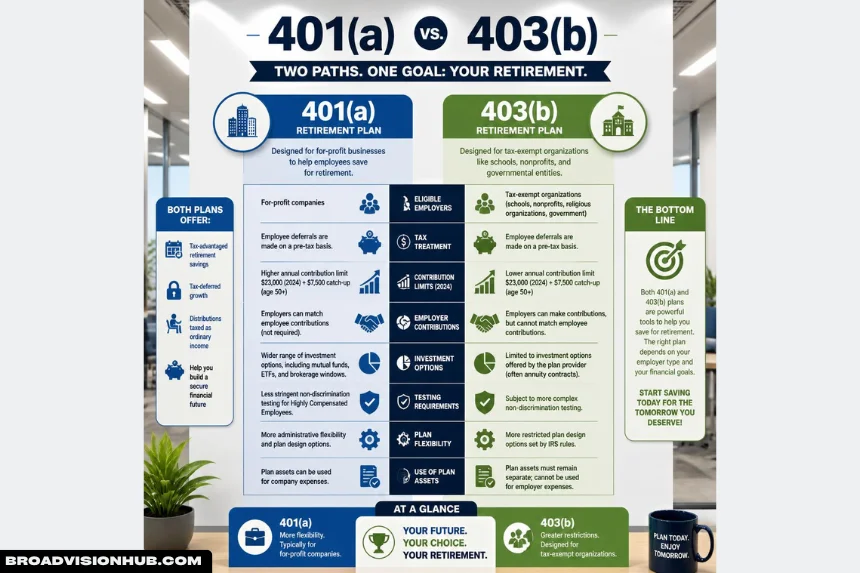
401a vs 403b at a Glance
The following table shows the most important differences.
| Feature | 401(a) | 403(b) |
|---|---|---|
| Plan type | Qualified retirement plan | Tax-advantaged retirement plan |
| Common employers | Government and public-sector employers, among others | Public schools, certain 501(c)(3) organizations, churches, and other eligible employers |
| Plan design | Largely controlled by employer | Employer establishes plan, but employees commonly control elective salary deferrals |
| Employee contributions | May be required or available depending on plan | Voluntary elective deferrals are common |
| Employer contributions | Common and plan-specific | May be available |
| Mandatory contributions | Possible | Elective salary deferrals are generally voluntary |
| Roth option | Depends on plan structure and applicable rules | May offer designated Roth contributions |
| Investment choices | Determined by employer’s plan | Determined by employer’s plan |
| Vesting | Employer contributions may have vesting requirements | Employer contributions may have vesting requirements |
| Can you have both? | Yes | Yes |
| 2026 elective-deferral limit | Does not work like the standard 403(b) elective-deferral limit | $24,500 for ordinary elective salary deferrals |
| 2026 defined-contribution annual-additions limit | Applicable Section 415 limits may apply | Generally $72,000 or 100% of includible compensation, subject to applicable rules |
For 2026, the IRS increased the general 403(b) elective-deferral limit to $24,500. In addition, the defined-contribution annual-additions limit increased to $72,000. These figures represent different limits and should not be treated as interchangeable.
Therefore, someone should not assume that a $72,000 annual-additions limit means they can personally defer $72,000 of salary into either account.
What Is a 401(a) Plan?
A 401(a) plan is an employer-sponsored qualified retirement plan established under Section 401(a) of the Internal Revenue Code.
These plans are especially common in the public sector. For example, state and local government employers may use 401(a) plans as part of their employee retirement systems. The IRS specifically states that public employers may establish Section 401(a) qualified plans.
Unlike a typical employee-directed salary-deferral account, however, a 401(a) often gives the employer considerable control over its design.
The employer’s plan may determine:
- who participates;
- whether employee contributions are required;
- how much the employer contributes;
- the contribution formula;
- available investments;
- vesting requirements;
- distribution rules.
As a result, two workers with accounts labelled “401(a)” can have significantly different retirement-plan arrangements.

Who Typically Gets a 401(a)?
401(a) plans are frequently associated with government and public-sector employment.
For example, they may appear in retirement benefit packages for employees of:
- state governments;
- local governments;
- public agencies;
- educational institutions;
- public universities;
- other organizations with qualified retirement arrangements.
However, the employer’s plan controls eligibility. Therefore, merely working in the public sector does not mean every employee automatically receives the same type of 401(a).
Additionally, a 401(a) can serve different purposes from one employer to another. One organization might use it primarily for employer contributions. Another could require eligible employees to contribute a specified percentage of compensation.
That flexibility is one reason 401(a) plans can seem more complicated than 403(b) accounts.
Who Contributes to a 401(a)?
Depending on the plan, a 401(a) can receive several types of contributions.
For example, contributions may include:
Employer contributions:
The employer contributes money according to a formula established by the plan.
Mandatory employee contributions:
The employee may be required to contribute a certain amount or percentage under the terms of the retirement system.
Employer “pick-up” contributions:
In certain governmental arrangements, contributions designated as employee contributions may be treated as employer contributions when specific requirements are satisfied.
The IRS explains that governmental retirement arrangements may involve mandatory employee contributions and employer “pick-up” contributions under Section 414(h)(2). Moreover, employees generally cannot simply opt to receive qualifying picked-up contributions as cash instead.
Therefore, the statement that “only employers contribute to 401(a) plans” is inaccurate.
Instead, the correct answer is:
Who contributes to a 401(a) depends on the employer’s plan design.
Are 401(a) Contributions Mandatory?
They can be, but they are not universally mandatory.
Some 401(a) arrangements require eligible employees to make contributions. In other cases, the employer may provide the primary contribution.
Consequently, employees should check their plan documents rather than relying on a general internet rule.
For instance, suppose a public employer requires an employee to contribute 5% of eligible compensation to a 401(a), while the employer contributes another percentage. In that hypothetical arrangement, participation and contribution rules are largely predetermined.
However, another employer could structure its 401(a) differently.
This employer-controlled design is one of the most important concepts when comparing 401a vs 403b.
What Is a 403(b) Plan?
A 403(b) plan is a tax-advantaged retirement plan available to employees of certain eligible organizations.
According to the IRS, eligible arrangements can include employees of public schools and certain tax-exempt organizations, as well as certain ministers. Public educational organizations can include public schools, state colleges, and universities.
403(b) plans are sometimes called tax-sheltered annuity plans. However, modern 403(b) arrangements can offer various investment structures depending on the plan.
Most importantly for this comparison, a 403(b) commonly allows an eligible employee to decide how much salary to defer, subject to IRS limits and employer-plan rules.
Therefore, employees generally have more direct control over elective contributions than they would under a mandatory 401(a) contribution arrangement.
Who Can Participate in a 403(b)?
Eligibility depends on the organization and plan.
Common eligible groups can include employees of:
- public school systems;
- state colleges and universities;
- qualifying 501(c)(3) organizations;
- churches and certain church-related organizations;
- other eligible tax-exempt organizations.
Certain ministers can also qualify under the federal rules.
For example, the IRS confirms that both faculty members and nonacademic employees of qualifying public educational organizations can potentially participate when they meet the applicable requirements.
Nevertheless, an employer must actually maintain a 403(b) plan before an employee can contribute to one.
How Do 403(b) Contributions Work?
A major feature of a 403(b) is the ability to make elective salary deferrals.
In simple terms, the employee chooses to direct part of eligible pay into the retirement plan instead of receiving that amount as current cash compensation.
For 2026, the basic employee elective-deferral limit for a 403(b) is $24,500. Moreover, eligible participants may qualify for catch-up contributions beyond that basic amount.
A 403(b) may include several contribution sources:
- employee pre-tax elective deferrals;
- designated Roth contributions when offered;
- employer matching contributions;
- employer nonelective contributions;
- certain after-tax contributions where applicable.
The IRS confirms that a 403(b)’s annual-additions calculation can include elective deferrals, nonelective contributions, and after-tax contributions.
Therefore, describing a 403(b) as “employee contributions only” would also be misleading.
Are 403(b) Contributions Mandatory?
Employee elective salary deferrals are generally based on an employee’s election.
In other words, an eligible employee commonly chooses whether to contribute and how much to defer, subject to the plan and federal limits.
However, employers can structure broader retirement benefit packages in different ways. For example, an employee could participate in a mandatory retirement arrangement through one plan while separately choosing whether to make elective contributions to a 403(b).
This distinction helps explain why some public employees see both a 401(a) and 403(b) when reviewing their workplace benefits.
401a vs 403b: The 8 Most Important Differences
Although both plans can support retirement savings, several differences affect how employees actually use them.
1. Employee Eligibility
The first major difference involves who can participate.
401(a) plans can be established as qualified employer retirement plans and are particularly common among governmental employers.
In contrast, 403(b) eligibility is tied to specific categories of organizations and workers. For example, the IRS identifies public schools, qualifying tax-exempt organizations, and certain ministers among eligible 403(b) participants.
Therefore, a private-sector employee cannot assume that a 403(b) is available simply because they want one.
Likewise, employees generally cannot open either workplace plan independently in the same way they might open an IRA.
2. Who Controls Contributions?
The second major difference is control.
With a 401(a), the employer commonly has greater control over the contribution structure. For example, the plan may establish a required employee contribution rate or specify an employer contribution formula.
A 403(b), on the other hand, commonly lets the employee choose how much salary to defer.
As a result, the 403(b) often functions as the more flexible voluntary-savings account when an employer offers both.
Consider this hypothetical arrangement:
A public university automatically contributes money for an eligible worker through a 401(a). Meanwhile, the employee chooses to contribute an additional percentage of salary to a 403(b).
In that situation, the accounts complement one another rather than compete with each other.
3. Mandatory vs Voluntary Contributions
This distinction is especially important.
A 401(a) can include mandatory employee contributions. Therefore, an employee may have little or no choice about a required contribution once eligible for the retirement system.
By contrast, 403(b) elective salary deferrals are generally voluntary. The employee normally decides whether to defer pay and how much to contribute, within applicable limits.
However, these descriptions are general patterns rather than universal rules.
Consequently, your Summary Plan Description and other official benefits materials should take priority over a generic 401(a)-versus-403(b) comparison.
4. Employer Contributions
Both plans can receive employer money.
However, employer contributions are particularly common in 401(a) arrangements because employers often use these plans to provide a structured retirement benefit.
For instance, an employer could contribute a fixed percentage of eligible compensation or use another formula specified in the plan.
Meanwhile, a 403(b) may also receive:
- matching contributions;
- nonelective employer contributions;
- other permitted employer funding.
Therefore, the presence of an employer contribution does not, by itself, tell you whether an account is a 401(a) or 403(b).
5. Contribution Limits
Another major difference concerns how federal contribution limits apply.
For a 403(b), the IRS establishes a specific employee elective-deferral limit. In 2026, that basic limit is $24,500. Additionally, eligible older workers may make catch-up contributions.
Meanwhile, the broader defined-contribution annual-additions limit is $72,000 for 2026, subject to applicable compensation and aggregation rules.
However, this does not mean an employee has a simple personal $72,000 salary-deferral limit for a 401(a).
Instead, 401(a) contribution calculations depend on:
- the type of contribution;
- the employer’s plan;
- compensation;
- applicable Section 415 rules;
- other plans that may need to be aggregated.
Therefore, contribution limits deserve a dedicated explanation rather than a misleading one-line comparison.
6. Catch-Up Contributions
The 403(b) has another important feature: eligible employees can potentially make contributions above the normal elective-deferral limit.
For 2026, the standard catch-up amount for eligible participants age 50 or older is $8,000. Furthermore, SECURE 2.0 provides a higher catch-up limit for qualifying participants who reach ages 60 through 63 during the calendar year.
Some long-service 403(b) participants may also qualify for a special 15-year service catch-up when their plan permits it and IRS requirements are met.
These provisions make 403(b) contribution planning more complex than simply looking at the standard $24,500 figure.
7. Investment Choices
Investment options for both 401(a) and 403(b) plans depend substantially on the employer’s plan.
Therefore, neither account type automatically has better investments.
One employer may provide a broad selection of low-cost investment funds. Another may offer a smaller menu.
Consequently, employees comparing plans should examine factors such as:
- available investment funds;
- expense ratios;
- administrative fees;
- target-date funds;
- annuity options where applicable;
- diversification choices.
In other words, the plan label alone does not determine investment quality.
8. Vesting Rules
Finally, employees should understand vesting.
Vesting determines when certain employer-provided retirement benefits permanently belong to the employee.
For example, a plan could require an employee to complete a specified period of service before becoming fully vested in certain employer contributions.
Therefore, someone considering a job change should not look only at the account balance. They should also determine how much of the employer-funded portion is vested.
Importantly, vesting rules vary by plan. As a result, the employer’s official retirement-plan documents provide the most reliable answer for a specific employee.
The Bottom Line So Far
When asking what is the difference between 401a and 403b, the most useful distinction is control and purpose.
A 401(a) is generally more employer-directed. The employer establishes the plan’s contribution structure, and mandatory contributions may apply.
A 403(b), meanwhile, commonly provides eligible employees with more control over voluntary salary deferrals. Moreover, employers can contribute to a 403(b), so it should not be viewed as an employee-only account.
Most importantly, the plans can work together. Therefore, having both a 401(a) and a 403(b) does not necessarily mean you need to choose one and ignore the other.
The next step is understanding 2026 contribution limits, catch-up rules, whether you can contribute to both plans, how the limits interact, and why employers sometimes offer both accounts.
401a vs 403b Contribution Limits for 2026
Contribution limits are one of the most important—and most misunderstood—parts of the 401a vs 403b comparison.
At first glance, you may see a $72,000 limit associated with defined-contribution plans and a $24,500 limit associated with 403(b) plans. However, these figures measure different things.
The $24,500 figure is the 2026 employee elective-deferral limit for a 403(b). In contrast, $72,000 is the general 2026 annual-additions limit for defined-contribution plans under Section 415(c). Annual additions can include several contribution sources rather than only money voluntarily deferred from an employee’s paycheck.
Therefore, you should not simply compare $72,000 with $24,500 and conclude that a 401(a) lets an employee personally contribute almost three times as much.
401(a) Contribution Limit for 2026
For a defined-contribution 401(a) arrangement, applicable Section 415 limits generally restrict total annual additions.
For 2026, the defined-contribution annual-additions dollar limit is:
$72,000
The general Section 415 framework also considers compensation. For applicable defined-contribution plans, annual additions generally cannot exceed the lesser of the federal dollar limit or 100% of the participant’s compensation, subject to the specific rules that apply to the plan.
Annual additions can include amounts such as:
- employer contributions;
- certain employee contributions;
- employer matching or nonelective contributions where applicable;
- other amounts counted under Section 415.
However, a 401(a) is a broad qualified-plan category, and contribution structures differ significantly among employers.
For example, one governmental 401(a) might require the employee to contribute a percentage of salary while the employer contributes another percentage. Another employer could make the primary contribution itself.
Therefore, the correct question is not simply:
“How much can I personally put into a 401(a)?”
Instead, employees should ask:
“What contributions does my plan permit or require, and how do the applicable annual-additions rules apply to those contributions?”
The plan administrator or official plan document should provide that information.
403(b) Contribution Limit for 2026
The 403(b) rules are easier to understand when the limits are separated into categories.
For 2026, the basic employee elective-deferral limit is:
$24,500
This means an employee can generally elect to defer up to $24,500 of salary into a 403(b), assuming the employee has sufficient compensation and the plan allows the contribution.
However, that is not necessarily the maximum amount that can enter the account from all sources.
For 2026, the general 403(b) annual-additions limit is the lesser of:
- $72,000, or
- 100% of includible compensation for the employee’s most recent year of service.
The annual-additions calculation can include employee elective deferrals, employer nonelective contributions, and certain after-tax contributions.
Therefore, an employee might defer $24,500 while the employer contributes additional money, provided the applicable limits and plan terms are satisfied.
2026 401(a) vs 403(b) Limits at a Glance
| 2026 Limit | 401(a) Defined-Contribution Plan | 403(b) |
|---|---|---|
| Employee elective-deferral limit | Depends on plan structure; not simply the standard 403(b) limit | $24,500 |
| General defined-contribution annual-additions limit | $72,000, subject to applicable rules | $72,000, subject to applicable rules |
| Standard age-50+ catch-up | Not a universal 401(a) feature | $8,000 when eligible and permitted |
| Ages 60–63 catch-up | Not a universal 401(a) feature | $11,250 when eligible and permitted |
| Special 15-year service rule | No equivalent general 401(a) rule | May apply to qualifying 403(b) participants |
The key point is simple: elective-deferral limits and annual-additions limits are not the same thing.
403(b) Catch-Up Contributions for 2026
A 403(b) can provide additional contribution opportunities for some employees.
These rules are particularly important for workers approaching retirement.
Standard Age-50 Catch-Up
If a 403(b) plan permits catch-up contributions, an employee who is age 50 or older by the end of 2026 may generally contribute an additional:
$8,000
Therefore, the basic $24,500 elective-deferral limit plus the standard catch-up can allow an eligible participant to defer as much as:
$32,500 in 2026
subject to compensation, plan rules, and other applicable limits.
Higher Catch-Up for Ages 60 Through 63
SECURE 2.0 created a higher catch-up opportunity for certain older workers.
For 2026, an eligible employee who turns 60, 61, 62, or 63 during the calendar year may qualify for a catch-up limit of:
$11,250
instead of the standard $8,000 age-50 catch-up.
Therefore, an eligible participant in this age range could potentially make:
$24,500 basic deferral + $11,250 catch-up = $35,750
in employee elective deferrals for 2026, assuming all applicable requirements are satisfied.
Important 2026 Roth Catch-Up Rule
There is also an important change for higher-paid workers in 2026.
According to current IRS guidance, beginning in 2026, participants in plans with Roth features that offer catch-up contributions must make their catch-up contributions on a Roth basis when their prior-year wages from the sponsoring employer exceeded $150,000 for 2026 purposes.
This rule concerns catch-up contributions, not necessarily all of the employee’s regular 403(b) contributions.
Therefore, higher-paid participants should review their payroll elections and employer guidance rather than assuming every catch-up contribution can remain pre-tax.
What Is the 403(b) 15-Year Service Catch-Up?
A lesser-known 403(b) rule can allow certain long-serving employees to make additional elective deferrals.
If the plan permits the provision, an employee with at least 15 years of service with the same qualifying employer may receive an increased elective-deferral limit.
The additional amount is generally limited to the least of:
- $3,000;
- $15,000 reduced by amounts previously used under this special rule; or
- a formula based on $5,000 multiplied by years of service, reduced by prior elective deferrals.
Only certain eligible employers qualify for this special rule. Moreover, the employee must satisfy the service requirements.
Therefore, someone should not automatically add $3,000 to their 403(b) limit simply because they have worked for the same employer for 15 years.
The plan must permit the catch-up, and the employee must qualify.
Additionally, if someone qualifies for both the 15-year service increase and an age-based catch-up, special ordering rules apply.
Can You Have Both a 401(a) and 403(b)?
Yes, an employee can have both a 401(a) and a 403(b).
In fact, the two plans may be designed to work together.
For example, a public university, school system, government organization, or other eligible employer might use a 401(a) for its core retirement contribution structure while also offering a 403(b) for voluntary employee savings.
A hypothetical benefits package could work like this:
401(a): The employer automatically contributes a percentage of eligible compensation, while the employee may also have a required contribution.
403(b): The employee chooses whether to defer additional salary for retirement.
As a result, the employee is not necessarily choosing between a 401(a) and 403(b).
Instead, each account may serve a different purpose.
This distinction is one of the most important answers to what is the difference between 401a and 403b.
Can You Contribute to Both a 401(a) and 403(b)?
Potentially, yes. However, the answer depends on what type of contribution is going into the 401(a), how the employer structured both plans, and which federal contribution limits apply.
For example, an employee might have mandatory contributions placed into a governmental 401(a) while voluntarily deferring salary into a 403(b).
Nevertheless, contribution limits become more complicated when someone participates in several employer retirement arrangements.
The IRS applies different rules to:
- elective deferrals;
- annual additions;
- employer contributions;
- employee contributions;
- catch-up contributions;
- plans maintained by the same or related employers;
- certain situations involving multiple employers.
Therefore, you should not simply add the maximum figures for two retirement plans together and assume that total amount is automatically permitted.
For 403(b)s specifically, the IRS notes that annual-additions calculations and coordination can depend on whether accounts are maintained by the same employer and on other facts surrounding plan ownership and employment.
Consequently, someone who is trying to maximize contributions across both a 401(a) and 403(b) should verify the numbers through the employer’s benefits office or plan administrator.
Why Would an Employer Offer Both a 401(a) and 403(b)?
At first, two workplace retirement accounts may appear unnecessarily complicated.
However, offering both can allow an employer to separate different retirement-saving functions.
The 401(a) Can Provide the Core Retirement Benefit
For example, an employer might use a 401(a) to establish a predictable contribution structure.
The arrangement could include:
- employer contributions;
- mandatory employee contributions;
- employer pick-up contributions in qualifying governmental arrangements;
- a predetermined contribution formula.
The IRS recognizes mandatory employee contributions and qualifying employer “pick-up” arrangements within governmental retirement systems.
Therefore, the 401(a) may form the foundation of the employee’s workplace retirement benefit.

The 403(b) Can Provide Additional Voluntary Savings
Meanwhile, the 403(b) can allow employees to decide how much additional salary they want to save.
For example, an employee might choose to defer:
- 3% of salary;
- 6% of salary;
- a fixed dollar amount each paycheck; or
- enough to reach the annual IRS limit.
The actual options depend on the employer’s payroll system and plan rules.
As a result, the 403(b) can give an employee more control over additional retirement savings while the 401(a) handles another part of the employer’s retirement program.
401a vs 403b Employer Contributions
Employer contributions can exist in both account types.
However, they commonly play a particularly important role in 401(a) arrangements.
Employer Contributions to a 401(a)
A 401(a) plan may use an employer contribution formula established in advance.
For example, an employer might contribute:
- a fixed percentage of compensation;
- an amount related to the employee’s required contribution;
- a contribution based on employment classification;
- another amount specified by the plan.
Governmental employers may also use qualifying employer “pick-up” arrangements for certain contributions designated as employee contributions. Under Section 414(h)(2), qualifying picked-up amounts can be treated as employer contributions for federal income-tax purposes when the requirements are satisfied.
However, the exact tax and payroll treatment depends on the arrangement.
Employer Contributions to a 403(b)
A 403(b) can also receive employer contributions.
Depending on the plan, an employer could make:
- matching contributions;
- nonelective contributions;
- other permitted contributions.
Therefore, the statement that “employers fund the 401(a) while employees fund the 403(b)” is too simplistic.
A better rule is:
401(a) contribution structures are generally more employer-directed, while 403(b)s commonly provide employees with elective salary-deferral flexibility.
401a vs 403b Vesting
Vesting becomes important whenever an employer contributes money to a retirement plan.
In simple terms, vesting determines how much of certain employer-funded benefits you permanently own.
For example, suppose an employer has contributed $20,000 to an employee’s retirement account. If the employee is only 60% vested when leaving the job, the plan’s vesting rules could affect how much of that employer-provided amount the employee keeps.
However, vesting schedules depend on the plan and the applicable legal requirements.
Common arrangements can include:
Immediate vesting:
The employer contribution belongs to the employee as soon as it is credited.
Graded vesting:
Ownership increases gradually as the employee completes more years of service.
Cliff vesting:
The participant becomes fully vested after completing a specified service requirement.
Therefore, an employee should never assume the total balance displayed on an account statement equals the exact amount they could take when leaving employment.
Instead, check the vested balance.
Why Vesting Matters When Comparing Jobs
Imagine that Employer A offers a larger 401(a) contribution but requires a longer vesting period.
Meanwhile, Employer B provides a smaller contribution but offers immediate vesting.
The larger contribution is not automatically the better benefit if you expect to leave before becoming fully vested.
Therefore, when evaluating a new job, compare:
- contribution percentage;
- vesting schedule;
- employee contribution requirements;
- investment choices;
- administrative fees;
- salary and other benefits.
This produces a much more useful comparison than focusing on the account name alone.

401a vs 403b Tax Differences
Both plans can provide valuable tax advantages, but tax treatment depends on the type of contribution.
Traditional 403(b) Contributions
Traditional employee elective deferrals to a 403(b) generally reduce the amount included in current federal taxable income for income-tax purposes.
Instead, applicable taxes are generally deferred until taxable distributions occur.
Therefore, traditional contributions can reduce current taxable income while allowing retirement savings to grow on a tax-deferred basis.
However, tax deferral does not mean the money is permanently tax-free.
Roth 403(b) Contributions
Some 403(b) plans allow designated Roth contributions.
With Roth contributions, the employee generally pays applicable income tax on the contribution now. In exchange, qualified Roth distributions can receive tax-free federal income-tax treatment when applicable requirements are met.
Therefore, choosing between traditional and Roth 403(b) contributions involves more than simply asking which reduces taxes today.
The decision can depend on:
- current tax rate;
- expected future tax circumstances;
- years until retirement;
- other taxable income;
- whether the plan offers a Roth option.
401(a) Tax Treatment
401(a) tax treatment depends heavily on the contribution source.
For example, employer contributions are generally treated differently from certain employee after-tax contributions.
Additionally, governmental Section 401(a) plans can use qualifying employer “pick-up” contributions under Section 414(h)(2). When the federal requirements are satisfied, these amounts can receive employer-contribution treatment for federal income-tax purposes.
Therefore, employees should avoid assuming that every deduction shown under a 401(a) receives exactly the same tax treatment.
Their payroll department and plan documentation can explain how their particular contributions are treated.
401a vs 403b Withdrawal Rules
Both retirement plans are designed primarily for long-term retirement savings.
As a result, employees generally cannot treat either account like an ordinary savings account.
However, distribution rules depend on the plan type, contribution source, and specific plan document.
403(b) Withdrawals
The IRS explains that a 403(b) plan may permit distributions after certain events, including:
- reaching age 59½;
- severance from employment;
- disability;
- death;
- qualifying financial hardship.
However, a plan is not necessarily required to offer every distribution option permitted by federal law.
Therefore, there are two separate questions:
- Does federal law permit a distribution?
- Does your particular plan allow that distribution?
Both must be considered.
401(a) Withdrawals
Because a 401(a) can take different qualified-plan forms, the distribution rules can vary.
The IRS explains that qualified retirement plans generally specify their own allowable distributable events within federal requirements. Depending on the underlying plan type, permitted events may include termination of employment, reaching a specified age, disability, retirement, or other events authorized under the plan.
Consequently, it is risky to say:
“Every 401(a) lets you withdraw at age 59½.”
Instead, consult the plan’s Summary Plan Description.
What About the 10% Early-Distribution Tax?
A separate issue is the federal additional tax on early distributions.
Generally, taxable retirement-plan distributions received before age 59½ may face a 10% additional federal tax unless an exception applies.
However, several exceptions can apply.
For example, certain qualified-plan distributions made after an employee separates from service in or after the year the employee reaches age 55 can qualify for an exception to the additional tax.
Therefore, “when the plan lets you withdraw” and “whether an additional tax applies” should not be treated as the same question.
Can You Borrow From a 401(a) or 403(b)?
A retirement plan may allow participant loans, but loans are not automatically available.
For a 403(b), the IRS specifically states that the plan may, but is not required to, allow loans.
Similarly, certain qualified defined-contribution plans can provide participant loans when their plan documents permit them. The IRS recommends checking with the plan sponsor or reviewing the Summary Plan Description to determine whether loans are available.
Therefore, an employee should never assume that having money in a retirement account means they can borrow against it.
Moreover, retirement-plan loans have rules concerning:
- maximum amounts;
- repayment periods;
- repayment schedules;
- interest;
- defaults;
- job separation.
If a loan fails to satisfy applicable rules or is not properly repaid, tax consequences can result.
Can You Roll Over a 401(a) or 403(b)?
In many cases, eligible distributions from qualified retirement plans and 403(b) plans can be rolled into another eligible retirement arrangement.
Common destinations can include:
- another qualified employer retirement plan that accepts rollovers;
- another 403(b) where permitted;
- a traditional IRA;
- a Roth IRA, although conversion-related tax consequences may apply.
However, not every distribution is eligible for rollover.
The IRS identifies several distributions that generally cannot be rolled over, including:
- required minimum distributions;
- hardship distributions;
- certain substantially equal periodic payments;
- certain corrective distributions;
- some loan-related deemed distributions.
Therefore, an employee should confirm that the payment qualifies as an eligible rollover distribution before moving the money.
Direct Rollover vs Receiving the Money Yourself
A direct rollover usually means the retirement plan sends eligible funds directly to the receiving retirement account.
This can simplify the tax process.
By contrast, when a taxable eligible rollover distribution is paid directly to the participant, federal rules generally require 20% withholding. The participant normally has 60 days to complete an eligible rollover and would need to replace withheld funds from another source to roll over the entire taxable amount.
Therefore, a direct rollover is often operationally simpler when a rollover is appropriate.
What Happens to a 401(a) or 403(b) When You Leave Your Job?
Leaving an employer does not automatically mean your retirement savings disappear.
However, your available choices depend on the account, balance, plan terms, vesting, and type of distribution.
Common possibilities may include:
Leave the Money in the Existing Plan
Some former employees can keep vested assets in their former employer’s plan.
This may be attractive when the plan has:
- low fees;
- strong institutional investments;
- useful retirement features;
- investment options not easily available elsewhere.
However, account-balance rules and plan provisions matter.
Roll Eligible Funds Into a New Employer Plan
A new employer’s retirement plan may accept rollovers.
However, receiving plans are not required to accept every incoming rollover. The IRS notes that the receiving plan’s document must permit the rollover and the funds must qualify.
Therefore, check the new plan before initiating the transfer.
Roll Eligible Funds Into an IRA
Eligible retirement-plan distributions can often be rolled into an IRA.
An IRA may offer:
- broader investment selection;
- consolidation of old workplace accounts;
- different fees and services.
However, moving money to an IRA can also change creditor protections, investment options, withdrawal rules, fees, and future planning opportunities.
Therefore, an IRA rollover should not automatically be treated as better than leaving money in an employer plan.
Take a Cash Distribution
An employee may sometimes choose a cash distribution when the plan permits it.
However, taxable amounts that are not rolled over generally become taxable income. Furthermore, an additional early-distribution tax may apply when no exception is available.
Consequently, cashing out retirement savings can have immediate tax costs and reduce long-term retirement assets.
Practical Example: Using a 401(a) and 403(b) Together
Consider a hypothetical employee named Jordan who works for a public university.
The university’s retirement package might work as follows:
401(a):
The university contributes a predetermined percentage of Jordan’s eligible compensation. Jordan may also have a required employee contribution under the plan.
403(b):
Jordan separately chooses to defer part of each paycheck into a 403(b).
In this example, the 401(a) provides the employer-designed core retirement benefit.
Meanwhile, the 403(b) gives Jordan additional control over voluntary retirement savings.
Therefore, asking:
“Should Jordan choose the 401(a) or the 403(b)?”
may be the wrong question.
A better question is:
“How do the two plans work together within Jordan’s overall retirement package?”
Of course, this is only a hypothetical example. Actual employer plans may use different contribution formulas, eligibility requirements, vesting schedules, investments, and distribution rules.
Is a 401(a) Better Than a 403(b)?
Neither plan is automatically better.
In many cases, employees do not even have to choose one instead of the other.
A 401(a) may be especially valuable when the employer makes substantial contributions. Meanwhile, a 403(b) may be valuable because it allows the employee to voluntarily increase retirement savings.
Therefore, compare the actual benefits rather than the plan names.
Important factors include:
| Factor | What to Check |
| Employer contribution | How much does the employer add? |
| Required contribution | Must you contribute to the 401(a)? |
| Voluntary savings | How much can you elect to put into the 403(b)? |
| Vesting | When do employer contributions become fully yours? |
| Investments | Which funds or other options are available? |
| Fees | What administrative and investment costs apply? |
| Roth option | Does the 403(b) offer Roth contributions? |
| Loans | Does either plan permit participant loans? |
| Distribution rules | When can you access the account? |
| Rollover rules | What happens after leaving employment? |
Ultimately, a well-funded 401(a) and a flexible 403(b) can complement each other rather than compete.
What Should You Do If Your Employer Offers Both?
If your employer offers both plans, start by understanding exactly what each account does.
1. Check Whether Your 401(a) Contribution Is Mandatory
Review the employee contribution percentage and whether you can change it.
If contributions are mandatory, that amount should already be part of your retirement-planning calculation.
2. Identify the Employer Contribution
Determine:
- how much your employer contributes;
- which account receives it;
- whether there is a matching formula;
- whether service requirements apply.
3. Review Your 403(b) Contribution Election
Next, determine how much additional salary you can reasonably save.
For 2026, remember that the basic 403(b) elective-deferral limit is $24,500, with additional catch-up opportunities for qualifying employees.
4. Check Your Vesting Schedule
If employer contributions are not immediately vested, determine when you will become fully vested.
This is especially important if you may change jobs.
5. Compare Investment Fees
Look beyond fund performance.
Also review:
- expense ratios;
- administration fees;
- annuity charges where relevant;
- surrender charges where applicable;
- advisory fees;
- other plan expenses.
6. Verify Your Contribution Limits
Employees participating in multiple retirement arrangements should not rely solely on an online calculator.
Instead, verify applicable limits with the employer or plan administrator, particularly when trying to maximize contributions.
7. Read the Official Plan Documents
Finally, obtain the Summary Plan Description or equivalent official benefits documentation.
Generic explanations can show what is the difference between 401a and 403b, but only your employer’s documents can tell you precisely:
- what you must contribute;
- what your employer contributes;
- when you vest;
- which investments you can choose;
- whether loans are available;
- when distributions are allowed;
- what rollover options your plan permits.
Therefore, the official plan documentation should always take priority when making decisions about your specific accounts.
401a vs 403b: Which Plan Gives You More Control?
When comparing 401a vs 403b, a 403(b) generally gives employees more direct control over voluntary salary contributions.
With a 403(b), eligible employees commonly decide:
- whether to contribute;
- how much salary to defer;
- whether to use traditional or Roth contributions when both are available;
- how to allocate contributions among available investments.
A 401(a), meanwhile, is often more employer-directed. For example, an employer may determine the contribution formula, require employee contributions, establish eligibility rules, and select the investment menu.
However, greater control does not automatically make a 403(b) better.
Suppose an employer makes a substantial contribution to a 401(a). In that case, the employer-funded benefit could be extremely valuable even though the employee has less control over the contribution structure.
Therefore, employees should compare the actual benefits rather than judging the plans solely by flexibility.
401(a) vs 403(b): Final Comparison
The following summary brings the most important differences together.
| Question | 401(a) | 403(b) |
|---|---|---|
| Who establishes it? | Employer | Eligible employer |
| Who commonly uses it? | Government/public-sector and other eligible employers | Public schools, certain nonprofits, churches and other eligible organizations |
| Are employee contributions voluntary? | Depends on plan; contributions may be mandatory | Elective salary deferrals are generally voluntary |
| Can employer contribute? | Yes | Yes |
| Can employee contribute? | Depending on plan structure | Yes, through elective deferrals when permitted |
| Who controls contribution structure? | Usually employer has greater control | Employee generally has more control over elective deferrals |
| 2026 standard 403(b)-style elective-deferral limit | Not automatically applicable as a 401(a) employee deferral limit | $24,500 |
| 2026 annual-additions limit | Generally subject to applicable $72,000 Section 415 limit | Generally $72,000 or applicable compensation limit |
| Age-50 catch-up | Not a universal 401(a) feature | $8,000 in 2026 when eligible |
| Ages 60–63 catch-up | Not a universal 401(a) feature | $11,250 in 2026 when eligible |
| 15-year service catch-up | No equivalent general provision | Available to certain eligible participants |
| Roth contributions | Depends on plan design and contribution arrangement | May be offered |
| Employer vesting rules | May apply | May apply to employer money |
| Loans | May be offered by qualifying plans | May be offered |
| Rollovers | Eligible distributions may generally qualify | Eligible distributions may generally qualify |
| Can you have both? | Yes | Yes |
For 2026, the IRS confirms a $24,500 elective-deferral limit for 403(b) plans, an $8,000 standard age-50 catch-up, an $11,250 catch-up for qualifying participants ages 60 through 63, and a $72,000 defined-contribution annual-additions limit.
Frequently Asked Questions About 401(a) vs 403(b)
What is the main difference between a 401a and 403b?
The main difference is how the plans are typically structured. A 401(a) generally gives the employer greater control over contributions and participation rules. In contrast, a 403(b) commonly allows eligible employees to voluntarily defer part of their salary into the retirement plan.
However, both accounts can receive employer contributions, and exact rules depend on the individual plan.
Can I have a 401a and 403b at the same time?
Yes. An employer can offer both a 401(a) and a 403(b).
For example, an employer could use a 401(a) for employer or mandatory contributions while offering a 403(b) for voluntary salary deferrals.
Therefore, having both accounts does not necessarily mean you must choose between them.
Can I contribute to both a 401a and 403b?
Potentially, yes.
For example, an employee might make mandatory contributions to a 401(a) while also electing salary deferrals to a 403(b).
However, contribution limits depend on the type of contribution and the retirement plans involved. Consequently, employees who participate in several plans should verify applicable limits with their employer or plan administrator.
Does a 401a affect my 403b contribution limit?
Not automatically in the simple sense that every dollar entering a 401(a) reduces the $24,500 403(b) elective-deferral limit.
The 403(b) elective-deferral limit applies to salary deferrals, and elective deferrals to certain other retirement plans must be coordinated. Separately, annual-additions and plan-aggregation rules can apply depending on the plans, employers, and contribution types involved. IRS Publication 571 specifically provides additional aggregation rules for people participating in 403(b)s and qualified plans in certain circumstances.
Therefore, employees with both accounts should avoid calculating their maximum contribution by simply adding or subtracting headline limits.
What is the 403b contribution limit for 2026?
The basic employee elective-deferral limit for a 403(b) is $24,500 in 2026.
Eligible employees age 50 or older can generally make an additional $8,000 catch-up contribution when the plan permits it.
Moreover, eligible workers who turn 60, 61, 62, or 63 during 2026 have a higher catch-up limit of $11,250 instead of $8,000.
What is the 401a contribution limit for 2026?
For defined-contribution arrangements subject to Section 415(c), the general annual-additions dollar limit is $72,000 in 2026, subject to applicable compensation, plan, and aggregation rules.
However, that does not mean an employee can automatically elect to defer $72,000 of salary into a 401(a).
Employer contributions, employee contributions, and other amounts may count toward the applicable annual-additions limit depending on the plan.
Is a 401a better than a 403b?
Neither is automatically better.
A 401(a) may provide valuable employer contributions. Meanwhile, a 403(b) can offer employees more flexibility to increase their own retirement savings.
Therefore, compare:
- employer contributions;
- required employee contributions;
- vesting;
- fees;
- investments;
- tax options;
- withdrawal provisions;
- voluntary contribution opportunities.
In many workplaces, the plans complement each other rather than compete.
Is a 401a like a pension?
A 401(a) should not automatically be described as the same thing as a traditional pension.
Section 401(a) contains qualification requirements for employer retirement plans, and the term can cover different plan structures. Many accounts commonly described as 401(a) plans are defined-contribution arrangements in which contributions go into an individual employee account.
In contrast, a traditional defined-benefit pension generally promises a retirement benefit calculated under a plan formula.
Therefore, check the actual plan type rather than assuming that the label “401(a)” means traditional pension.
Who owns the money in a 401a?
Employee contributions are generally subject to the plan’s applicable ownership rules, while employer-provided benefits may be subject to a vesting schedule.
Therefore, your displayed account balance and your vested account balance may not always be identical.
Your employer’s official plan documentation should explain when employer contributions become fully vested.
Can you lose 401a money if you quit?
You generally do not simply lose vested retirement benefits because you leave a job.
However, if part of an employer contribution has not yet vested, the plan’s vesting rules may cause you to forfeit some or all of that unvested amount.
Therefore, employees considering a job change should check their vesting status first.
Can a 401a be rolled into an IRA?
An eligible rollover distribution from a qualified employer plan can generally be rolled into an eligible retirement arrangement such as an IRA.
However, not every payment qualifies for rollover. For example, required minimum distributions and certain other distributions are excluded from eligible rollover treatment.
Additionally, the employee usually must first have a distributable event under the plan.
Can a 403b be rolled into an IRA?
Yes, eligible 403(b) distributions can generally be rolled into an IRA.
A direct rollover can move eligible money directly between retirement arrangements. Additionally, certain amounts can potentially be converted to a Roth IRA, although taxable conversion amounts may create current income-tax consequences.
Therefore, consider both tax consequences and investment differences before choosing a rollover destination.
Can I roll a 401a into a 403b?
Potentially.
A 403(b) can generally accept qualifying rollovers from eligible retirement plans when the receiving 403(b) plan allows incoming rollovers.
However, the receiving plan does not have to accept every rollover. Therefore, verify its rules before initiating a transfer.
Can I roll a 403b into a 401a?
Potentially, if the 401(a) arrangement is an eligible qualified plan, the distribution qualifies for rollover, and the receiving plan accepts incoming rollovers.
Again, plan rules matter.
Therefore, confirm eligibility with both plan administrators before moving funds.
Can you borrow from a 401a?
Some qualified employer retirement plans may permit participant loans.
However, a loan feature is not automatically available simply because the account is a 401(a).
Therefore, check your Summary Plan Description or contact the plan administrator.
Can you borrow from a 403b?
A 403(b) may allow participant loans, but federal law does not require every 403(b) plan to offer them.
Consequently, your employer’s plan documents determine whether borrowing is available.
What happens to a 401a when you leave your employer?
Your choices depend on your plan and account.
Potential options may include:
- keeping vested funds in the existing plan when permitted;
- rolling eligible money into a new employer plan;
- rolling eligible funds into an IRA;
- taking a distribution.
However, cash distributions can create income-tax consequences and potentially an additional early-distribution tax when no exception applies.
Therefore, leaving a job does not necessarily mean you should immediately cash out the account.
What happens to a 403b when you leave your job?
Separation from employment can create a distributable event under a 403(b).
Depending on the plan, you may be able to leave the money where it is, roll eligible funds into another retirement arrangement, or take a distribution.
A direct rollover can also avoid the mandatory 20% federal withholding that generally applies when certain taxable eligible rollover distributions are paid directly to the participant.
Does a 403b have required minimum distributions?
Generally, employer-sponsored retirement plans, including 403(b) plans, are subject to required minimum distribution rules.
However, designated Roth accounts in employer plans are no longer subject to lifetime RMDs for the original owner. Beneficiary distribution rules still apply after death.
The timing of an individual’s first RMD depends on age, employment status, plan provisions, and applicable federal rules.
Can a 401a and 403b both appear on the same paycheck?
Yes.
For example, an employee could see a required retirement contribution connected with a 401(a) while also seeing an elected 403(b) salary deferral.
Therefore, two retirement deductions on a paycheck do not necessarily represent duplicate accounts or an error.
The employer’s benefits or payroll department can identify exactly what each deduction represents.
Key Takeaways: 401a vs 403b
When comparing these retirement accounts, remember five points.
First, a 401(a) is generally more employer-directed. Employers commonly establish the contribution formula and can require employee participation.
Second, a 403(b) commonly provides voluntary salary-deferral flexibility. Eligible employees can generally decide how much salary to contribute within applicable limits.
Third, both plans can receive employer contributions. Therefore, the idea that a 401(a) is only employer-funded while a 403(b) is only employee-funded is incorrect.
Fourth, you can potentially have both plans. In fact, some employers intentionally use the accounts together.
Finally, plan documents matter. Contribution requirements, vesting, investment choices, loans, distributions, and rollover options can differ from one employer to another.
Conclusion: What Is the Difference Between 401a and 403b?
So, what is the difference between 401a and 403b plans?
A 401(a) is generally an employer-designed qualified retirement arrangement in which the employer has considerable control over participation and contribution rules. Employee contributions may even be mandatory. A 403(b), in contrast, is available through eligible organizations such as public schools and certain tax-exempt employers and commonly gives workers greater control over voluntary salary deferrals.
However, the plans are not necessarily alternatives. An employer can use a 401(a) as part of its core retirement benefit while simultaneously offering a 403(b) for additional employee savings.
For 2026, the standard 403(b) elective-deferral limit is $24,500, while the general defined-contribution annual-additions limit is $72,000. These are different limits and should not be confused.
Ultimately, the best way to understand your benefits is to review your employer’s official plan documents. Check contribution requirements, employer funding, vesting, fees, investment options, tax treatment, and distribution rules before making retirement decisions.