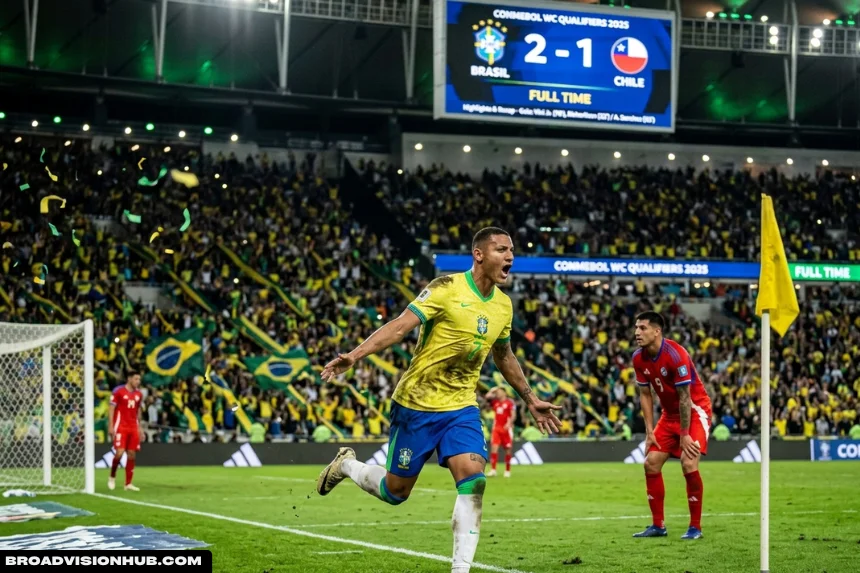
Brasil x Chile ended in a 3-0 victory for Brazil on September 4, 2025, at the Maracanã in Rio de Janeiro. Estêvão opened the scoring, Lucas Paquetá added the second shortly after entering from the bench, and Bruno Guimarães completed the result. Brazil had already qualified for the 2026 FIFA World Cup, but the performance still mattered because it strengthened Carlo Ancelotti’s early work with the national team.
The official CBF match report confirms the 3-0 score, the three scorers, and Brazil’s move to second place in the South American qualifiers with 28 points. More than 57,000 supporters watched the match at the Maracanã.
Brasil x Chile: Final Result
The final score was Brazil 3-0 Chile.
Notably, Brazil entered the match already certain of a place at the 2026 World Cup. Even so, Ancelotti wanted a strong performance in front of the home crowd.
From the start, the team attacked aggressively and kept Chile under pressure. Estêvão eventually broke the deadlock during the first half.
After halftime, Brazil increased the tempo and used its bench well. Then, Lucas Paquetá scored the second goal only moments after entering the match.
Soon afterward, Bruno Guimarães made it 3-0. The score reflected Brazil’s stronger second half and its ability to turn territorial control into clear chances.
Brasil x Chile Quick Match Facts
| Match detail | Information |
|---|---|
| Match | Brazil 3-0 Chile |
| Date | September 4, 2025 |
| Competition | 2026 World Cup qualifiers |
| Venue | Maracanã |
| City | Rio de Janeiro, Brazil |
| Brazil scorers | Estêvão, Lucas Paquetá, Bruno Guimarães |
| Brazil coach | Carlo Ancelotti |
| Attendance | More than 57,000 |
| Brazil points after match | 28 |
| Brazil position after round | 2nd |
| Qualification status | Brazil had already qualified |
| Next match | Bolivia away in El Alto |
Moreover, the result gave the crowd a strong home performance in Brazil’s penultimate qualifier.
In addition, it gave Ancelotti another chance to refine his preferred structure before the World Cup year.
How the Match Unfolded
Brazil began with intensity.
The midfield pressed high, the fullbacks supported attacks, and the front four tried to keep Chile pinned close to its own box.
Meanwhile, Chile defended in numbers and looked for opportunities to slow the rhythm.
As the first half developed, Brazil continued to create pressure without forcing unnecessary passes. That patience eventually produced the opening goal.
Brasil x Chile Started With Brazil on the Front Foot
Brazil attacked early.
Estêvão found space on the right, while Martinelli tried to stretch Chile on the opposite side.
Raphinha moved between the wing and central areas, which made Brazil’s attacking shape harder to track.
At the same time, Casemiro and Bruno Guimarães protected the midfield behind them.
Consequently, the setup helped Brazil recover second balls quickly. As a result, Chile struggled to build long attacking sequences.
Even so, Brazil did not score immediately, but the pattern of the match clearly favored the home side.
Chile Resisted the Early Pressure
Initially, Chile stayed compact for long stretches of the first half.
Rather than chasing Brazil high up the field, the visitors often protected central areas and forced the hosts to move the ball from side to side.
That approach slowed Brazil at times. However, constant defending carries a cost.
When Brazil increased the speed of its combinations, gaps started to appear.
Meanwhile, Estêvão remained especially dangerous because he could attack one-on-one and arrive inside the box. Eventually, Brazil found the breakthrough.
Brasil x Chile Changed After Estêvão’s Opener
Estêvão scored Brazil’s first goal and changed the emotional balance of the match.
Before that, the young attacker had already threatened Chile with his movement and direct play. Once he scored, Brazil looked more comfortable.
Chile now needed to leave its defensive shape more often, which created additional space.
As a result, Brazil could move the ball faster through midfield and attack gaps behind the first line of pressure.
The goal also carried personal meaning for Estêvão because it was his first for the senior Brazilian national team.
Goals From Brasil x Chile
Brazil scored three different types of goals.
The opener rewarded first-half pressure. Meanwhile, the second came from a sharp substitute impact and a decisive cross.
Finally, the third followed another dangerous Luiz Henrique action and a quick reaction inside the box.
Overall, the goals showed that Brazil could create danger through several players.
Estêvão Scored His First Brazil Goal
Estêvão opened the scoring in the first half.
In particular, the goal capped an active performance in which he repeatedly attacked Chile’s defensive line.
His movement caused problems because he did not stay fixed on the right touchline. Instead, he moved inside when space appeared and looked to arrive in scoring positions.
Consequently, that flexibility made him harder to mark.
Most importantly, the finish gave him his first senior international goal. A breakthrough at the Maracanã made the moment even more significant.
Lucas Paquetá Made an Instant Impact
Paquetá began the match on the bench.
Later, Ancelotti introduced him in the second half when Brazil wanted more creativity near the Chilean penalty area.
Crucially, the effect was immediate.
Luiz Henrique carried the ball down the left, beat his marker, and delivered a precise cross. Paquetá attacked the box and headed the ball into the net.
He had been on the field for less than a minute.
Therefore, the substitution gave Brazil exactly what Ancelotti wanted: fresh movement and a second goal.
Bruno Guimarães Completed Brasil x Chile
Soon afterward, Brazil scored its third goal after Paquetá’s header.
Once again, Luiz Henrique drove at the Chile defense.
His effort hit the crossbar, but the rebound stayed alive. Bruno Guimarães reacted quickly and finished the loose ball.
Earlier, the midfielder had already contributed to Brazil’s control in central areas.
Now he had a goal to complete his performance. The 3-0 score also allowed Brazil to finish with confidence rather than simply protect a narrow lead.
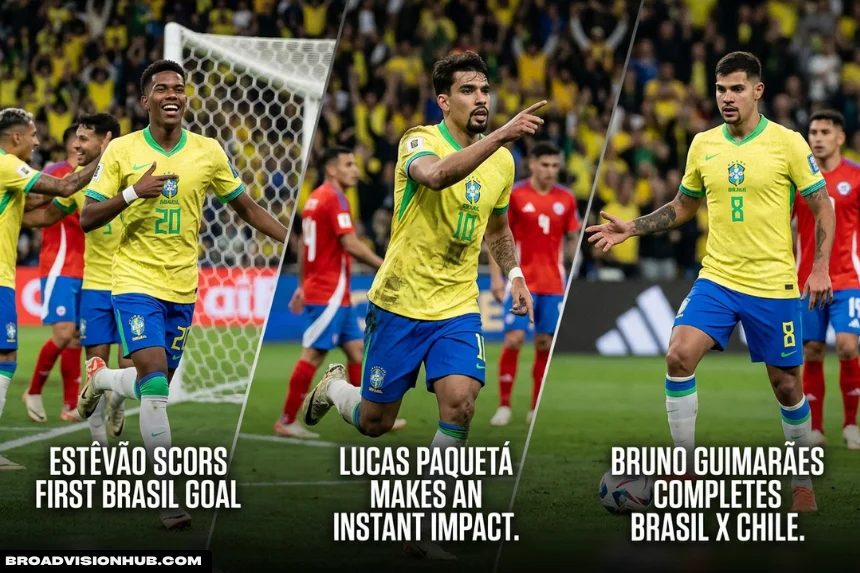
Estêvão’s Breakthrough Night
Estêvão entered the match as one of Brazil’s most exciting young attackers.
He left with his first senior international goal.
More importantly, that development mattered for both the player and the coaching staff. Brazil has several established attacking options, but World Cup preparation requires depth.
Estêvão offered a different profile.
He could start wide, dribble directly at defenders, and move into central areas at the right moment. In addition, his energy helped Brazil press after losing possession.
Therefore, the Chile match became more than a statistical milestone. It showed that he could influence an important senior international game at the Maracanã.
Luiz Henrique Changed the Second Half
Luiz Henrique did not start, yet he became one of the decisive players after entering.
At that point, Ancelotti introduced him for Estêvão. The substitution maintained Brazil’s direct threat and added fresh physical power.
However, Luiz Henrique did more than run at tired defenders.
He created the second goal with a strong individual move and accurate cross for Paquetá. Later, another drive ended with his shot hitting the crossbar.
Then, Bruno Guimarães converted the rebound.
As a result, Luiz Henrique played a direct role in the moves behind two goals. That type of bench contribution can become crucial in tournament football.
Brasil x Chile and Paquetá’s Instant Impact
Paquetá’s goal provided one of the clearest examples of effective substitution management.
He replaced João Pedro in the second half. Within moments, he moved into the penalty area and met Luiz Henrique’s cross.
The header made the score 2-0.
Just as importantly, Paquetá’s timing mattered as much as the finish. Rather than waiting outside the box, he recognized the open space and attacked it.
That movement gave Luiz Henrique a clear target.
Moreover, the goal reminded Ancelotti that Brazil’s midfielders can contribute inside the box instead of relying only on the forwards.
Ancelotti’s Tactical Approach
Ancelotti wanted Brazil to play with intensity, pressure, and defensive balance.
After the match, the coach praised the team’s rhythm and pressing in his official CBF post-match comments.
Accordingly, the starting structure reflected those priorities.
Casemiro anchored midfield, while Bruno Guimarães helped control possession and support attacks.
Ahead of them, Raphinha, Estêvão, Martinelli, and João Pedro gave Brazil movement across the front line.
At the same time, the system asked Brazil to react quickly after losing the ball.
That reduced Chile’s chances to counterattack. Later, Ancelotti used substitutions to refresh the attacking areas instead of allowing the match to lose intensity.
Brazil’s Pressing and Defensive Balance
Overall, Brazil’s pressing played an important role.
When Chile tried to build from the back, the Brazilian forwards closed passing lanes quickly.
The midfield then moved forward to reduce the space behind the first press.
That organization helped Brazil keep the game in Chile’s half for long periods.
At the same time, Casemiro offered protection when Brazil committed players forward.
For example, good pressing requires coordination.
If one attacker moves while the others stay passive, opponents can escape easily.
Brazil looked more synchronized in this match. Consequently, Chile struggled to create sustained attacks during Brazil’s strongest periods.
Brasil x Chile Lineups
Brazil used a mix of experienced leaders and younger attacking players.
Brazil Starting XI
- Alisson
- Wesley
- Gabriel Magalhães
- Marquinhos
- Douglas Santos
- Casemiro
- Bruno Guimarães
- Raphinha
- Estêvão
- Gabriel Martinelli
- João Pedro
Carlo Ancelotti was the head coach.
The CBF squad announcement also shows the wider group selected for the final two qualifying matches against Chile and Bolivia.
Key Brazil Substitutions
- Luiz Henrique for Estêvão
- Andrey Santos for Casemiro
- Lucas Paquetá for João Pedro
- Kaio Jorge for Gabriel Martinelli
- Richarlison for Raphinha
Importantly, the changes mattered.
Luiz Henrique helped create two goals, while Paquetá scored almost immediately.
Substitutions That Changed the Match
Ancelotti’s bench decisions helped Brazil turn a controlled match into a comfortable win.
At 1-0, Chile still had a realistic route back into the game.
In practice, fresh legs changed that dynamic.
Luiz Henrique attacked defenders directly. Paquetá added another runner into the penalty area.
Meanwhile, Andrey Santos brought energy to midfield after Casemiro left.
Kaio Jorge and Richarlison also allowed Brazil to keep pressing high.
Therefore, the second half showed the value of squad depth.
A strong starting lineup is important, but tournament success often depends on players who enter after 60 or 70 minutes.
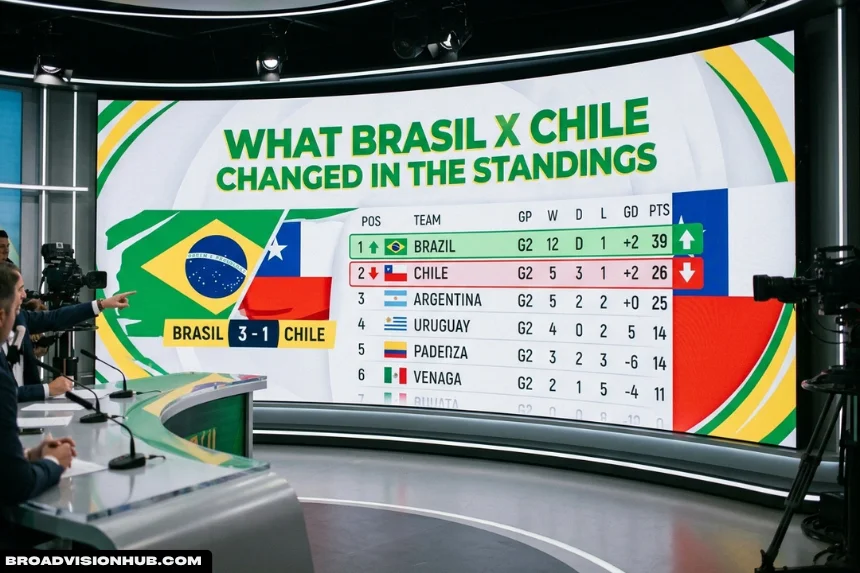
What Brasil x Chile Changed in the Standings
Brazil entered the match already qualified for the 2026 World Cup.
That meant the three points did not determine qualification.
However, the win still affected the standings.
After the round, Brazil moved to second place with 28 points.
The position gave Ancelotti a positive platform before the final qualifier in Bolivia.
It also helped Brazil finish the home portion of its campaign with momentum.
Chile, meanwhile, remained in a difficult qualifying position.
Therefore, the same match carried very different consequences for the two teams.
Maracanã Atmosphere and Symbolism
The Maracanã added another layer to the occasion.
More than 57,000 fans attended.
For Ancelotti, the match marked his first appearance as Brazil coach at the famous stadium.
The CBF also used the evening to honor former players connected to Brazil’s five World Cup-winning teams.
That ceremony linked the current squad with the national team’s history.
Moreover, Estêvão’s first senior goal came in front of that crowd.
The combination of a young scorer, historic venue, and convincing result gave the night a symbolic quality beyond the standings.
Brasil x Chile and Recent Head-to-Head History
Brazil has generally held the stronger recent record against Chile.
The Maracanã has also produced memorable meetings between the teams.
Before the 2025 qualifier, the previous Brazil-Chile game at the stadium took place in March 2022.
Brazil won that match 4-0.
The CBF’s retrospective on the previous Maracanã meeting notes that Vinícius Jr. scored his first senior Brazil goal in that 2022 game.
Three years later, Estêvão achieved a similar milestone against the same opponent at the same stadium.
Brasil x Chile at the Maracanã in 2022
Brazil won 4-0 on March 24, 2022.
Neymar, Vinícius Jr., Philippe Coutinho, and Richarlison scored.
The game also marked Brazil’s final home appearance before the 2022 World Cup.
For Vinícius Jr., the night was especially important because he scored his first senior international goal.
That detail created an interesting link to the 2025 meeting.
Both matches included a young Brazilian attacker reaching the same personal milestone against Chile at the Maracanã.
Brasil x Chile at the Maracanã in 2025
Brazil won 3-0.
Estêvão scored first, while Paquetá and Bruno Guimarães added second-half goals.
Unlike the 2022 meeting, Brazil had already secured World Cup qualification before kickoff.
Therefore, the 2025 match focused more on team development under Ancelotti.
The result still carried significance because Brazil produced one of its most convincing performances of the coach’s early tenure.
Why the First Goal Mattered
A 1-0 lead can completely change a qualifier.
Before Estêvão scored, Chile could focus on staying compact.
Once Brazil moved ahead, the visitors eventually needed to take more risks.
That opened additional space.
Brazil could then attack transitions more effectively and use the speed of its wide players.
The lead also reduced pressure on the home side.
Instead of forcing passes, Brazil could circulate possession and wait for openings.
Therefore, Estêvão’s goal affected more than the scoreboard. It changed the tactical conditions for the rest of the match.
Brasil x Chile Showed Brazil’s Attacking Depth
Brazil did not rely on one superstar.
Three different players scored.
A substitute created two of the key second-half actions. Another substitute scored almost immediately.
For that reason, the distribution is valuable.
Opponents can prepare specific plans for one player, but it becomes harder when several attackers and midfielders can decide the game.
Estêvão brought direct dribbling. Paquetá added timing and late runs.
Bruno Guimarães arrived from midfield, while Luiz Henrique changed the rhythm from the bench.
Therefore, the 3-0 win showed Ancelotti several attacking solutions in the same match.
The Role of Bruno Guimarães
Bruno Guimarães gave Brazil stability and progression in midfield.
He helped connect the defensive line with the attack.
When Chile closed central passing lanes, Bruno moved laterally to offer another angle.
He also supported the press after Brazil lost possession.
His goal rewarded that all-around contribution.
After Luiz Henrique hit the crossbar, Bruno reacted faster than the surrounding defenders and finished the rebound.
In turn, the moment showed awareness and anticipation.
Midfielders who arrive late in the box can create problems because defenders usually focus on the forwards.
Brasil x Chile and Brazil’s Young Players
The match also highlighted Brazil’s changing age profile.
Estêvão started, Wesley played at right back, and João Pedro led the line.
Later, Andrey Santos, Kaio Jorge, and Luiz Henrique entered.
As a result, that gave Ancelotti valuable information about players who could compete for future roles.
Experience still mattered through Alisson, Marquinhos, Casemiro, and Bruno Guimarães.
However, the mix looked important.
A World Cup squad needs both leadership and fresh energy.
The Chile match suggested Brazil was testing that balance rather than relying only on established names.
What Brazil Could Still Improve
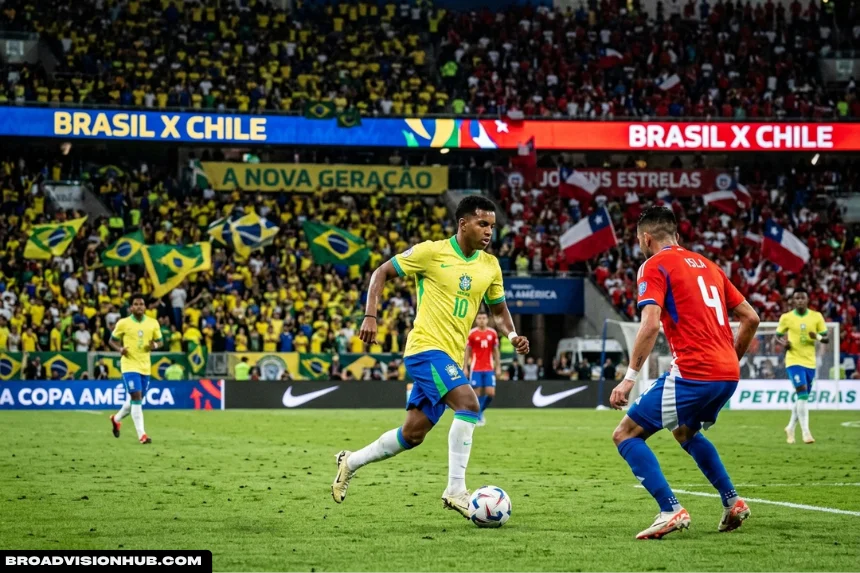
A 3-0 victory can hide smaller problems.
Brazil controlled the match, but the first goal did not arrive immediately.
At times, Chile’s compact shape slowed the home team.
Brazil could still improve the speed of its passing near the box.
More off-ball runs would also help create clearer lanes.
In addition, the team needed to maintain concentration whenever Chile escaped the press.
Even so, those details did not change the result.
However, Ancelotti’s job was to prepare the team for stronger opposition at the World Cup.
Therefore, even a convincing win offered areas for refinement.
Why the Result Mattered for Ancelotti
The match was only Ancelotti’s third in charge of Brazil.
His first two had produced a 0-0 draw with Ecuador and a 1-0 win over Paraguay.
Therefore, the Chile game represented another step.
Brazil scored three times, pressed effectively, and received strong contributions from substitutes.
The CBF’s post-match coverage recorded Ancelotti’s satisfaction with the team’s intensity, rhythm, defending, and pressure.
For a coach still building his system, that type of performance offered useful confirmation.
Brasil x Chile and the Importance of Width
Brazil’s attacking width helped stretch Chile’s defensive block.
Estêvão and Martinelli often started in wide positions, which forced Chile’s fullbacks to make difficult choices.
If a defender moved too far toward the touchline, space could appear inside. On the other hand, staying narrow allowed Brazil’s winger to receive with room to attack.
That balance became especially useful once Luiz Henrique entered.
His direct running created a different problem because he could beat a defender before delivering the final ball.
The second goal showed the value of that approach.
Luiz Henrique carried possession into an advanced area, created separation from his marker, and crossed for Paquetá.
Later, another aggressive action produced the shot that hit the crossbar before Bruno Guimarães scored.
Therefore, width was not simply about keeping players near the sideline.
Brazil used wide positions to open central spaces, isolate defenders, and create better angles for crosses and cutbacks.
That tactical detail can become important against teams that defend with many players behind the ball.
A narrow attack makes compact defenses more comfortable.
By contrast, a team that uses the full width of the pitch forces defenders to cover more ground.
The Chile match gave Ancelotti a useful example of how wide players and central runners can complement one another.
What the Match Revealed About Brazil’s World Cup Preparation
Brazil had already qualified before facing Chile, so the result did not decide whether the team would reach the 2026 World Cup.
Nevertheless, the match had real value for preparation.
Ancelotti still needed to understand which combinations worked best, which younger players could handle pressure, and how the team would respond when a match required changes from the bench.
Several answers looked encouraging.
Estêvão showed that he could start an important international game and contribute a goal.
Luiz Henrique demonstrated that a substitute could change the rhythm of the attack.
Paquetá proved useful as a late runner into the box, while Bruno Guimarães combined midfield control with a scoring contribution.
The defensive structure also gave Ancelotti a solid base.
Brazil pressed with more coordination and limited Chile’s ability to build sustained attacks.
However, the coaching staff still had reasons to keep working.
The team could improve the speed of circulation against compact defenses, create more off-ball movement near the penalty area, and remain alert whenever the press broke down.
Those details matter because World Cup opponents will present different tactical problems.
Some teams will press Brazil high.
Others will defend deep and wait for counterattacks.
A strong tournament side must solve both situations.
For that reason, the 3-0 win mattered less as a qualification result and more as a development checkpoint.
It showed progress under Ancelotti while also identifying areas that needed further refinement.
What Happened After Brasil x Chile
Brazil’s final qualifier came five days later.
The team traveled to El Alto to face Bolivia on September 9.
By contrast, the altitude created a very different challenge from the Maracanã.
Therefore, Ancelotti had to manage recovery and prepare a new match plan quickly.
The Chile win still gave Brazil momentum before the trip.
It also allowed the coaching staff to evaluate which players had earned more opportunities.
For broader background on the national team’s history, the Brazil national football team page provides context on Brazil’s World Cup record and international tradition.
Frequently Asked Questions About Brasil x Chile
1. What Was the Result of Brasil x Chile?
Brasil x Chile ended 3-0 for Brazil.
Estêvão scored the opening goal.
Lucas Paquetá and Bruno Guimarães added the other two in the second half.
The match took place at the Maracanã on September 4, 2025.
2. Who Scored in Brasil x Chile?
Estêvão, Lucas Paquetá, and Bruno Guimarães scored for Brazil.
First, Estêvão opened the scoring.
Paquetá made it 2-0 shortly after entering as a substitute, while Bruno completed the result.
3. When Was Brasil x Chile Played?
Brasil x Chile was played on September 4, 2025.
The match belonged to the closing stage of South American qualifying for the 2026 FIFA World Cup.
4. Where Was Brasil x Chile Played?
In addition, the match took place at the Maracanã in Rio de Janeiro.
More than 57,000 supporters attended the 3-0 Brazil victory.
5. Did Estêvão Score in Brasil x Chile?
Yes.
Estêvão scored Brazil’s first goal.
It was also his first goal for the senior Brazilian national team.
6. Did Lucas Paquetá Score in Brasil x Chile?
Yes.
Paquetá entered during the second half and scored almost immediately.
He headed in a cross created by Luiz Henrique.
7. Did Bruno Guimarães Score in Brasil x Chile?
Yes.
Bruno Guimarães scored Brazil’s third goal.
He reacted to the rebound after Luiz Henrique hit the crossbar.
8. Was Brazil Already Qualified Before Brasil x Chile?
Yes.
Brazil had already secured qualification for the 2026 World Cup before the Chile match.
The victory still helped Brazil move to second place in the qualifiers with 28 points.
9. Who Coached Brazil in Brasil x Chile?
Carlo Ancelotti coached Brazil.
The Chile game was his third match in charge and his first as Brazil coach at the Maracanã.
10. Who Did Brazil Play After Brasil x Chile?
Brazil faced Bolivia on September 9, 2025.
That match took place in El Alto and closed Brazil’s World Cup qualifying campaign.
Conclusion: Brasil x Chile Ended 3-0
Brasil x Chile finished 3-0 for Brazil, giving Carlo Ancelotti one of the strongest performances of his early national-team tenure.
Estêvão opened the scoring and celebrated his first senior Brazil goal.
Paquetá then made an immediate impact from the bench.
Bruno Guimarães completed the score after another dangerous Luiz Henrique action.
Beyond the goals, Brazil showed strong pressing, useful attacking depth, and effective second-half substitutions.
The result did not secure qualification because Brazil had already booked its place at the 2026 World Cup.
However, it moved the team to 28 points and second place in the South American standings after the round.
For Ancelotti, the match offered evidence that younger players and experienced leaders could function together.
Ultimately, for anyone searching brasil x chile, the main answer is simple: Brazil won 3-0 at the Maracanã on September 4, 2025, with goals from Estêvão, Lucas Paquetá, and Bruno Guimarães.
READ MORE AT: broadvisionhub