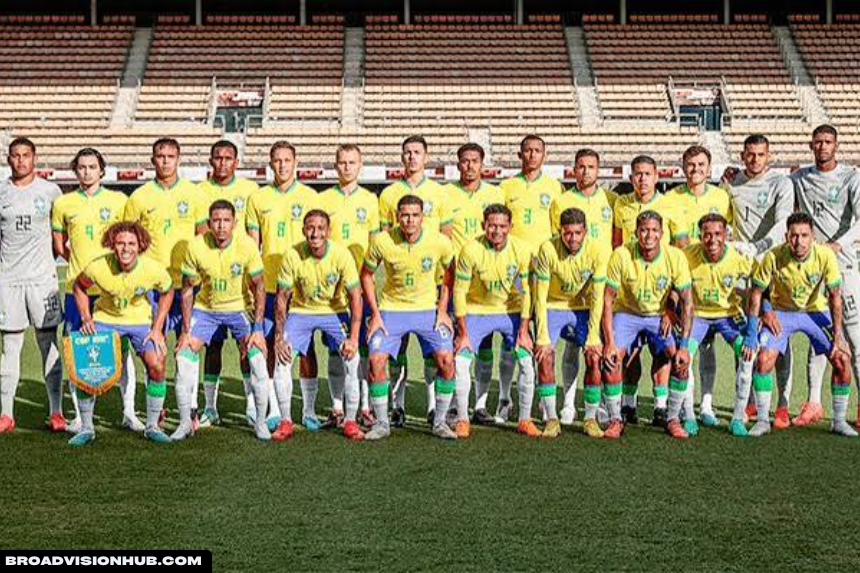
Brasil x Tunísia ended in a 1-1 draw on November 18, 2025, at the Decathlon Arena in Lille, France. Hazem Mastouri gave Tunisia the lead in the 23rd minute, while Estêvão equalized for Brazil from the penalty spot before halftime. Brazil later had a major chance to win, but Lucas Paquetá missed a second-half penalty.
The match was Brazil’s final international fixture of 2025 and formed part of Carlo Ancelotti’s preparation for the 2026 FIFA World Cup. Tunisia proved difficult to break down, defended with a compact low block, and attacked quickly in transition.
According to the official CBF match report, Brazil recovered after falling behind, controlled much of the second half, missed a penalty through Paquetá, and nearly won when Estêvão struck the post in stoppage time.
Brasil x Tunísia: Final Result
The final score was Brazil 1-1 Tunisia.
Tunisia took the lead in the 23rd minute after a fast counterattack. Mastouri finished the move and put the African side ahead.
Brazil responded gradually.
Casemiro and Éder Militão both tried efforts from distance, while Rodrygo became increasingly involved in the attacking play.
The equalizer came after VAR identified a handball inside the Tunisian penalty area.
Estêvão stepped up and converted confidently.
Therefore, Brazil entered halftime level at 1-1.
The second half brought the best chance for Brazil to complete the comeback, but Lucas Paquetá sent a penalty wide.
In stoppage time, Estêvão almost produced the winner with an individual move, but his shot hit the post.
Brasil x Tunísia Quick Match Facts
| Match detail | Information |
|---|---|
| Match | Brazil 1-1 Tunisia |
| Date | November 18, 2025 |
| Competition | International friendly |
| Venue | Decathlon Arena / Stade Pierre-Mauroy |
| City | Lille, France |
| Tunisia scorer | Hazem Mastouri |
| Brazil scorer | Estêvão |
| Tunisia goal | 23rd minute |
| Brazil goal | Penalty before halftime |
| Missed Brazil penalty | Lucas Paquetá |
| Brazil coach | Carlo Ancelotti |
| Significance | Brazil’s final match of 2025 |
The result meant Brazil closed the year without a second consecutive victory after beating Senegal 2-0 three days earlier.
However, the match also gave Ancelotti a useful tactical test against a team that defended deeper than Senegal.
How the Match Unfolded
The first 25 minutes were balanced.
Brazil had possession, but Tunisia denied central space and looked dangerous whenever it recovered the ball.
That pattern made the game different from Brazil’s previous friendly against Senegal.
Instead of facing a team willing to contest more space, Brazil had to find solutions against a compact defensive block.
Brasil x Tunísia Began as a Balanced Contest
Brazil did not immediately impose its preferred rhythm.
Tunisia kept the spaces between its defensive and midfield lines small.
As a result, Brazil’s attacking players often received the ball with several defenders already behind it.
The Tunisian approach also created opportunities for counterattacks.
Brazil pushed players forward, which meant losing possession could leave space behind the midfield.
That danger became clear in the 23rd minute.
Mastouri Gave Tunisia the Lead
Tunisia opened the scoring through Hazem Mastouri.
The move began after Wesley lost a duel in midfield.
Tunisia transitioned quickly, attacked the open space, and Mastouri completed the counterattack.
The goal rewarded Tunisia’s tactical discipline.
Rather than trying to dominate possession, the visitors waited for a moment when Brazil’s structure was vulnerable.
Once the opportunity appeared, they attacked directly.
Brazil suddenly had to chase the game.
Brasil x Tunísia Was Level Before Halftime
Brazil improved after conceding.
Casemiro tested the goal from distance, and Éder Militão also pushed forward to shoot.
Rodrygo then became involved in several dangerous attacks.
Eventually, Brazil earned a penalty after VAR identified a handball during a cross into Tunisia’s area.
Estêvão took responsibility.
He struck the penalty with power and equalized.
Therefore, Brazil went into halftime at 1-1 rather than trailing.
Goals From Brasil x Tunísia
The two goals came from very different situations.
Tunisia scored through a fast transition after recovering possession.
Brazil, by contrast, equalized from a penalty after sustained pressure and a VAR review.
That contrast reflected the tactical battle.
Tunisia wanted to stay compact and attack quickly.
Brazil wanted to control territory and create chances around the penalty area.
Mastouri’s Goal
Mastouri scored in the 23rd minute.
Tunisia won possession after a midfield duel and immediately moved forward.
Brazil’s defense had less time to organize because the transition happened quickly.
Mastouri took advantage and finished the attack.
The goal highlighted one of the main risks Brazil faced during the match.
When too many players moved forward at the same time, Tunisia had space to counter.
Therefore, Brazil needed to improve its defensive balance while attacking.
Estêvão’s Penalty in Brasil x Tunísia
Brazil equalized from the penalty spot.
A cross into Tunisia’s area was handled by a defender.
After VAR reviewed the incident, the referee awarded Brazil a penalty.
Estêvão stepped up and converted.
The goal was important not only because it made the score 1-1.
It also rewarded Brazil for gradually increasing its attacking pressure after falling behind.
Estêvão remained one of the most dangerous Brazilian players for the rest of the night.
Lucas Paquetá Missed Brazil’s Second Penalty
Brazil received another penalty during the second half.
This time, Vitor Roque won the spot kick after entering as a substitute.
Lucas Paquetá took responsibility.
However, he sent the penalty wide.
That was Brazil’s clearest opportunity to turn the match around.
A successful penalty would have given Ancelotti’s team a 2-1 lead at a time when Brazil had more control.
Instead, the score remained level.
The miss also gave Tunisia renewed confidence.
The visitors continued to defend compactly and looked for opportunities to counter when Brazil pushed forward.
Estêvão Nearly Won Brasil x Tunísia Late
Estêvão came close to deciding the match in stoppage time.
He received the ball in a crowded area, moved between defenders, and produced a delicate finish.
However, the ball hit the post.
It was an important final moment because it showed how close Brazil came to winning despite struggling for space throughout the game.
Estêvão’s performance stood out beyond the equalizing penalty.
He repeatedly looked willing to attack defenders and create something individually.
Therefore, although the match ended 1-1, the young forward left Lille as one of Brazil’s most encouraging performers.
Brasil x Tunísia Lineups
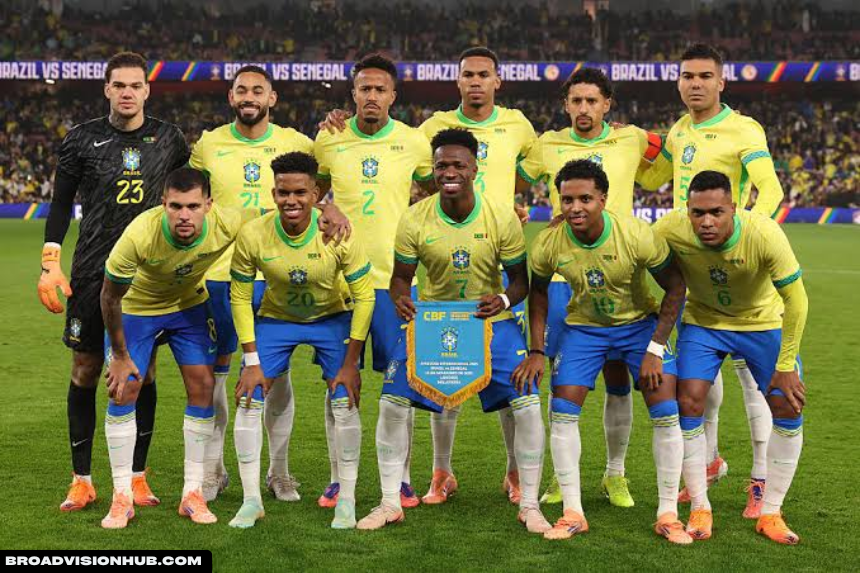
Brazil started with Bento in goal.
Brazil Starting XI
- Bento
- Wesley
- Marquinhos
- Éder Militão
- Caio Henrique
- Bruno Guimarães
- Casemiro
- Estêvão
- Rodrygo
- Matheus Cunha
- Vinícius Jr.
Carlo Ancelotti made several changes.
Danilo replaced Wesley at halftime, while Vitor Roque replaced Matheus Cunha.
Later, Fabinho came on for Casemiro, Fabrício Bruno replaced Éder Militão, and Lucas Paquetá replaced Bruno Guimarães.
Luiz Henrique also entered for Rodrygo.
These substitutions gave Brazil different attacking and midfield combinations.
Tunisia’s Defensive Strategy
Tunisia’s defensive organization was one of the main reasons the match remained difficult.
Carlo Ancelotti later described the opponent as a team that defended with a very low block.
That meant Brazil often faced many defenders close to the Tunisian penalty area.
The CBF’s report on Ancelotti’s post-match comments explains that the coach considered the Tunisia game more difficult than the 2-0 win over Senegal because there was less space for Brazil’s attacking players.
That tactical distinction matters.
Brazil has players who are extremely dangerous when they can run into open space.
Against Tunisia, however, they often had to create chances in crowded areas.
Therefore, quick combinations, width, and patience became more important.
Carlo Ancelotti’s Assessment
Ancelotti did not treat the draw as a meaningless friendly result.
Instead, he focused on the challenge Tunisia created.
The coach said Brazil started poorly but improved as the match continued.
He also believed Brazil created enough opportunities to win.
That assessment matches the key events.
Brazil equalized before halftime, controlled more of the second half, earned a second penalty, and hit the post late.
However, the team did not convert those chances into a winning goal.
For Ancelotti, that made the match a useful lesson.
The team needed to learn how to attack opponents that protect the penalty area with many players.
That type of problem can appear frequently in tournament football.
What Brasil x Tunísia Showed About Brazil
The match revealed both strengths and weaknesses.
Brazil showed resilience after conceding first.
The team did not panic and gradually took control.
Estêvão also provided another strong attacking performance, while Rodrygo was involved in several dangerous moves.
However, Brazil struggled at times to create clear chances against a deep defense.
That is a different challenge from attacking teams that leave space behind their back line.
Moreover, Tunisia’s opening goal showed that Brazil still needed to manage defensive transitions carefully.
Therefore, the 1-1 draw offered Ancelotti useful information even without a victory.
Why Tunisia Was an Important Test
Brazil deliberately scheduled matches against Senegal and Tunisia as part of its World Cup preparation.
The idea was to face different footballing styles.
The CBF explained the choice of opponents, noting that Tunisia represented a different North African footballing profile from Senegal.
Tunisia also entered the match with strong competitive credibility.
According to the CBF’s Tunisia qualifying profile, Tunisia collected 28 of a possible 30 points in its African World Cup qualifying group.
Therefore, Brazil was not facing a random friendly opponent.
Tunisia had already shown consistency, discipline, and defensive strength in competitive matches.
Brasil x Tunísia and Brazil’s 2025 Preparation
The draw closed Brazil’s 2025 international calendar.
Under Ancelotti, the national team was still developing ideas for the 2026 World Cup.
That made November’s friendlies especially useful.
Brazil defeated Senegal 2-0 in London and then drew 1-1 with Tunisia in Lille.
The two matches asked different questions.
Against Senegal, Brazil dealt with athleticism, speed, and a more open contest.
Against Tunisia, the challenge involved breaking down a compact low block.
Therefore, the second game may have been frustrating, but it still served the broader preparation plan.
Ancelotti had an opportunity to study different player combinations and identify problems before the World Cup year began.
Historical Brazil-Tunisia Meetings
Brazil and Tunisia have not played each other often at senior international level.
However, the meetings that did occur produced memorable results.
Before the 2025 draw, Brazil had won the two best-documented modern senior meetings.
The first came in 1973.
The second came in 2022, shortly before the Qatar World Cup.
The 2025 match was therefore notable because Tunisia avoided defeat against Brazil.
Brasil x Tunísia in 1973
Brazil faced Tunisia during an international tour in 1973.
The match took place in Tunis.
Brazil won 4-1.
The CBF’s historical preview notes that the match formed part of a broader tour through Africa and Europe.
That Brazilian team was only a few years removed from winning the 1970 World Cup.
Therefore, the 1973 meeting belongs to a very different era of international football.
Brasil x Tunísia in 2022
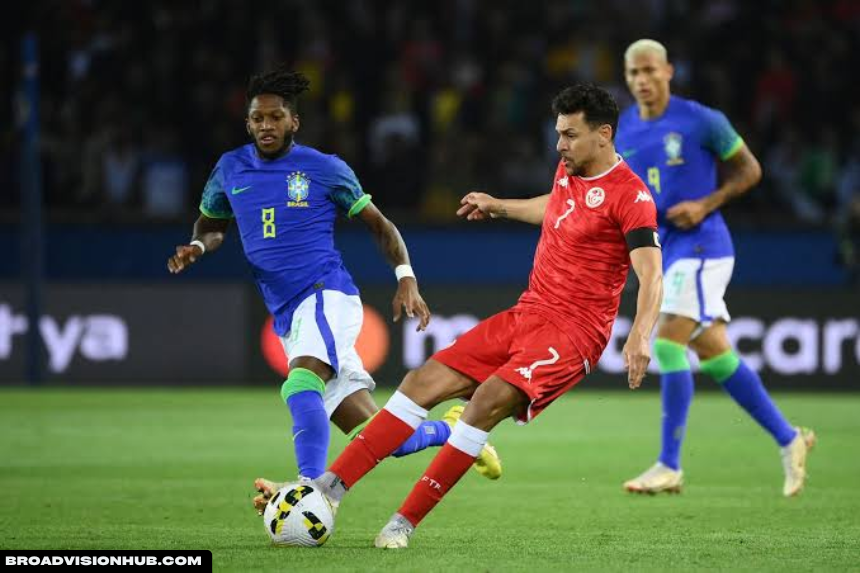
Brazil and Tunisia met again on September 27, 2022, at the Parc des Princes in Paris.
Brazil won 5-1.
Raphinha scored twice, while Richarlison, Neymar and Pedro also found the net.
The official CBF match record for Brazil 5-1 Tunisia confirms the result.
That game served as part of Brazil’s final preparation before the 2022 World Cup in Qatar.
The scoreline was much more comfortable than the 2025 meeting.
Brasil x Tunísia in 2025
The 2025 match ended 1-1.
Mastouri gave Tunisia the lead, while Estêvão equalized from the penalty spot.
Brazil had the best chance to win when Paquetá received a second-half penalty, but he missed.
Estêvão then hit the post late.
Therefore, Tunisia produced its strongest result of the three highlighted senior meetings by avoiding defeat.
The draw also demonstrated how much a well-organized defensive structure can change a matchup.
Brazil’s Attack Against a Low Block
Breaking down a low block requires different skills from counterattacking.
There is less open space.
Attackers often receive the ball with defenders close to them.
That means movement without the ball becomes extremely important.
Brazil tried to use Rodrygo, Estêvão, Vinícius Jr., and Matheus Cunha between and around Tunisia’s defensive lines.
However, the spaces were narrow.
Crosses and long-range shots became part of the solution.
Casemiro and Militão both tried from distance during the first half.
Brazil also needed faster combinations near the penalty area.
Therefore, the match offered a useful tactical rehearsal for future opponents that may defend in a similar way.
Brasil x Tunísia and Estêvão’s Growing Role
Estêvão was one of the biggest positives for Brazil.
He took responsibility for the first penalty and converted.
He also remained dangerous throughout the match.
In stoppage time, he nearly scored the winner when his shot hit the post.
His willingness to attack defenders directly helped Brazil when structured possession became predictable.
That is valuable against deep defensive blocks.
An individual dribble can force defenders to move and create spaces that passing alone may not open.
Therefore, Estêvão’s performance gave Ancelotti another reason to view him as an important option for the 2026 cycle.
Vinícius Jr. and Rodrygo’s Challenge
Vinícius Jr. and Rodrygo entered the match as two of Brazil’s most established attacking players.
However, Tunisia’s defensive setup reduced the amount of open space available to them.
Rodrygo still became involved in several dangerous attacks after Brazil conceded.
Vinícius Jr., meanwhile, often faced multiple defenders when receiving near the final third.
This is an important tactical issue.
Both players are extremely dangerous when they can accelerate into space.
Against compact teams, however, they need support from fullbacks, midfield runners, and quick combinations.
Therefore, the match showed why Brazil cannot rely only on individual attacking talent.
The Importance of Brazil’s Defensive Transitions
Tunisia’s goal provided a clear warning.
Brazil lost a duel in midfield and then had limited time to reorganize.
Tunisia attacked immediately.
That is the danger of committing many players forward against a compact opponent.
When possession is lost, the attacking team can suddenly become vulnerable.
Brazil needs good spacing behind the ball so one mistake does not expose the defense.
This concept is especially important in knockout football.
A single transition can decide a close match.
Therefore, even though Brazil controlled much of the friendly, Mastouri’s goal gave Ancelotti another area to review.
What the Draw Said About Brazil’s Chance Creation
Brazil created enough pressure to threaten Tunisia, but the match also showed that creating possession is not the same as creating clear chances.
Against a low block, the ball can circulate for long periods without producing a high-quality opening.
That is why the timing of off-ball runs becomes so important.
When a winger stays wide, a midfielder may need to attack the half-space. When a striker drops toward the ball, another player must threaten the space behind the defense.
Brazil showed flashes of those movements, especially when Rodrygo found pockets around the edge of the area.
However, the attacks were not always synchronized.
At times, several players wanted the ball to feet rather than making complementary runs.
That made Tunisia’s compact shape easier to maintain.
Therefore, one of the main lessons was about coordination rather than individual talent.
Brazil already had technically gifted attackers.
The next step was making sure those attackers moved in ways that created space for one another.
Brasil x Tunísia and the Value of Set-Piece Pressure
Both of Brazil’s penalties came from situations created around Tunisia’s penalty area.
That matters because set pieces and penalty-area pressure can become decisive when open-play space is limited.
The first penalty came after a handball identified through VAR.
The second came after Vitor Roque attacked the box and won another spot kick.
Even though Paquetá missed the second attempt, the two penalties showed that Brazil was repeatedly forcing Tunisia into difficult defensive situations.
This is an important point for tournament football.
When an opponent defends deep, clean one-on-one chances may be rare.
Instead, pressure can lead to fouls, handballs, rebounds, corners, and second-ball opportunities.
Brazil therefore needed to value those moments.
A team that can combine open-play creativity with strong set-piece pressure becomes much harder to defend.
Why the Result Was Frustrating but Useful
From Brazil’s perspective, the 1-1 result was frustrating because the team had opportunities to win.
Paquetá’s missed penalty was the clearest example.
Estêvão’s late shot against the post was another.
However, friendly matches are also meant to expose problems before competitive games begin.
In that sense, Tunisia offered Brazil exactly the kind of test Ancelotti needed.
The opponent did not make the game easy.
Tunisia defended compactly, countered quickly, and forced Brazil to solve problems in tight spaces.
A comfortable 4-0 victory might have created confidence, but it would not necessarily have revealed the same tactical weaknesses.
Therefore, the draw had practical value.
It showed Brazil where its attacking structure still needed improvement and reminded the team that defensive transitions had to remain secure even when dominating possession.
That type of lesson can be more useful in November than discovering the same weakness during a World Cup knockout match.
Brasil x Tunísia and the Pressure on Brazil’s No. 10 Role
Another interesting issue was the way Brazil used creative responsibility around the middle of the pitch.
Rodrygo often moved inside, while Bruno Guimarães and Casemiro provided different types of support from deeper positions.
Later, Paquetá entered and became involved in the biggest second-half moment when he took the penalty.
Brazil’s challenge was not a lack of players capable of passing or dribbling.
Instead, the problem was finding enough room between Tunisia’s lines.
That placed more pressure on whoever occupied central creative zones.
Quick first touches, one-touch combinations, and disguised passes become more valuable when space is limited.
Therefore, the match offered another reminder that Brazil’s attacking structure cannot depend only on wide isolation for Vinícius Jr. or individual dribbling from Estêvão.
The team also needs consistent central creation.
That balance would be important heading into the 2026 World Cup cycle.
What Happened After the Friendly
The Tunisia match ended Brazil’s 2025 schedule.
The national team then moved into the final phase of preparation for the 2026 World Cup.
At the time, the next scheduled international window was March 2026.
The FIFA Brazil data centre records the 1-1 draw as Brazil’s November 18, 2025 friendly in Lille.
By the time the 2026 World Cup arrived, Ancelotti had used additional friendlies to continue shaping the squad.
Therefore, Brasil x Tunísia became one of several preparation matches rather than an isolated event.
For broader historical background, the Brazil national football team page provides context on Brazil’s international record.
Frequently Asked Questions About Brasil x Tunísia
1. What Was the Result of Brasil x Tunísia?
Brasil x Tunísia ended 1-1.
Tunisia scored first through Hazem Mastouri, while Estêvão equalized for Brazil from the penalty spot.
2. Who Scored in Brasil x Tunísia?
Hazem Mastouri scored for Tunisia in the 23rd minute.
Estêvão scored Brazil’s equalizer from a penalty before halftime.
Therefore, both teams scored once.
3. When Was Brasil x Tunísia Played?
Brasil x Tunísia was played on November 18, 2025.
It was Brazil’s final international match of the calendar year.
4. Where Was Brasil x Tunísia Played?
The match took place at the Decathlon Arena, also known as Stade Pierre-Mauroy, in Lille, France.
Brazil and Tunisia therefore played the friendly at a neutral European venue.
5. Did Estêvão Score in Brasil x Tunísia?
Yes.
Estêvão scored Brazil’s equalizer from the penalty spot.
He also nearly scored the winning goal in stoppage time, but his shot hit the post.
6. Did Lucas Paquetá Miss a Penalty in Brasil x Tunísia?
Yes.
Brazil received a second penalty during the second half.
Lucas Paquetá took it but sent his attempt wide.
7. Who Scored for Tunisia in Brasil x Tunísia?
Hazem Mastouri scored Tunisia’s goal.
He finished a quick counterattack in the 23rd minute after Brazil lost possession in midfield.
8. What Was Brazil’s Lineup in Brasil x Tunísia?
Brazil started with Bento; Wesley, Marquinhos, Éder Militão, Caio Henrique; Bruno Guimarães, Casemiro; Estêvão, Rodrygo, Matheus Cunha, and Vinícius Jr.
Carlo Ancelotti made several substitutions during the second half.
9. How Many Times Have Brazil and Tunisia Met?
The best-documented senior meetings highlighted by CBF include Brazil’s 4-1 win in 1973, 5-1 win in 2022, and 1-1 draw in 2025.
Therefore, the 2025 result was significantly tighter than the previous two meetings.
10. Why Was Brasil x Tunísia Important for Brazil?
The friendly was part of Brazil’s preparation for the 2026 World Cup.
Tunisia offered a useful test because of its compact defensive structure and strong African qualifying campaign.
As a result, the match helped Ancelotti evaluate how Brazil handled a low defensive block.
Conclusion: Brasil x Tunísia Ended 1-1
Brasil x Tunísia finished 1-1 in Lille, bringing Brazil’s 2025 international calendar to a close.
Hazem Mastouri gave Tunisia the lead in the 23rd minute after a fast counterattack.
Estêvão then equalized from the penalty spot before halftime.
Brazil had a major opportunity to win during the second half, but Lucas Paquetá missed a second penalty.
Finally, Estêvão came close again in stoppage time when his shot struck the post.
The result was not the victory Brazil wanted.
However, the match still provided a valuable tactical test.
Tunisia defended with a compact low block, restricted space for Brazil’s attackers, and threatened on transitions.
Ancelotti later highlighted how different that challenge was from Brazil’s 2-0 victory over Senegal.
Therefore, the draw gave Brazil useful information ahead of the 2026 World Cup.
For anyone searching brasil x tunísia, the key answer is simple: Brazil and Tunisia drew 1-1 on November 18, 2025, with Mastouri scoring for Tunisia and Estêvão equalizing from the penalty spot.
Learn More about: Gary Anderson Kicker