I also rechecked the regulatory claims against the current eCFR. As of July 2026, 21 CFR §131.160 still says sour cream is made by souring pasteurized cream with lactic-acid-producing bacteria, generally requires at least 18% milkfat and 0.5% titratable acidity, and permits the standardized names “Sour cream” or “Cultured sour cream.” Separately, 21 CFR §131.162 defines acidified sour cream as pasteurized cream soured with permitted acidifiers, with or without lactic-acid-producing bacteria.
Use this cleaned replacement for the repetitive/problematic portion:
Cultured Sour Cream Quick Answer
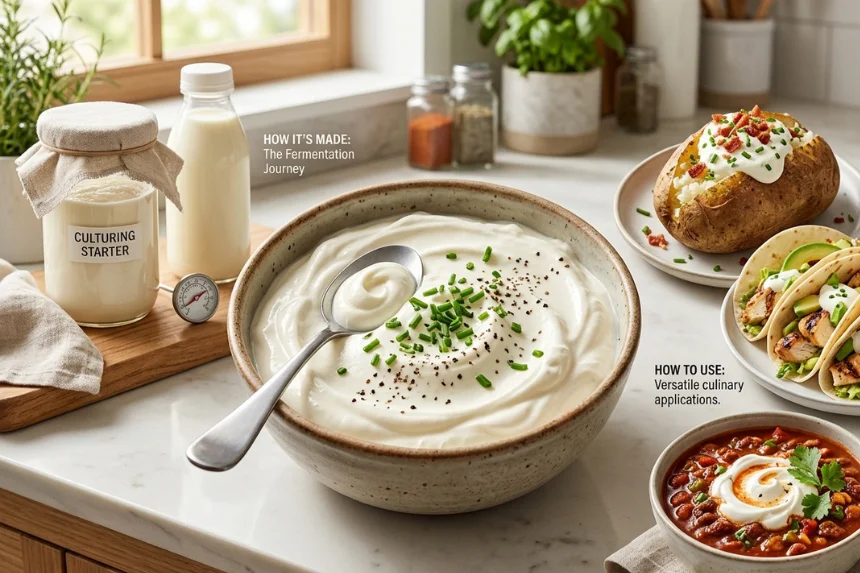
Cultured sour cream is pasteurized cream intentionally soured with lactic-acid-producing bacteria. During fermentation, acidity increases while the cream develops its familiar tangy flavor and thick texture.
In the United States, “sour cream” and “cultured sour cream” are alternative standardized names for the same food. The federal standard generally requires at least 18% milkfat and at least 0.5% titratable acidity, calculated as lactic acid.
However should not be confused with acidified which belongs to a separate federal standard and may be soured with added acidifiers instead of relying on bacterial fermentation alone.
Quick Facts
| Fact | What It Means |
|---|---|
| Main dairy base | Pasteurized cream |
| Fermented? | Yes |
| Souring method | Lactic-acid-producing bacteria |
| U.S. standardized name | Sour cream or cultured sour cream |
| Basic minimum milkfat | 18% |
| Minimum acidity | 0.5% titratable acidity, calculated as lactic acid |
| Same as regular sour cream? | Yes, under the U.S. standard |
| Same as acidified sour cream? | No |
| Same as spoiled cream? | No |
| Always probiotic? | Not necessarily |
| Automatically lactose-free? | No |
| Optional ingredients permitted? | Yes |
Federal regulations also permit certain ingredients that can improve texture, reduce syneresis, extend shelf life, add flavor, or serve other permitted functions. Therefore, a commercial product does not legally have to contain only cream and starter bacteria.
What Does “Cultured” Mean?
In dairy production, cultured means that selected microorganisms are intentionally used during fermentation.
For standard sour cream, lactic-acid-producing bacteria sour the pasteurized cream. As fermentation proceeds, the dairy develops:
- increased acidity;
- a tangy flavor;
- characteristic aroma;
- thicker consistency;
- the familiar body associated with sour cream.
Therefore, the word describes a controlled food-production process.
It does not mean cream was simply left sitting until it turned sour.
Cultured vs. Spoiled Cream
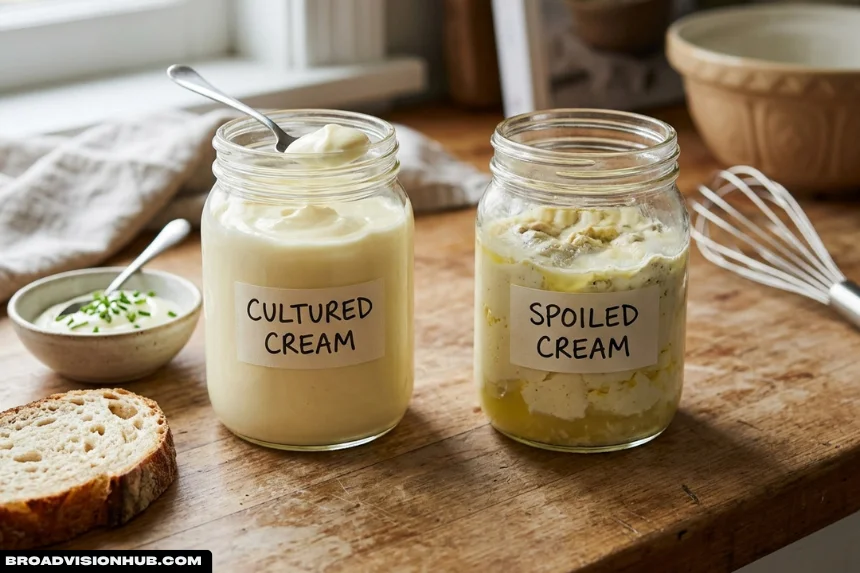
Controlled fermentation and spoilage are fundamentally different.
Cultured dairy uses selected microorganisms under controlled manufacturing conditions.
Spoiled dairy, by contrast, undergoes unwanted microbial growth, chemical deterioration, or other uncontrolled changes.
Therefore, old heavy cream that develops an unpleasant sour odor should not be treated as homemade sour cream.
Although both situations may involve increasing acidity, the microbiology and food-safety context are not equivalent.
Is Cultured Sour Cream the Same as Regular Sour Cream?
Yes, under the U.S. federal standard of identity.
The regulation permits the standardized food to be named either:
- Sour cream
- Cultured sour cream
Those labels do not describe two different grades of standard sour cream.
Therefore, a package labeled is not automatically:
- healthier;
- more natural;
- more traditional;
- more strongly fermented;
- higher in live cultures;
- more probiotic;
- or higher quality
than a comparable product labeled simply sour cream.
Instead, compare the actual:
- ingredient list;
- Nutrition Facts panel;
- milkfat content;
- culture claims;
- manufacturer information.
In other words, the word “cultured” alone is not a nutrition or probiotic claim.
Why Does the Label Use the Word “Cultured”?
Manufacturers may use that wording because federal regulations expressly allow as an alternative standardized name.
Therefore, the label does not automatically identify a special premium category.
For ordinary U.S. labeling purposes:
Cultured sour cream is standard sour cream produced through the required bacterial souring process.
What Does U.S. Law Require?
The federal standard gives a relatively precise definition.
Under 21 CFR §131.160, standard sour cream:
- begins with pasteurized cream;
- is soured by lactic-acid-producing bacteria;
- generally contains at least 18% milkfat;
- has at least 0.5% titratable acidity calculated as lactic acid;
- may contain specified optional ingredients;
- may be called either “Sour cream” or “Cultured sour cream.”
U.S. Sour Cream Standard at a Glance
| Requirement | Federal Standard |
|---|---|
| Dairy base | Pasteurized cream |
| Souring process | Lactic-acid-producing bacteria |
| Basic minimum milkfat | 18% |
| Minimum titratable acidity | 0.5%, calculated as lactic acid |
| Permitted standardized names | Sour cream / Cultured sour cream |
| Optional ingredients | Certain permitted texture, shelf-life, flavoring, sweetening, salt, rennet and related ingredients |
There is one important qualification to the 18% figure.
When characterizing sweeteners or bulky flavoring ingredients are added, the regulation calculates milkfat relative to the remaining food. However, the finished product still cannot fall below 14.4% milkfat under that provision.
Therefore, 18% is the basic standard for ordinary sour cream, while flavored formulations require additional regulatory context.
How Much Milkfat Does It Contain?
For standard unflavored sour cream, the basic federal minimum is 18% milkfat.
Milkfat contributes to the product’s:
- richness;
- mouthfeel;
- body;
- creamy character.
However, products marketed as reduced-fat, light, or alternative sour-cream products can follow different compositional or labeling requirements.
Therefore, consumers should check the actual product name and Nutrition Facts panel rather than assuming every sour-cream-style food contains exactly the same amount of fat.
How Acidic Is It?
Federal regulations require standard sour cream to reach at least 0.5% titratable acidity, calculated as lactic acid.
This wording does not mean that manufacturers simply add bottled lactic acid until the product contains 0.5%.
Titratable acidity measures the overall acid content of the food.
In traditionally lactic-acid-producing bacteria drive the souring process.
Consequently, acidity contributes to both the familiar tangy flavor and the physical changes that help create the product’s characteristic consistency.
Is Sour Cream Acidic Because It Is Fermented?
For standard cultured sour cream, yes.
Lactic-acid-producing bacteria sour the pasteurized cream and create the acidity associated with the finished food. Under the federal standard, that product may be labeled either sour cream or cultured sour cream.
However, federal regulations also recognize a separate product called acidified sour cream.
That distinction is important.
Cultured Sour Cream vs. Acidified Sour Cream
The two foods may look and taste similar, but U.S. regulations distinguish them primarily by the method used to sour the cream.
| Feature | Standard Sour Cream | Acidified Sour Cream |
|---|---|---|
| Federal section | 21 CFR §131.160 | 21 CFR §131.162 |
| Dairy base | Pasteurized cream | Pasteurized cream |
| Main souring method | Lactic-acid-producing bacteria | Safe and suitable acidifiers |
| Bacteria required? | Yes, for the souring process | No; they may be added |
| Basic minimum milkfat | 18% | 18% |
| Minimum acidity | 0.5% titratable acidity | 0.5% titratable acidity |
| Standardized name | Sour cream / Cultured sour cream | Acidified sour cream |
For standard sour cream, bacteria perform the required souring process.
For acidified sour cream, manufacturers may instead use safe and suitable acidifiers, and lactic-acid-producing bacteria are optional rather than required.
Therefore, the key distinction is not simply whether both products taste acidic.
It is how that acidity is produced.
Also delete these parts from your original
Delete the second “What Does ‘Cultured’ Mean in Cultured Sour Cream?” section because you already explained the same point earlier. Your current draft gives essentially the same fermentation explanation twice.
Also keep only one “cultured vs. spoiled” section. Right now that distinction is repeated at lines 43–51 and again at lines 85–97.
Finally, delete the orphaned duplicate text beginning with “more fermented; more traditional; more natural…” because it repeats the paragraph immediately above it and makes the article look accidentally pasted twice.
lso contain lactic-acid-producing bacteria.
Both federal standards generally require at least 18% milkfat and a titratable acidity of at least 0.5% calculated as lactic acid. The main regulatory difference, therefore, is the souring method rather than simply whether bacteria are present.
Cultured Sour Cream
Under 21 CFR §131.160, sour cream results from souring pasteurized cream using lactic-acid-producing bacteria.
Acidified Sour Cream
Under the separate standard in 21 CFR §131.162, acidified sour cream is produced by souring pasteurized cream with safe and suitable acidifiers, with or without the addition of lactic-acid-producing bacteria.
Moreover, the regulation requires the product name:
“Acidified sour cream.”
Cultured vs. Acidified Sour Cream
| Feature | Cultured Sour Cream | Acidified Sour Cream |
| Main base | Pasteurized cream | Pasteurized cream |
| Primary souring approach | Lactic-acid-producing bacteria | Added acidifiers |
| Bacteria central to souring process | Yes | Not necessarily |
| Basic minimum milkfat | 18% | 18% |
| Minimum titratable acidity | 0.5% | 0.5% |
| U.S. standardized label | Sour cream / Cultured sour cream | Acidified sour cream |
| Fermentation required as the defining souring method | Yes | No |
Both federal standards set the basic milkfat level at 18% and acidity at 0.5% calculated as lactic acid. However, their methods of developing that acidity are different.
This distinction is more meaningful than comparing “cultured sour cream” with a vaguely defined “regular sour cream.”
Does Lemon Juice Actually Culture Cream?
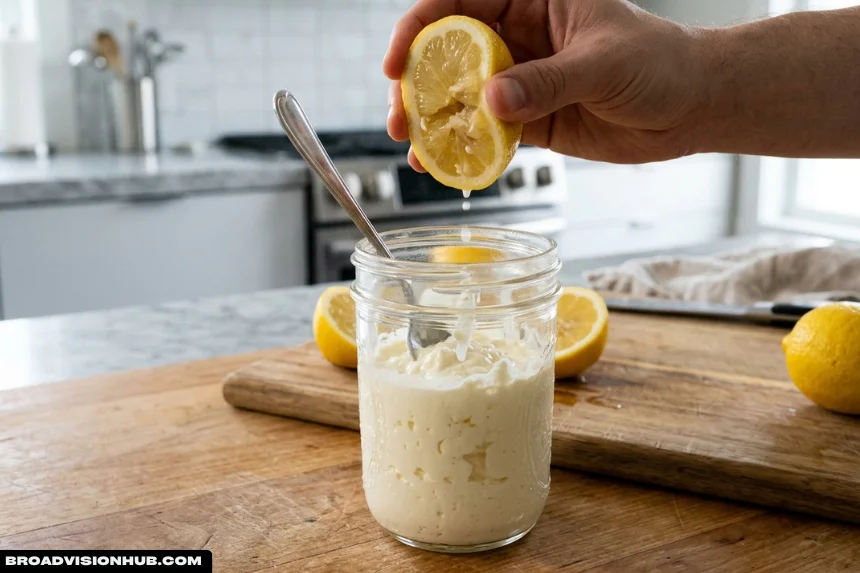
No. Adding lemon juice to cream does not culture the cream.
Lemon juice supplies acid directly.
Similarly, vinegar adds acidity directly.
Therefore:
cream + starter bacteria + fermentation
= cultured process
while:
cream + lemon juice or vinegar
= direct acidification
A homemade lemon-and-cream mixture can still work as a tangy substitute in certain recipes. However, it should not be described as having undergone bacterial culturing when no starter fermentation occurred.
Is Lemon Juice Sour Cream the Same as Acidified Sour Cream?
Not automatically in the regulatory sense.
This distinction is important.
The federal term “acidified sour cream” describes a standardized commercial food that must satisfy the applicable composition, acidity, ingredient, and labeling requirements.
A home mixture of cream and lemon juice uses the same broad idea of direct acidification, but that does not mean every homemade mixture legally qualifies as standardized acidified sour cream.
Therefore, the safest wording is:
Cream mixed with lemon juice is directly acidified rather than bacterially cultured.
Can You Make Sour Cream With Vinegar?
You can make a sour, thickened cream-style mixture with vinegar.
However, vinegar does not itself provide the bacterial fermentation that defines standard cultured sour cream.
Consequently, a recipe using:
cream + vinegar
should not be described as equivalent to:
cream + starter culture + controlled fermentation
from a dairy-science perspective.
Both can produce tanginess, but they arrive there through different processes.
What Is It Made Of?
At its most basic conceptual level, cultured sour cream starts with:
pasteurized cream + lactic-acid-producing bacteria.
However, commercial products may contain additional ingredients.
Federal regulations permit certain safe and suitable ingredients that:
- improve texture;
- prevent syneresis;
- extend shelf life.
The rule also permits limited sodium citrate before culturing, as well as rennet, salt, nutritive sweeteners, and permitted flavoring ingredients.
Therefore, an ingredient list containing a stabilizer does not automatically mean a product is “fake sour cream.”
Does It Need Only Two Ingredients?
Not necessarily.
A simple traditional formulation may have a very short ingredient list.
However, the U.S. standard explicitly permits additional ingredients for technological and sensory purposes.
Commercial manufacturers may use them to improve:
- consistency;
- stability;
- resistance to whey separation;
- flavor;
- or shelf life.
Consequently, ingredient-list length and whether the product meets the sour cream standard are not the same question.
Why Do Some Sour Creams Contain Gums or Stabilizers?
One reason is texture control.
Penn State Extension explains that stabilizers may be used in cultured dairy products to improve texture and help prevent whey from separating over time.
Federal rules similarly permit safe and suitable ingredients that improve texture or prevent syneresis, the technical term for liquid separation from the gel-like dairy structure.
Therefore, stabilizers may help manufacturers create:
- consistent thickness;
- smoother texture;
- better storage stability;
- and less visible liquid separation.
Whether a consumer prefers a shorter ingredient list is a personal purchasing choice. However, stabilizer use should not automatically be confused with an absence of bacterial culturing.
How Is Cultured Sour Cream Made?
Commercial production varies among manufacturers. Nevertheless, cultured dairy processing generally follows a controlled sequence.
Penn State Extension describes cultured dairy manufacturing as involving a dairy base, processing, fermentation, cooling, and packaging, with the exact cultures, formulations, temperatures, and times varying by product. It specifically notes that sour cream and buttermilk use different formulations and process targets from yogurt.
A simplified cultured sour cream process looks like this:
Step 1: Prepare the Cream Base
The dairy base is formulated to achieve the desired composition and finished-product characteristics.
For standardized U.S. sour cream, the regulatory starting point is pasteurized cream.
Step 2: Pasteurize the Dairy Base
Pasteurization is part of the federal identity standard for sour cream.
Besides its food-safety role, a controlled dairy base also allows the intended starter culture to develop under more predictable manufacturing conditions.
Step 3: Homogenize Where Appropriate
Commercial cultured-dairy processing may include homogenization to improve fat distribution and product consistency.
However, exact processing systems vary by manufacturer and product style.
Step 4: Add the Starter Culture
Lactic-acid-producing bacteria are introduced.
These organisms are responsible for the defining souring process required for cultured sour cream.
Step 5: Allow Controlled Fermentation
During fermentation, bacteria metabolically produce acids and other compounds.
As a result:
- acidity increases;
- flavor becomes tangier;
- protein behavior changes;
- and the product develops more body.
The exact starter organisms, fermentation temperature, and fermentation time can vary.
Penn State emphasizes that cultured dairy products use product-specific cultures, formulations, fermentation times, and temperatures.
Step 6: Cool the Cultured Product
Once the desired fermentation endpoint is reached, the product is cooled.
Cooling helps slow further culture activity and allows manufacturers to control the finished flavor and texture.
Step 7: Package and Refrigerate
The finished cultured sour cream is packaged and maintained under refrigeration.
From this point onward, temperature control remains important for both product quality and food safety.
Does Every Brand Use the Same Process?
No.
The regulatory standard defines key characteristics, but manufacturers still have flexibility in:
- cream formulation;
- starter-culture selection;
- processing equipment;
- homogenization;
- fermentation targets;
- stabilizers;
- flavor systems;
- and packaging.
Penn State Extension specifically notes that cultured dairy products can use different cultures, ingredients, fermentation times, temperatures, and formulations.
Therefore, two tubs can both legitimately be cultured sour cream while differing noticeably in:
- tanginess;
- thickness;
- buttery aroma;
- smoothness;
- and ingredient lists.
What This Dairy Product Is — and Is Not
At this point, the central distinctions are clear.
Cultured sour cream is:
pasteurized cream intentionally soured with lactic-acid-producing bacteria
a fermented dairy food
an alternative standardized name for sour cream in the United States
generally at least 18% milkfat under the basic federal standard
at least 0.5% titratable acidity calculated as lactic acid
Cultured sour cream is not automatically:
a separate product from “regular” U.S. sour cream
probiotic
lactose-free
made with only two ingredients
cream mixed with lemon juice
the same thing as acidified sour cream
spoiled cream
Those distinctions provide the foundation for understanding what happens during fermentation.
The next part examines the bacteria used in cultured sour cream, why the product tastes tangy and sometimes buttery, why it thickens, what causes liquid separation, whether cultures remain alive, whether sour cream qualifies as probiotic, how much lactose remains, and how cultured sour cream compares with crème fraîche, yogurt, and buttermilk.
Which Starter Bacteria Are Commonly Used?
Cultured sour cream is made with lactic-acid-producing starter bacteria, but not every manufacturer uses exactly the same strains.
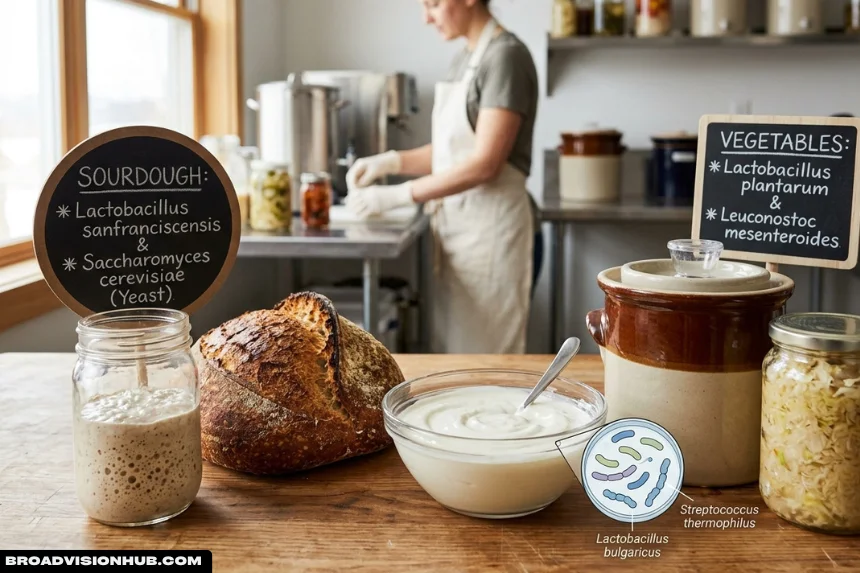
Commercial sour cream commonly relies on mesophilic dairy cultures, meaning bacteria that perform well at moderate fermentation temperatures. Dairy-science references identify Lactococcus lactis strains as important acid producers, while Leuconostoc and certain citrate-metabolizing Lactococcus strains can contribute aroma compounds.
Common organisms found in sour-cream starter systems can include:
- Lactococcus lactis subsp. lactis;
- Lactococcus lactis subsp. cremoris;
- citrate-utilizing Lactococcus strains;
- and Leuconostoc species.
However, the U.S. standard does not require one exact species combination. Instead, it requires the cream to be soured using lactic-acid-producing bacteria.
Therefore, it would be inaccurate to say:
“Every cultured sour cream contains exactly the same bacteria.”
Starter formulations can differ by manufacturer and desired flavor profile.
What Do Sour Cream Starter Cultures Actually Do?
Starter cultures perform more than one job.
Most importantly, they convert fermentable milk sugars into organic acids, especially lactic acid.
As a result:
- acidity rises;
- the flavor becomes tangier;
- milk proteins change their physical behavior;
- the cream develops more body;
- and aroma compounds can form.
Penn State Extension explains that cultured dairy products such as sour cream use product-specific starter cultures, ingredients, processing methods, and fermentation conditions.
Therefore, sour cream fermentation is not simply a way to make cream taste sour. Instead, the microorganisms help build the product’s flavor, aroma, texture, and structure.
What Creates the Tangy Flavor?
The characteristic tang in cultured sour cream comes mainly from acid production during fermentation.
As lactic-acid bacteria grow, they increase the acidity of the cream.
Consequently, the flavor changes from the relatively mild sweetness of cream to the sharper taste associated with sour cream.
However, acidity is only one part of sour cream flavor.
Different starter cultures can also produce aromatic compounds that make one brand taste:
- buttery;
- mild;
- sharp;
- creamy;
- or more intensely fermented.
Therefore, two products can meet the same sour cream standard while still tasting noticeably different.
Where Does the Buttery Flavor Come From?
One important aroma compound is diacetyl.
Diacetyl is strongly associated with buttery flavor and aroma. Certain dairy bacteria can produce it while metabolizing citrate during fermentation.
Dairy-science references describe Leuconostoc as an important flavor-producing organism in cultured dairy starters because it can contribute diacetyl. Diacetyl is particularly important in cultured products including sour cream and buttermilk.
Therefore:
lactic acid
→ contributes tanginess
while
diacetyl and related aroma compounds
→ can contribute buttery notes.
Does Every Sour Cream Contain the Same Amount of Diacetyl?
No.
The final aroma depends on factors such as:
- starter-culture composition;
- fermentation conditions;
- processing;
- formulation;
- and storage.
Therefore, one sour cream may taste noticeably buttery while another tastes primarily acidic.
What Creates the Thick Texture?
Cultured sour cream becomes thick through a combination of fermentation, milkfat, protein behavior, and product formulation.
As bacterial fermentation increases acidity, the protein structure within the cream changes.
Meanwhile, the relatively high fat content contributes richness and body.
Dairy-science references describe sour cream fermentation as producing lactic acid that promotes aggregation within the cream structure, helping create high viscosity.
Commercial manufacturers may also use stabilizing ingredients to improve consistency.
Penn State Extension notes that stabilizers can be added to cultured dairy products to provide better texture and help keep whey from separating during storage.
Therefore, sour cream thickness does not come from only one factor.
It reflects the interaction of:
acid development + protein structure + fat + processing + optional stabilizers
What Is Syneresis in Sour Cream?
Syneresis is the separation of liquid from a gel-like food structure.
In sour cream, it is usually seen as a small amount of watery-looking liquid collecting on the surface.
Commercial formulation often tries to minimize this separation because consumers generally prefer a smooth, uniform product.
Penn State Extension specifically notes that stabilizers may be used in cultured dairy products to help prevent whey separation over time.
Is Liquid on Top of Sour Cream a Sign It Has Gone Bad?
Not necessarily.
A small amount of liquid separation can be normal.
The liquid is associated with the watery phase of the dairy product separating slightly from the thicker structure.
Therefore, a thin layer of liquid by itself should not automatically be interpreted as spoilage.
However, sour cream showing other warning signs—such as mold, unusual discoloration, major package swelling, or an abnormal odor—should be treated differently.
Are Stabilizers Necessary?
Not every product uses the same stabilizer system.
However, manufacturers may use permitted stabilizing ingredients to improve:
- thickness;
- smoothness;
- water retention;
- consistency;
- and storage stability.
Penn State Extension explains that stabilizers can improve cultured-product texture and reduce whey separation.
Therefore, the presence of a gum or stabilizer does not mean the sour cream was not fermented.
Likewise, a product with a shorter ingredient list is not automatically more fermented than one containing permitted texture ingredients.
The best comparison depends on what the consumer values:
- ingredient simplicity;
- texture;
- fat content;
- taste;
- or particular culture claims.
Is It a Fermented Food?
Yes.
Cultured sour cream is a fermented dairy product because selected microorganisms intentionally grow and produce acidity in the cream.
Penn State lists sour cream alongside yogurt, buttermilk, kefir, cream cheese, and other cultured dairy products.
Therefore, calling cultured sour cream a fermented food is accurate.
However, another important distinction follows:
Fermented does not automatically mean probiotic.
Those terms describe different things.
Do Live Cultures Remain?
Starter microorganisms are used to make.
However, consumers should not assume that every product contains the same number or types of viable microorganisms when it is eaten.
Several factors can influence viable culture levels, including:
- starter strain;
- processing;
- storage time;
- storage temperature;
- and manufacturer formulation.
Therefore, readers specifically seeking live microorganisms should examine the package for statements such as:
- “live cultures”;
- “live and active cultures”;
- named microorganisms;
- or manufacturer-specific culture information.
The word cultured by itself primarily tells you that fermentation was used to make the food.
It does not tell you the viable microorganism count at the moment of consumption.
Is Cultured Sour Cream Probiotic?
Not automatically.
This is one of the most important distinctions in the article.
The National Institutes of Health defines probiotics as live microorganisms that provide health benefits when consumed in sufficient amounts. NIH also explains that although microorganisms are used to produce fermented foods, not every fermented food necessarily contains microorganisms with demonstrated probiotic benefits.
Therefore:
Cultured sour cream is fermented, but it should not automatically be described as a probiotic food.
For a strong probiotic claim, the important questions are:
- Which microorganism is present?
- What strain is it?
- Is it alive when consumed?
- Is enough present?
- Is a health benefit supported for that strain and amount?
The word cultured alone cannot answer those questions.
Is Cultured Sour Cream Good for Gut Health?
It is better to avoid a broad statement such as:
“Cultured sour cream improves gut health.”
The evidence depends on the particular microorganisms present and whether they meet the criteria for probiotic benefit.
NIH emphasizes that health effects depend on specific probiotic microorganisms and amounts rather than simply on whether a food underwent fermentation.
Therefore, a more accurate statement is:
Some cultured dairy products may contain live microorganisms, but the fermentation process alone does not prove a specific gut-health benefit.
This distinction prevents the article from turning a food-processing fact into an unsupported medical claim.
Does Cultured Sour Cream Contain Lactose?
Yes. Standard is still a dairy food and can contain lactose.
Lactose is the naturally occurring sugar in milk and milk products.
Although microorganisms consume some fermentable sugars during cultured-dairy production, fermentation should not be interpreted as automatically removing all lactose.
Therefore:
Cultured sour cream is not automatically lactose-free.
Consumers who specifically need lactose-free dairy should look for a product that is clearly labeled lactose-free or lactose-reduced.
Does Fermentation Remove All the Lactose From Sour Cream?
No.
Fermentation changes the dairy product, but it does not guarantee complete lactose removal.
Consequently, the statements:
“cultured”
and
“lactose-free”
are not interchangeable.
The most reliable way to identify a lactose-free sour cream product is to check the manufacturer’s labeling rather than assuming fermentation has removed the lactose.
Can People With Lactose Intolerance Eat Cultured Sour Cream?
Tolerance varies.
The National Institute of Diabetes and Digestive and Kidney Diseases explains that people with lactose intolerance can tolerate different amounts of lactose. Many people do not need to completely eliminate every milk product, but individual responses differ.
Therefore, the article should not promise:
“Cultured sour cream is safe for everyone with lactose intolerance.”
Instead:
Some people with lactose intolerance may tolerate small amounts of certain dairy foods, while others may experience symptoms. Cultured sour cream should still be treated as a lactose-containing dairy food unless specifically labeled otherwise.
NIDDK also notes that lactose-free and lactose-reduced dairy products are available for people who need to reduce lactose intake.

Lactose Intolerance vs. Milk Allergy
These two conditions are often confused, but they are not the same.
Lactose Intolerance
Lactose intolerance involves difficulty digesting lactose, the natural sugar found in dairy.
Symptoms can include:
- bloating;
- gas;
- diarrhea;
- nausea;
- and abdominal discomfort.
Milk Allergy
Milk allergy is an immune-system reaction to milk proteins.
NIDDK explicitly distinguishes lactose intolerance from milk allergy.
Therefore, even a lactose-free sour cream may still contain milk proteins and may not be suitable for someone with a milk allergy.
That distinction is important when readers search for dairy alternatives.
Is Cultured Sour Cream Healthier Than Regular Sour Cream?
Not simply because the word “cultured” appears on the label.
As explained earlier, and sour cream are alternative names for the same standardized U.S. product.
Therefore, comparing “cultured” with “regular” as though one category were automatically healthier is misleading.
Instead, compare individual products based on factors such as:
- serving size;
- calories;
- saturated fat;
- sodium;
- ingredient list;
- milkfat level;
- and specific live-culture claims.
Additionally, remember:
Cultured does not automatically mean probiotic.
Therefore, consumers should not assume a health advantage solely from that word.
Cultured Sour Cream vs. Crème Fraîche
Cultured sour cream and crème fraîche are related fermented cream products, but they are not identical.
Utah State University Extension describes crème fraîche as cultured cream and notes that it is generally less sour and richer in fat than typical U.S. sour cream.
Cultured Sour Cream vs. Crème Fraîche
| Feature | Cultured Sour Cream | Crème Fraîche |
|---|---|---|
| Dairy base | Cream | Cream |
| Fermented | Yes | Yes |
| Typical flavor | Distinctly tangy | Usually milder and richer |
| U.S. standardized sour-cream identity | Yes | No |
| Texture | Thick and creamy | Thick and rich |
| Common uses | Toppings, dips, baking, sauces | Sauces, soups, desserts, toppings |
| Heat behavior | Can separate under aggressive heat | Often more forgiving in cooking |
Both products have legitimate culinary uses.
However, they should not be treated as identical simply because both begin with cultured cream.
Can Crème Fraîche Replace Cultured Sour Cream?
Often, yes, depending on the recipe.
Crème fraîche can work particularly well in:
- sauces;
- soups;
- toppings;
- creamy dressings;
- and savory dishes.
However, because its flavor and fat level can differ from sour cream, the result may taste richer and less sharply acidic.
Therefore, substitution may change the final flavor even when the texture works well.
Cultured Sour Cream vs. Yogurt
Both sour cream and yogurt are fermented dairy foods.
However, their formulations and manufacturing processes differ.
Penn State Extension notes that different cultured dairy products require different cultures, ingredients, processing methods, fermentation times, and temperatures.
The simplest practical distinction is:
Cultured Sour Cream
Primarily cream-based and relatively high in fat.
Yogurt
Primarily milk-based and cultured using yogurt-specific starter systems.
Therefore, yogurt and sour cream should not be treated as nutritionally identical.
Can Yogurt Replace Sour Cream?
Sometimes.
Plain yogurt, especially thick Greek-style yogurt, can replace sour cream in many recipes such as:
- dips;
- dressings;
- baked goods;
- sauces;
- and toppings.
However, the result may differ in:
- fat content;
- tartness;
- thickness;
- and heat stability.
Therefore, substitution works best when the recipe can tolerate those differences.
Cultured Sour Cream vs. Buttermilk
Both and cultured buttermilk are fermented dairy products, but they differ significantly in texture and consistency.
Characteristics of Cultured Sour Cream
- Cream-based
- Thick
- Rich
- Spoonable
Characteristics of Cultured Buttermilk
- milk-based;
- much thinner;
- pourable;
- commonly used in baking and marinades.
Dairy-science sources note that cultured buttermilk and sour cream can use related mesophilic starter systems, including acid-producing lactococci and aroma-producing organisms. However, their dairy bases and finished structures are different.
Why Can Sour Cream and Buttermilk Taste Similar?
Both can develop:
- lactic acidity;
- tangy flavor;
- and buttery aromatic notes.
In particular, diacetyl-producing starter bacteria can contribute the familiar buttery aroma associated with several cultured dairy products.
However, sour cream contains substantially more fat and develops a much thicker body.
Therefore, similar fermentation aromas do not make the two products interchangeable in every recipe.
Can Buttermilk Replace Cultured Sour Cream?
Not directly in equal-volume applications where thickness matters.
For example, buttermilk may work well when a recipe needs:
- acidity;
- moisture;
- or a pourable dairy ingredient.
However, it cannot provide the same thickness as sour cream without other recipe adjustments.
Therefore, substitution depends on what function sour cream is performing.
Cultured Sour Cream, Yogurt, Crème Fraîche and Buttermilk Compared
| Feature | Cultured Sour Cream | Crème Fraîche | Yogurt | Cultured Buttermilk |
| Fermented dairy | Yes | Yes | Yes | Yes |
| Main base | Cream | Cream | Milk | Milk |
| Texture | Thick | Thick | Spoonable to thick | Pourable |
| Typical flavor | Tangy | Mild/rich | Tangy | Tangy/buttery |
| High fat | Usually | Usually | Varies | Usually much lower |
| Same culture system | Not necessarily | Not necessarily | No | Related systems may be used |
| Good for toppings | Yes | Yes | Yes | Usually no |
| Common baking use | Yes | Sometimes | Yes | Yes |
The main lesson is simple:
“Cultured dairy” describes a broad family of foods, not one identical fermentation process or nutritional profile.
Different cultured dairy products use different bases, cultures, fermentation targets, and formulations. Penn State specifically emphasizes these product-specific differences.
What Should You Look for on a Cultured Sour Cream Label?
If you are comparing supermarket products, focus on actual label information rather than marketing assumptions.
Check:
Ingredient List
This can show:
- cream;
- cultures;
- stabilizers;
- salt;
- or other permitted ingredients.
Nutrition Facts
Compare:
- serving size;
- calories;
- saturated fat;
- sodium;
- and other nutrients relevant to your diet.
Culture Statements
If live microorganisms matter to you, look for language identifying:
- live cultures;
- named cultures;
- or other manufacturer-specific information.
Lactose Claims
Do not assume culturing means lactose-free.
Look specifically for:
lactose-free or lactose-reduced
when that matters.
Cultured Sour Cream: Fermentation Facts vs. Common Assumptions
| Statement | Accurate? |
| Cultured sour cream is fermented | ✅ Yes |
| Lactic-acid bacteria create acidity | ✅ Yes |
| All brands use exactly the same starter bacteria | ❌ No |
| Diacetyl can contribute buttery aroma | ✅ Yes |
| Fermentation contributes to thickening | ✅ Yes |
| Liquid separation always means spoilage | ❌ No |
| Cultured means probiotic | ❌ Not automatically |
| Every tub contains the same number of live bacteria | ❌ No |
| Culturing removes all lactose | ❌ No |
| Lactose intolerance and milk allergy are the same | ❌ No |
| Crème fraîche and sour cream are identical | ❌ No |
| Yogurt and sour cream use identical processes | ❌ No |
| Buttermilk and sour cream are interchangeable everywhere | ❌ No |
What Makes Cultured Sour Cream Unique?
Cultured sour cream sits at an interesting point between cream and fermentation.
Its character comes from several elements working together:
cream provides richness.
lactic-acid bacteria develop acidity.
starter-culture metabolism creates characteristic flavors.
diacetyl and related compounds can contribute buttery aroma.
acid-induced structural changes help create thickness.
milkfat adds body and smoothness.
optional stabilizers can improve consistency and reduce whey separation.
Therefore, cultured sour cream is not simply heavy cream that tastes sour.
It is a deliberately manufactured fermented dairy product whose final characteristics depend on the cream base, microorganisms, fermentation conditions, and formulation.
However, understanding how it is produced raises another practical question:
Can you safely make cultured sour cream yourself?
The final part covers homemade , why pasteurized cream is the safer choice, the difference between controlled fermentation and spoiled dairy, refrigeration, room-temperature limits, freezing, spoilage signs, cooking and baking uses, substitutions, common myths.
Can You Make Cultured Sour Cream at Home?
Yes can be made at home, but controlled fermentation and food safety matter.
The safest approach is not to leave cream at room temperature and hope it becomes sour. Instead, home culturing should begin with pasteurized cream, clean equipment, and an appropriate starter culture.
Utah State University Extension provides a research-based cultured-cream method that uses heated cream, a defined starter source, sanitized jars, controlled incubation, and a target acidity of pH 4.6 or below. Although its published recipe is for cultured cream or crème fraîche rather than standardized commercial sour cream, the guidance illustrates an important principle: successful dairy fermentation should be deliberate and controlled, not accidental spoilage.
Therefore, home cooks should use a tested recipe rather than improvising fermentation temperatures and times.
Basic Safety Principles for Homemade Cultured Cream
Use:
- pasteurized cream;
- clean and sanitized containers;
- a reliable starter culture;
- a research-tested recipe;
- controlled fermentation conditions;
- and prompt refrigeration after fermentation.
Do not use cream that is already questionable or spoiled as the starting material.
Why Use Pasteurized Cream?
Pasteurization significantly reduces the risk from dangerous microorganisms that may occur in raw dairy.
The FDA warns that unpasteurized milk and cream can carry pathogens including:
- Salmonella;
- E. coli;
- Listeria;
- and Campylobacter.
These organisms can cause serious foodborne illness. The risk is particularly concerning for children, pregnant people, older adults, and people with weakened immune systems.
Therefore, for homemade cultured sour cream, pasteurized cream is the safer starting point.
This choice also matches the U.S. standardized definition discussed earlier, which specifies pasteurized cream for commercial sour cream.
Is Raw Cream Better for Cultured Sour Cream?
No reliable food-safety basis supports calling raw cream the better choice.
Raw dairy enthusiasts sometimes claim that naturally occurring microorganisms make raw cream ideal for fermentation. However, the FDA emphasizes that raw milk does not reliably eliminate pathogens and can contain harmful bacteria even when it appears normal.
Moreover, dangerous contamination cannot always be detected by:
- smell;
- appearance;
- flavor;
- or routine sensory inspection.
Therefore, a cream that looks fresh can still contain harmful microorganisms.
For home food safety:
Choose pasteurized cream and use a defined fermentation method rather than relying on uncontrolled microorganisms in raw dairy.
Is Spoiled Cream the Same as Cultured Sour Cream?
No.
This is one of the most important distinctions in the entire article.
Cultured Sour Cream
Cultured sour cream results from controlled fermentation using intended lactic-acid-producing bacteria.
Spoiled Cream
Spoiled cream has undergone unwanted changes from uncontrolled microbial growth, chemical deterioration, or poor storage.
Therefore:
Cream becoming sour because it has been forgotten in the refrigerator does not turn it into cultured sour cream.
Pasteurization also does not make cream shelf-stable forever. The FDA notes that pasteurized dairy still needs refrigeration because spoilage organisms can remain or contamination can occur after processing.
Never use visibly spoiled or suspicious cream as a starter culture.
Can Old Sour Cream Be Used as a Starter?
Do not assume that an old container is suitable simply because it still smells tangy.
A deliberately selected starter should contain microorganisms suitable for the fermentation being performed.
Old dairy may have:
- declining culture activity;
- unwanted contamination;
- storage abuse;
- or spoilage organisms.
Therefore, when making cultured cream at home, a fresh commercial starter or a research-tested starter source is a better choice.
How Long Does Cultured Sour Cream Last?
Commercial sour cream should remain refrigerated.
USDA guidance states that sour cream is generally safe in the refrigerator for approximately one to three weeks under proper refrigeration, although package instructions, opening date, contamination, and handling conditions also matter.
However, this range should not be interpreted as a guarantee that every opened container will remain good for exactly three weeks.
Always consider:
- the manufacturer’s date;
- how long the package has been open;
- refrigerator temperature;
- whether clean utensils were used;
- and whether spoilage signs are present.
How Long Does Homemade Cultured Sour Cream Last?
Homemade products deserve more conservative handling because they do not necessarily have the same:
- commercial sanitation controls;
- packaging;
- stabilizers;
- processing;
- or shelf-life validation
as factory-produced sour cream.
Colorado State University Extension lists approximately 3–4 days for homemade sour-cream-type dips compared with roughly two weeks for commercial products in its general storage guidance.
Therefore, follow the storage period given by the specific tested recipe you used rather than assuming homemade sour cream has the same shelf life as a sealed commercial tub.
What Temperature Should Cultured Sour Cream Be Stored At?
Keep sour cream refrigerated at 40°F (4°C) or below.
The FDA recommends maintaining refrigerated dairy products at 40°F or colder.
An appliance thermometer can help confirm that the refrigerator is actually maintaining a safe temperature.
This is particularly useful because a refrigerator may feel cold while still operating above the recommended temperature.
How Long Can Cultured Sour Cream Sit Out?
Follow the general food-safety rule for perishable dairy:
Refrigerate it within two hours.
If the surrounding temperature is above 90°F (32°C), refrigerate perishables within one hour.
The FDA gives these time limits as part of its safe-food-handling guidance.
Therefore, sour cream should not remain:
- on a buffet all afternoon;
- beside the stove for several hours;
- in a hot car;
- or on a picnic table in summer heat.
Does Fermentation Make Sour Cream Safe at Room Temperature?
No.
Fermentation creates acidity, but refrigerated remains a perishable dairy product.
The fact that it has been fermented does not make it shelf-stable.
Therefore:
fermented does not mean safe to store unrefrigerated indefinitely.
Can You Freeze Cultured Sour Cream?
Technically, sour cream can freeze, but the quality often suffers.
USDA guidance specifically notes that sour cream does not freeze well.
Freezing can disrupt the product’s emulsion and gel structure.
After thawing, you may notice:
- graininess;
- watery separation;
- reduced smoothness;
- or a less creamy texture.
Therefore, freezing is usually not the best choice when you plan to use sour cream as a fresh topping.
Can Frozen Sour Cream Still Be Used for Cooking?
Often, yes.
If the thawed texture is no longer smooth enough for:
- tacos;
- baked potatoes;
- dips;
- or garnishes,
it may still work reasonably well in:
- casseroles;
- cakes;
- muffins;
- sauces;
- or other cooked dishes
where perfect visual texture matters less.
Thaw frozen dairy in the refrigerator rather than on the counter.
How Can You Tell if Cultured Sour Cream Has Gone Bad?
Possible spoilage warning signs include:
- visible mold;
- unusual discoloration;
- distinctly abnormal or unpleasant odor;
- unusual texture;
- severe separation accompanied by other changes;
- or damaged or swollen packaging.
Penn State Extension advises discarding refrigerated food that develops an unusual odor, color, or texture and specifically warns not to taste questionable food to determine whether it is safe.
Therefore:
When sour cream seems genuinely questionable, tasting it is not an appropriate safety test.
Is Watery Sour Cream Spoiled?
Not necessarily.
A small amount of liquid separation can occur through syneresis.
Therefore, seeing a little watery liquid on the surface does not automatically mean sour cream is unsafe.
However, liquid separation combined with:
- mold;
- abnormal color;
- unpleasant smell;
- or major deterioration
is more concerning.
Judge the whole product rather than relying on one characteristic.
Can You Scrape Mold Off Sour Cream?
No.
Sour cream is a soft, high-moisture food. Mold growth can extend below the visible surface.
Therefore, do not scrape away the visible spot and eat the rest.
Discard a sour cream container when mold is present.
Can You Cook With Cultured Sour Cream?
Absolutely.
Cultured sour cream works in both cold and cooked dishes.
Common uses include:
- baked potatoes;
- tacos;
- nachos;
- dips;
- dressings;
- soups;
- casseroles;
- mashed potatoes;
- sauces;
- cheesecakes;
- muffins;
- cakes;
- pancakes;
- and quick breads.
Its combination of acidity, milkfat, and moisture gives it several useful culinary functions.
What Does Cultured Sour Cream Do in Baking?
In baking, sour cream can contribute:
Moisture
Its water content helps keep cakes and quick breads tender.
Fat
Milkfat contributes richness and softer texture.
Acidity
The acidity can influence flavor and interact with alkaline leaveners such as baking soda when the recipe is formulated around that reaction.
Body
Its thickness adds moisture without thinning batter as much as ordinary milk might.
Therefore, sour cream is especially common in:
- coffee cakes;
- pound cakes;
- muffins;
- cheesecakes;
- pancakes;
- and rich quick breads.
Can Cultured Sour Cream Replace Regular Sour Cream?
Yes.
For U.S. recipes, this is generally straightforward because cultured sour cream and sour cream are alternative names for the same standardized product category.
Therefore, when a recipe asks for full-fat sour cream, a product labeled can generally be used directly.
The more important distinctions are whether the product is:
- full-fat;
- reduced-fat;
- fat-free;
- dairy-free;
- flavored;
- or otherwise specially formulated.
Those variations can affect recipe behavior more than the word “cultured.”
Can Yogurt Replace Cultured Sour Cream?
Often, yes.
Utah State University Extension lists plain yogurt as a possible substitute for sour cream in cooking and baking.
However, the finished dish may differ in:
- fat content;
- tanginess;
- thickness;
- richness;
- and heat stability.
Greek-style yogurt is usually closer in thickness than ordinary yogurt.
Therefore, yogurt substitution works best when the recipe can tolerate a somewhat different dairy profile.
Can Buttermilk Replace Cultured Sour Cream?
Sometimes, but not as a direct substitute where thickness is important.
Buttermilk provides:
- acidity;
- fermented dairy flavor;
- and moisture.
However, it is much thinner than sour cream.
Consequently, replacing one cup of sour cream with one cup of buttermilk may make a batter, sauce, or dip too loose unless the rest of the recipe is adjusted.
Can Crème Fraîche Replace Cultured Sour Cream?
Yes, in many savory and dessert applications.
Crème fraîche is also cultured cream, but it tends to be:
- richer;
- milder;
- and less sharply acidic.
Therefore, the final dish may taste less tangy.
Crème fraîche can be particularly useful in hot sauces because its richer composition often makes it more tolerant of heating.
Why Does Sour Cream Sometimes Curdle in Hot Food?
High heat can destabilize dairy proteins and cause separation.
To reduce the risk:
- avoid aggressively boiling sour cream;
- lower the heat before adding it;
- stir it in gradually;
- or temper it with some warm liquid first.
For soups and sauces, adding sour cream near the end of cooking often produces a smoother result.
Should Sour Cream Be Boiled?
Usually, prolonged hard boiling is unnecessary and can damage texture.
A better technique is to cook the main dish first, reduce the heat, and then incorporate the sour cream gently.
This is especially useful for:
- creamy soups;
- stroganoff-style sauces;
- pan sauces;
- and casseroles.
Is Cultured Sour Cream Healthy?
Cultured sour cream can fit into many diets, but the word cultured does not automatically make it healthier than another sour cream.
Remember that U.S. regulations treat sour cream and as alternative names for the same standardized food.
Therefore, nutritional evaluation should depend on the actual product.
Check:
- portion size;
- calories;
- saturated fat;
- sodium;
- ingredient list;
- and any specific live-culture claims.
Also remember that fermented does not automatically mean probiotic.
Cultured Sour Cream Myths vs. Facts
| Claim | Fact |
|---|---|
| Cultured sour cream is completely different from ordinary U.S. sour cream | ❌ No. The names can describe the same standardized product |
| Cultured sour cream is fermented | ✅ Yes |
| Lemon juice cultures cream | ❌ No. It directly acidifies it |
| Acidified sour cream and cultured sour cream use identical souring methods | ❌ No |
| Every cultured sour cream uses identical bacteria | ❌ No |
| Cultured automatically means probiotic | ❌ No |
| Culturing removes all lactose | ❌ No |
| Cultured sour cream can contain stabilizers | ✅ Yes |
| A little surface liquid automatically means spoilage | ❌ No |
| Spoiled cream becomes cultured sour cream | ❌ No |
| Raw cream is automatically safer or better for fermentation | ❌ No |
| Cultured sour cream needs refrigeration | ✅ Yes |
| Commercial sour cream can generally be refrigerated about 1–3 weeks | ✅ USDA general guidance |
| Sour cream freezes perfectly | ❌ No. Texture usually suffers |
| Cultured sour cream works in baking | ✅ Yes |
| Cultured sour cream can replace regular sour cream | ✅ Yes |
Frequently Asked Questions About Cultured Sour Cream
What is cultured sour cream?
Cultured sour cream is pasteurized cream intentionally fermented with lactic-acid-producing bacteria.
In the United States, “sour cream” and are alternative standardized names for the same food category.
What does cultured mean on sour cream?
It means microorganisms were deliberately used to ferment and sour the cream.
The term refers to controlled bacterial fermentation rather than accidental spoilage.
Is cultured sour cream the same as regular sour cream?
Under the U.S. standard of identity, yes. Sour cream may alternatively be labeled
Yes. Lactic-acid-producing bacteria intentionally create acidity during manufacturing.
Is cultured sour cream probiotic?
Not automatically.
Fermentation and probiotic status are different concepts. A probiotic claim depends on specific live microorganisms and demonstrated benefits.
Does cultured sour cream have live cultures?
Cultures are used during production, but the word “cultured” alone does not guarantee a particular viable culture count when you eat the product.
Check individual package and manufacturer information when live cultures matter to you.
Does cultured sour cream have lactose?
Yes, conventional can contain lactose.
It should not be considered lactose-free unless specifically labeled that way.
Is cultured sour cream safe for lactose intolerance?
Tolerance varies between individuals.
Some people tolerate certain amounts of dairy, while others experience symptoms with smaller amounts. A lactose-free product may be preferable when lactose needs to be strictly limited.
Is cultured sour cream safe for milk allergy?
Regular sour cream contains milk proteins.
Therefore, lactose-free sour cream would not automatically be safe for someone with a milk allergy.
Is cultured sour cream healthier than regular sour cream?
Not simply because it says cultured.
Since the terms can refer to the same standardized product, compare the actual Nutrition Facts and ingredient lists.
What is acidified sour cream?
Acidified sour cream is a separately defined U.S. product in which safe and suitable acidifiers can be used to create acidity, with or without bacterial cultures.
Can lemon juice make cultured sour cream?
No.
Lemon juice directly acidifies cream. It does not create bacterial fermentation by itself.
Can you make cultured sour cream at home?
Yes, but use pasteurized cream, clean equipment, an appropriate culture, and a research-tested fermentation method.
Can you use raw cream?
Raw cream carries greater microbial risk. FDA recommends choosing pasteurized dairy because raw milk and cream can contain dangerous pathogens.
Is spoiled cream the same as cultured sour cream?
No.
Culturing is controlled fermentation. Spoilage is uncontrolled deterioration.
How long does cultured sour cream last?
USDA gives approximately one to three weeks refrigerated as general guidance for commercial sour cream.
Follow the product label and discard it earlier if spoilage appears.
What temperature should sour cream be stored at?
Keep refrigerated dairy at 40°F (4°C) or below.
How long can sour cream sit out?
Perishable dairy should generally be refrigerated within two hours, or within one hour when temperatures exceed 90°F.
Can you freeze cultured sour cream?
You can freeze it, but USDA notes that sour cream does not freeze well because texture can deteriorate.
Is watery sour cream bad?
A small amount of whey separation can be normal.
However, discard the product if other spoilage signs such as mold, unusual color, or abnormal odor appear.
Can you bake with cultured sour cream?
Yes.
It contributes moisture, richness, acidity, and tenderness to many baked goods.
Can cultured sour cream replace sour cream in a recipe?
Yes. For standard U.S. products, cultured sour cream and sour cream are alternative names for the same standardized category.
What is the difference between cultured sour cream and crème fraîche?
Both are cultured cream products, but crème fraîche is generally richer and milder, whereas U.S. sour cream typically has a more pronounced tang.
Is cultured sour cream the same as yogurt?
No.
Both are fermented dairy foods, but sour cream is cream-based while yogurt is primarily milk-based and uses different formulations and fermentation systems.
Final Thoughts on Cultured Sour Cream
Cultured sour cream is more than cream with a sour taste.
It is a deliberately fermented dairy food made by souring pasteurized cream with lactic-acid-producing bacteria.
Most importantly for U.S. consumers, cultured sour cream is not a special category separate from ordinary sour cream. Under the federal standard, “Sour cream” and “Cultured sour cream” are alternative names for the same standardized food.
Meanwhile, acidified sour cream is separately defined because direct acidifiers can be used in its production.
That distinction also explains why:
cream + bacterial culture + fermentation
is not the same process as
cream + lemon juice or vinegar.
Likewise, fermentation should not be confused with spoilage.
Cultured sour cream is produced using intended microorganisms and controlled processing, whereas spoiled cream has deteriorated unpredictably.
The word cultured also does not guarantee that a product is:
- probiotic;
- lactose-free;
- nutritionally superior;
- or made with exactly two ingredients.
Instead, consumers should rely on the actual ingredient list, Nutrition Facts panel, culture claims, and product labeling.
Finally, food safety still matters after fermentation.
Use pasteurized dairy for homemade culturing, keep sour cream at 40°F or below, avoid leaving it unrefrigerated for extended periods, and discard products showing genuine spoilage. FDA continues to warn that raw milk and cream can contain serious foodborne pathogens, while USDA gives approximately one to three weeks as general refrigerated storage guidance for commercial sour cream.
With those distinctions clear, cultured sour cream becomes much easier to understand: it is a controlled fermented cream product valued for its tangy flavor, rich texture, culinary versatility, and long-standing role in American cooking.
LEARN MORE ABOUT : Beeswax Benefits