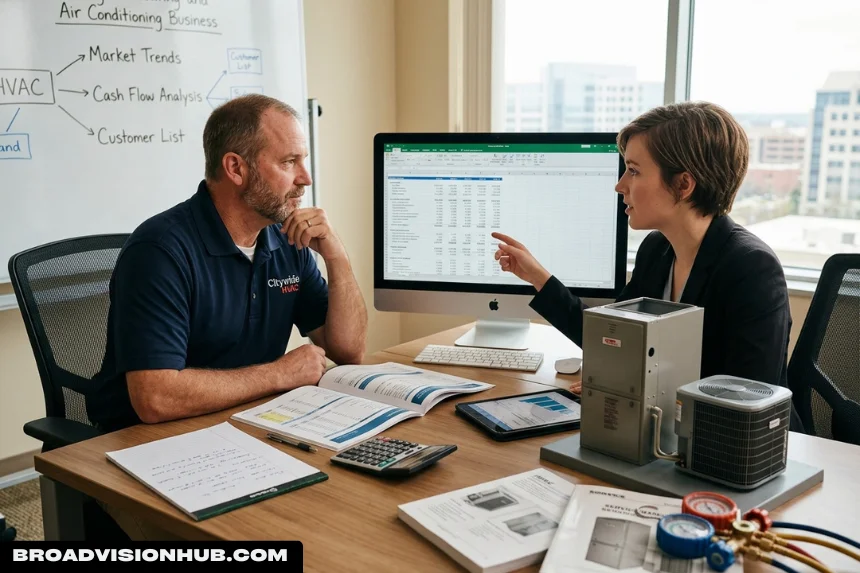
Learning how to value a heating and air conditioning business starts with its normalized earnings, not its total revenue or the original cost of its equipment. Most owner operated HVAC companies use seller’s discretionary earnings, or SDE. Meanwhile, larger companies with professional management generally use adjusted EBITDA. A market supported multiple is then applied to the appropriate earnings figure.
However, this calculation provides only a starting point. A buyer will also evaluate maintenance agreements, customer concentration, service mix, owner involvement, technician retention, financial records, vehicles, licenses, liabilities, and future capital needs. Therefore, two HVAC companies with identical revenue can have substantially different values.
A proper valuation should produce a reasonable range rather than one guaranteed price. Moreover, the final amount a seller receives can change because of debt, cash, working capital, earnouts, seller financing, taxes, and other transaction terms.
Quick answer: Calculate normalized SDE for a smaller owner operated HVAC company or adjusted EBITDA for a larger management run business. Next, multiply that figure by a range supported by comparable transactions. Finally, cross check the result against cash flow, assets, liabilities, recurring revenue, operational risks, and the proposed deal structure.
Therefore, understanding how to value a heating and air conditioning business requires both an earnings calculation and a review of company-specific risks.
This guide provides an educational framework for estimating value. Nevertheless, a formal appraisal may be necessary for financing, tax reporting, litigation, succession planning, or a completed business sale.
How to Value a Heating and Air Conditioning Business at a Glance
The basic calculation appears simple:
Estimated value = Normalized earnings × Market supported multiple
Still, the inputs require careful judgment. First, the correct earnings metric must be selected. Second, the financial statements must be normalized. Finally, the multiple must reflect comparable businesses with similar size, services, risk, and buyer appeal.
For a small owner-operated company, the starting formula is usually:
Indicative value = Normalized SDE × Relevant SDE multiple
For a larger company with an established management team, buyers may start with:
Enterprise value = Adjusted EBITDA × Relevant EBITDA multiple
These formulas cannot be used interchangeably. In particular, applying an EBITDA multiple to SDE may overstate value because SDE normally includes one owner’s compensation.

Which Valuation Method Should You Use?
| Business situation | Best starting point | Why it may be appropriate | Main limitation |
|---|---|---|---|
| Owner-operated HVAC company | Normalized SDE | Reflects the financial benefit available to one working owner | Add-backs must be documented and defensible |
| Management-run HVAC company | Adjusted EBITDA | Measures operating performance while retaining professional management costs | Adjustments can distort earnings if used aggressively |
| Company with reliable comparable sales | Market approach | Reflects prices paid for similar businesses | Private transaction details may be limited |
| Company with predictable future cash flow | Income approach or DCF | Considers future earning capacity | Results depend heavily on assumptions |
| Asset-heavy or distressed company | Asset approach | Values equipment, inventory, vehicles, and other assets after liabilities | May overlook goodwill and recurring customer relationships |
In addition, choosing how to value a heating and air conditioning business depends on its size, management structure, financial stability, and valuation purpose.
A reliable valuation often uses more than one approach. For example, an owner may calculate value from SDE and then compare the result with recent HVAC transactions. An adviser may also use an income-based method as a second check.
What Does an HVAC Business Valuation Measure?
An HVAC business valuation estimates the economic value of the company as of a specific date and for a specific purpose. Although people often use “business value,” “asking price,” and “sale price” as if they mean the same thing, each term represents something different.
Understanding these differences prevents unrealistic expectations and calculation errors.
Fair Market Value in an HVAC Business Valuation
For federal valuation purposes, the IRS describes fair market value as the price a willing buyer and willing seller would agree upon when neither must complete the transaction and both understand the relevant facts.
This definition highlights an important point: fair market value does not depend only on what the owner wants. Instead, it considers financial performance, market conditions, company-specific risks, and available transaction evidence.
Furthermore, the IRS’s established valuation guidance does not provide one formula that fits every closely held business. Relevant facts must be considered together. Therefore, a general online multiple cannot prove the fair market value of a particular HVAC company.
For this reason, deciding how to value a heating and air conditioning business requires more than applying one general industry formula.
Asking Price Versus HVAC Business Market Value
However, an asking price is the amount the owner initially requests. However, it may reflect personal goals, retirement needs, emotional attachment, or an adviser’s marketing strategy.
Estimated market value, by comparison, should rely on financial evidence and market conditions. Even then, the negotiated purchase price may change after due diligence.
For example, a buyer could initially offer $2 million. Later, the buyer might discover that several vehicles require replacement. The parties may reduce the price, adjust the working-capital requirement, or move part of the payment into an earnout.
Consequently, owners should distinguish among:
- The desired asking price.
- The estimated market value.
- The negotiated purchase price.
- Cash received at closing.
- Deferred payments or earnouts.
- Net proceeds after debt, fees, and taxes.
Enterprise Value Versus Equity Value in HVAC Valuation
Meanwhile, enterprise value estimates the value of the company’s operating business without focusing primarily on how that business is financed. An EBITDA multiple commonly produces an enterprise-value estimate.
Equity value, on the other hand, represents the amount attributable to the owner after applicable financial adjustments.
A simplified illustration is:
Illustrative equity value = Enterprise value + Included cash − Assumed debt ± Transaction adjustments
Suppose an HVAC company has an estimated enterprise value of $4 million. It also has $150,000 of transferable cash and $600,000 of debt that must be paid at closing. Before other adjustments, the illustrative equity value would be $3.55 million.
However, the actual purchase agreement controls the calculation. Some transactions are completed on a cash-free, debt-free basis. Others include selected assets, liabilities, inventory, or receivables. Therefore, the seller should never assume that enterprise value equals cash received.
The Purchase Price May Include More Than Cash
For example, a buyer might offer a higher headline price while paying only part of it at closing. The rest could depend on:
- An earnout tied to future performance.
- A seller-financed promissory note.
- An escrow or holdback.
- Continued customer retention.
- A working-capital adjustment.
- The seller remaining for a transition period.
As a result, two offers with the same stated price may have very different levels of risk. A lower all-cash offer could be more valuable than a higher offer that depends heavily on uncertain future results.
Why the Valuation Purpose Matters
Therefore, the reason for the valuation influences the required level of detail, documentation, and independence.
Common purposes include:
- Preparing to sell the company.
- Evaluating an acquisition.
- Securing business financing.
- Buying out a partner.
- Planning retirement or succession.
- Transferring ownership to family members.
- Establishing value for tax purposes.
- Resolving a legal or marital dispute.
- Measuring progress toward an owner’s exit goal.
An informal estimate may support internal planning. In contrast, a lender, court, tax authority, or unrelated buyer may require a qualified independent valuation.
Why the Valuation Date Matters
Moreover, business value changes over time.For instance, earnings may rise, a major customer may leave, or a maintenance program may improve retention. Similarly, interest rates, buyer demand, labor availability, and local economic conditions may change.
Therefore, every valuation should identify its effective date. A valuation prepared two years ago may no longer reflect the company’s current financial condition or the present acquisition market.
Moreover, anyone determining how to value a heating and air conditioning business should use information available on the selected valuation date.

Step 1 — Gather the Information Buyers Will Examine
Before calculating SDE or EBITDA, collect the documents that support the company’s reported performance. Consequently, accurate records allow buyers to verify earnings. Conversely, missing or inconsistent records increase uncertainty and can reduce confidence in the valuation.
A buyer will usually examine several completed financial years plus current year-to-date results. The exact period will depend on the buyer, lender, and transaction.
Financial Records for an HVAC Business Valuation
Start by assembling:
- Federal and state business tax returns.
- Monthly and annual profit-and-loss statements.
- Current and historical balance sheets.
- Cash-flow statements.
- General ledger reports.
- Bank statements.
- Payroll records.
- Accounts-receivable aging reports.
- Accounts-payable aging reports.
- Debt and equipment-loan schedules.
- Capital-expenditure records.
- Vehicle leases and financing agreements.
- Documentation for every proposed add-back.
The figures should reconcile wherever possible. For example, reported revenue should align with tax returns, accounting records, bank deposits, and operational software.
If these records conflict, the owner should investigate the reason before approaching buyers. Otherwise, the buyer may lower normalized earnings or require additional due diligence.
Revenue and Customer Records
However, total annual revenue does not reveal the complete financial picture. Therefore, revenue should be separated into meaningful categories.
Useful breakdowns include:
- Maintenance-plan revenue.
- Repair and emergency-service revenue.
- Replacement-system installations.
- New-construction revenue.
- Residential service revenue.
- Commercial service revenue.
- Revenue by location or service territory.
- Revenue generated by major customers.
- Warranty or callback work.
- Revenue from related plumbing or electrical services.
This breakdown helps a buyer judge the quality and predictability of revenue. For example, recurring maintenance revenue may create better visibility than one-time installation projects. However, buyers will still examine renewal rates, pricing, service costs, and cancellation patterns.
Maintenance Agreements in HVAC Business Valuation
In addition, a large agreement count does not prove that the program is profitable. Therefore, prepare evidence showing:
- Number of active agreements.
- Agreement prices.
- Renewal and cancellation history.
- Services promised under each plan.
- Direct labor and material costs.
- Customer usage patterns.
- Revenue recognition method.
- Agreement transferability.
- Delinquent or inactive accounts.
In addition, the company should distinguish active paying customers from expired, complimentary, or inactive memberships. A buyer will probably recalculate these figures during due diligence.
How Customer Concentration Affects HVAC Business Value
Similarly, customer concentration measures how much revenue depends on a small number of customers. This risk can appear in residential, commercial, and new-construction businesses.
For example, a commercial HVAC company may depend heavily on one property-management group. Likewise, a residential contractor may receive much of its installation work from one builder.
Prepare:
- Revenue by customer.
- Revenue from the largest customer.
- Revenue from the five largest customers.
- Contract expiration dates.
- Historical customer-retention information.
- Details of any customer connected to the owner.
A diversified customer base generally reduces the financial damage caused by losing one account. However, concentration must be evaluated alongside contract length, profitability, and customer history.
Employee and Management Information
Furthermore, HVAC companies depend heavily on trained technicians, dispatchers, salespeople, installers, and supervisors. Consequently, a buyer will want to understand who performs each essential function.
Prepare a roster that identifies:
- Employee position.
- Employment status.
- Compensation.
- Length of service.
- Certifications and licenses.
- Primary responsibilities.
- Sales or performance incentives.
- Vacation and benefit obligations.
- Any family relationship with the owner.
- Whether the employee plans to remain after a sale.
The management structure deserves special attention. If the owner handles every estimate, dispatch decision, customer complaint, and hiring decision, the company may be difficult to transfer.
Licensing and Compliance in HVAC Business Valuation
Meanwhile, HVAC licensing requirements vary by state and locality. In addition, technicians who perform work that could release regulated refrigerants generally need the appropriate EPA Section 608 certification.
Accordingly, gather:
- State and local contractor licenses.
- EPA Section 608 certification records.
- Required permits.
- Insurance policies.
- Safety records.
- Environmental compliance documents.
- Customer warranty obligations.
- Pending legal or regulatory matters.
- Records of complaints or unresolved claims.
The owner should also determine whether a required contractor license depends personally on them. If it does, the buyer may need another qualified license holder before or after closing.
Fleet, Equipment, and Inventory Records
Likewise, an HVAC company’s vehicles and tools support its earnings. Nevertheless, their condition can create hidden costs.
Prepare:
- Vehicle list with mileage and condition.
- Vehicle titles, leases, and loan balances.
- Maintenance history.
- Replacement schedule.
- Major tools and diagnostic equipment.
- Inventory reports.
- Refrigerant inventory.
- Warehouse equipment.
- Equipment subject to liens.
- Assets owned personally by the seller.
Deferred vehicle replacement can reduce the practical value of an offer. For example, a buyer may accept the earnings calculation but lower the price because several service vans need immediate replacement.
Technology and Operating Systems
Buyers may also examine whether the company has reliable operational data.
Relevant systems include:
- Field-service-management software.
- Customer relationship management software.
- Dispatch and scheduling tools.
- Call tracking.
- Accounting software.
- Inventory controls.
- Pricing systems.
- Digital maintenance-agreement records.
- Technician productivity reports.
- Documented operating procedures.
However, technology does not automatically add a fixed amount to the valuation. However, accurate systems can make performance easier to verify and reduce transition risk.
HVAC Valuation Document Checklist
| Document or record | What it helps verify | Why it matters |
|---|---|---|
| Tax returns and profit-and-loss statements | Historical revenue and profit | Establishes the starting point for normalized earnings |
| Balance sheets and debt schedules | Assets, liabilities, and financing | Helps separate enterprise value from equity value |
| Payroll records | Owner and employee compensation | Supports SDE, EBITDA, and replacement-salary adjustments |
| Maintenance-agreement reports | Recurring revenue and renewals | Helps buyers assess revenue visibility and retention |
| Revenue by customer | Customer concentration | Reveals dependence on major accounts |
| Revenue by service line | Maintenance, repair, installation, and construction mix | Shows the quality and stability of earnings |
| Technician and license records | Workforce qualifications and continuity | Identifies staffing and compliance risks |
| Fleet and equipment records | Asset condition and future capital needs | Reveals deferred repair or replacement costs |
| Accounts-receivable aging | Collectability of customer balances | Supports working-capital and cash-flow analysis |
| Proposed add-back schedule | Normalization adjustments | Allows buyers to test whether adjusted earnings are defensible |
Consequently, learning how to value a heating and air conditioning business begins with records that allow buyers to verify earnings and operating risks.
Step 2 — How to Value a Heating and Air Conditioning Business by Normalizing Earnings
Therefore, normalized earnings attempt to show the financial performance a buyer could reasonably expect after removing unusual, personal, or nonrecurring items.
Reported net income rarely provides the complete answer. For example, an owner may pay personal vehicle expenses through the company. Alternatively, the company may have incurred a one-time legal cost. These items can affect reported profit without reflecting ordinary future operations.
However, normalization must work in both directions. Owners often focus on expenses they want to add back. Buyers will also identify costs that were understated, delayed, or omitted.
Start With Reported Net Income
First, reported net income is the profit remaining after the company deducts its recorded expenses. It provides an important starting point because it connects the valuation to tax returns and financial statements.
Still, reported net income can differ from normalized earnings because of:
- Owner compensation.
- Interest expense.
- Income taxes.
- Depreciation and amortization.
- Personal expenses.
- Unusual one-time costs.
- Above-market or below-market compensation.
- Deferred maintenance.
- Related-party transactions.
Each adjustment should have supporting documents and a clear explanation.
Using SDE to Calculate HVAC Business Value
Generally, SDE estimates the total financial benefit available to one working owner. Therefore, it is often used for smaller HVAC companies where the buyer expects to replace the seller operationally.
A simplified formula is:
SDE = Net income + One owner’s compensation + Interest + Income taxes + Depreciation + Amortization + Qualified discretionary or nonrecurring expenses
Owner compensation may include salary, payroll taxes, health insurance, retirement contributions, and other documented benefits. However, the same item must never be added twice.
Suppose a company reports $160,000 in net income. It also pays one working owner $110,000 and records $20,000 in depreciation. In addition, the company incurs a documented $10,000 one-time legal expense.
Its preliminary SDE would be:
$160,000 + $110,000 + $20,000 + $10,000 = $300,000
This figure remains preliminary because a buyer will verify every adjustment. The buyer will also check whether the owner performs work that requires additional employees or unusually high replacement costs.
Directional HVAC Business Valuation Multiples
By contrast, EBITDA means earnings before interest, taxes, depreciation, and amortization. Buyers use it to compare operating performance while reducing differences created by financing, tax structure, and certain noncash accounting expenses.
A simplified formula is:
EBITDA = Net income + Interest + Income taxes + Depreciation + Amortization
Adjusted EBITDA may include additional normalization changes. For example, the company might remove a genuinely nonrecurring expense. It could also normalize owner compensation to the market cost of replacement management.
However, EBITDA does not normally add back the entire compensation of an owner who performs a necessary management role. A buyer will still need someone to run the company. Therefore, only the amount above a reasonable replacement cost may qualify as an adjustment.
SDE Versus EBITDA
| Feature | SDE | EBITDA |
|---|---|---|
| Most relevant company type | Smaller owner-operated company | Larger management-run company |
| Treatment of one owner’s compensation | Usually added back | Market-rate management cost generally remains |
| Likely buyer | Individual owner-operator | Strategic, institutional, or financial buyer |
| Main purpose | Measures benefit available to one working owner | Measures operating earnings before financing and certain accounting items |
| Common risk | Overstating discretionary add-backs | Ignoring the cost of professional management |
Legitimate Add-Backs
First, an add-back should meet three basic conditions:
- The expense appears in the financial statements.
- Reliable records support the amount.
- A buyer probably will not incur the expense after closing.
Potential examples include:
- One working owner’s compensation in an SDE calculation.
- A documented personal expense paid by the company.
- A truly nonrecurring legal or consulting cost.
- A one-time relocation expense.
- Interest, taxes, depreciation, and amortization where the selected metric requires them.
- The excess portion of owner compensation above a defensible replacement salary in an adjusted EBITDA calculation.
The word “potential” is important. Every buyer may interpret an adjustment differently.
Questionable or Commonly Rejected Add-Backs
However, buyers may reject adjustments when the underlying cost is necessary, recurring, undocumented, or likely to return.
Common examples include:
- Repairs that occur regularly.
- Normal marketing expenses.
- Salaries for family members who perform necessary work.
- Deferred vehicle or equipment maintenance.
- Expected future savings that have not occurred.
- Unrecorded cash income.
- Below-market rent paid to the owner.
- Costs transferred to another related business.
- Recurring professional fees labeled as one-time expenses.
- The full owner salary when professional replacement management is required.
For example, suppose the owner manages dispatch, sales, recruitment, and daily operations. The company cannot remove the full compensation expense from an EBITDA calculation unless those responsibilities will disappear. A buyer must either perform the work or hire someone else.
Add-Back Quality Table
| Proposed adjustment | Likely treatment | Documentation needed | Key buyer question |
|---|---|---|---|
| One working owner’s compensation in SDE | Commonly considered | Payroll and benefit records | Will the buyer replace the owner? |
| Excess owner compensation in EBITDA | May be considered | Duties and market replacement salary | What will professional management cost? |
| One-time legal expense | May be considered | Invoice and explanation | Is the event genuinely nonrecurring? |
| Documented personal expense | May be considered | General-ledger and receipt records | Will the buyer avoid this expense? |
| Depreciation and amortization | Included in standard SDE and EBITDA calculations | Financial statements | What future capital spending is still necessary? |
| Deferred fleet maintenance | Generally not a valid add-back | Vehicle and repair records | What cost will the buyer inherit? |
| Unreported cash revenue | Generally rejected | Reliable evidence is absent | Can the earnings be verified? |
| Necessary family-member labor | Must be normalized to market cost | Duties, hours, and replacement wage | Who will perform this work after closing? |
However, knowing how to value a heating and air conditioning business also means rejecting expenses that a buyer would continue to incur.
Normalization Can Also Reduce Earnings
On the other hand, a credible valuation does not only increase reported earnings. Sometimes normalized earnings must be reduced.
Possible downward adjustments include:
- An owner receiving below-market compensation.
- Unpaid work performed by family members.
- Below-market rent on an owner-controlled property.
- Insufficient insurance coverage.
- Deferred vehicle replacement.
- Unrecorded warranty obligations.
- Temporary labor savings that cannot continue.
- Missing management positions.
- Expenses shifted to a related entity.
For instance, an owner may pay themselves only $40,000 while performing work that would cost $140,000 to replace. An EBITDA analysis may need to add the missing $100,000 expense. Consequently, adjusted EBITDA could be lower than reported EBITDA.
Step 3 — Decide Whether to Use SDE or EBITDA
Choosing the correct earnings metric is one of the most important parts of determining how to value a heating and air conditioning business. SDE and EBITDA both measure earnings, but they represent different ownership structures and buyer expectations.
Using the wrong metric can produce a misleading estimate even when every other calculation is correct.
Use SDE for an Owner-Operated HVAC Business
SDE is generally appropriate when:
- One owner actively works in the company.
- The likely buyer will replace that owner.
- The business does not require a complete professional management team.
- Owner salary and benefits represent a significant part of the financial benefit.
- An individual buyer is the most realistic purchaser.
For example, an HVAC company may employ six technicians while the owner handles estimates, scheduling, customer relationships, and administration. An individual buyer might take over those duties. Therefore, SDE can help measure the total benefit available to that working buyer.
However, SDE does not mean the company can operate without labor. The buyer is effectively purchasing both an investment and a job. As a result, an owner-dependent business may receive a lower multiple than a company with established management.

Use EBITDA for a Management-Run HVAC Company
By comparison, EBITDA becomes more relevant when:
- A management team operates the business.
- The owner has limited daily involvement.
- A general manager or operational leader will remain.
- The company attracts strategic or institutional buyers.
- The buyer intends to keep professional management.
- The business has enough scale to support its organizational structure.
Because EBITDA retains the cost of necessary management, it can provide a clearer comparison among larger companies.
Still, business size alone does not determine the metric. A company with substantial revenue may remain highly dependent on its owner. Conversely, a smaller company may already have independent management. Therefore, the actual operating structure matters more than one fixed revenue threshold.
Calculate the Owner’s Replacement Cost
Before removing owner compensation, list every role the owner performs.
These roles may include:
- General management.
- Sales.
- Estimating.
- Technician supervision.
- Dispatch.
- Recruiting.
- Marketing.
- Financial management.
- License qualification.
- Major customer relationships.
Next, estimate what it would cost to replace those functions. A single general manager may cover them, or the company may need several employees.
Suppose an owner receives $250,000 annually. However, a qualified general manager would cost $170,000, including benefits and payroll expenses. An adjusted EBITDA calculation might consider only the $80,000 difference as a potential adjustment.
By contrast, an SDE calculation may add back the owner’s full compensation because the assumed buyer will perform the owner’s work.
Never Mix the Earnings Metric and Multiple
Most importantly, the selected multiple must match the financial metric.
Avoid these combinations:
- Applying an EBITDA multiple to SDE.
- Applying an SDE multiple to EBITDA.
- Applying an earnings multiple to total revenue.
- Comparing a local owner-operated contractor with a national platform.
- Using a public-company multiple for a privately held small business.
- Multiplying unadjusted net income by an SDE benchmark.
For example, imagine that a company has $500,000 in SDE but only $300,000 in adjusted EBITDA. Applying the same multiple to both figures would produce different valuations. Therefore, a published multiple is meaningless unless the underlying earnings metric is identified.
Revenue multiples require similar caution. Two companies may each generate $3 million in sales. Nevertheless, one might produce $600,000 in normalized earnings while the other produces only $200,000. Their economic values should not be treated as equal.
Most importantly, anyone deciding how to value a heating and air conditioning business must keep SDE, EBITDA, and revenue multiples separate.
SDE and EBITDA Are Starting Points, Not Final Values
Once the correct earnings metric has been calculated, the next task is selecting a supportable valuation method and multiple. The company’s size, service mix, recurring revenue, customer concentration, owner dependence, workforce, and market position will determine where it belongs within a reasonable range.
Part B will continue from this point with the market, income, and asset approaches; valuation multiples; worked SDE and EBITDA examples; company-specific value drivers; and the conversion from enterprise value to potential seller proceeds.
Step 4 — How to Value a Heating and Air Conditioning Business With the Right Method
After normalizing earnings, the next step is selecting one or more valuation methods. Each method examines the company from a different perspective. Therefore, using several methods can produce a more defensible valuation range.
The three primary approaches are:
- The market approach.
- The income approach.
- The asset-based approach.
For a profitable HVAC company, buyers often give the most weight to normalized earnings and comparable transactions. However, the income and asset approaches can help test whether the resulting value makes economic sense.
Market Approach
First, the market approach compares the company with similar HVAC businesses that have recently sold. It examines the relationship between the sale price and a financial metric, such as SDE, EBITDA, or revenue.
A simplified formula is:
Estimated value = Normalized earnings × Comparable transaction multiple
A useful comparable should resemble the subject company in several ways:
- Geographic market.
- Annual revenue.
- Normalized earnings.
- Residential or commercial focus.
- Maintenance and service revenue.
- New-construction exposure.
- Number of locations.
- Management structure.
- Customer concentration.
- Transaction date.
- Buyer type.
The closer the comparison, the more useful it becomes. For example, a local owner-operated contractor should not be compared directly with a multi-state platform acquired by private equity.
Nevertheless, perfect comparables rarely exist. Private business transactions may also keep important financial terms confidential. Therefore, advisers usually examine a group of sales and adjust for differences instead of relying on one transaction.
Use Sold Transactions Instead of Asking Prices
However, an asking price shows what an owner hopes to receive. In contrast, a completed transaction shows what a buyer actually agreed to pay.
Furthermore, a public sale price may not reveal the entire deal structure. It could include:
- Seller financing.
- An earnout.
- Retained equity.
- Real estate.
- Excess inventory.
- Assumed debt.
- A working-capital adjustment.
- A required employment agreement.
Consequently, even sold-company data must be examined carefully. The stated price alone may not provide a reliable valuation multiple.
Income Approach
Alternatively, the income approach estimates value from the company’s ability to generate future economic benefits. It is especially helpful when the business has predictable financial performance.
Two common income-based methods are:
- Capitalization of cash flow.
- Discounted cash flow.
Both methods connect value to expected future earnings. However, they handle growth and risk differently.
Capitalization of Cash Flow
In simple terms, the capitalization method converts one representative level of normalized cash flow into value.
A simplified formula is:
Business value = Normalized cash flow ÷ Capitalization rate
The capitalization rate reflects risk and long-term growth expectations. A higher rate produces a lower value because the expected cash flow carries greater risk.
For example, assume a company has sustainable normalized cash flow of $400,000. If a qualified valuation analysis supports a 25% capitalization rate, the calculation would be:
$400,000 ÷ 0.25 = $1.6 million
A 25% capitalization rate is mathematically similar to a four-times earnings multiple:
1 ÷ 0.25 = 4
However, selecting the correct rate requires professional judgment. The rate must reflect company-specific risk, expected growth, and the market’s required return. Therefore, owners should not select a rate simply because it produces their desired value.
Discounted Cash Flow Method
Meanwhile, a discounted cash flow analysis, or DCF, projects the company’s future cash flows and converts them into their present value.
The method normally includes:
- A forecast period.
- Projected revenue.
- Operating margins.
- Capital expenditures.
- Working-capital needs.
- Taxes and other cash requirements.
- A discount rate.
- A terminal value.
The general concept is:
Business value = Present value of projected cash flows + Present value of terminal value
DCF can be useful for an established HVAC company with reliable forecasts. For instance, a business may have several years of stable maintenance revenue and a documented expansion plan.
However, small changes in the assumptions can cause large changes in value. An overly optimistic growth rate or an understated discount rate can produce an unrealistic result. Consequently, DCF should include several scenarios rather than one perfect forecast.
These scenarios may include:
- A conservative case.
- A base case.
- A stronger-growth case.
The assumptions should also reflect technician capacity, service territory, fleet requirements, marketing costs, equipment demand, and customer retention.
Asset-Based Approach
Finally, the asset-based approach calculates the fair value of the company’s assets and subtracts its liabilities.
A simplified formula is:
Adjusted net asset value = Fair value of assets − Fair value of liabilities
Potential assets include:
- Service vehicles.
- Installation trucks.
- Diagnostic tools.
- Shop equipment.
- Parts inventory.
- Refrigerant inventory.
- Office equipment.
- Accounts receivable.
- Owned real estate.
- Trade name and other intangible assets.
Potential liabilities include:
- Vehicle loans.
- Equipment financing.
- Accounts payable.
- Customer deposits.
- Warranty obligations.
- Tax liabilities.
- Legal claims.
- Accrued employee expenses.
This method can provide a useful floor for an asset-heavy or distressed company. Nevertheless, it may undervalue a profitable HVAC business because it does not fully capture future earnings, customer relationships, trained employees, or recurring maintenance revenue.
Going-Concern Value Versus Liquidation Value
A going-concern valuation assumes the company will continue operating. Therefore, its workforce, systems, customer relationships, and earning capacity remain connected.
Liquidation value assumes that individual assets will be sold, often under time pressure. As a result, liquidation value is usually lower than going-concern value for a profitable service company.
Owners should not use the liquidation value of trucks and equipment as the primary measure of a healthy HVAC business. Likewise, buyers should not automatically add the full asset value to an earnings-based valuation. The selected multiple may already assume that the necessary operating assets are included.
Why More Than One Method Is Useful
Nevertheless, no valuation method is perfect. Therefore, a careful analysis may compare:
- An SDE or EBITDA multiple.
- Recent comparable transactions.
- A capitalization or DCF result.
- Adjusted net asset value.
If the results fall within a similar range, the estimate becomes easier to defend. However, a large difference between methods may signal a problem.
For example, an earnings calculation might indicate a value of $2 million, while adjusted net assets equal only $300,000. That difference may be reasonable for a profitable service business with substantial goodwill.
Conversely, an earnings value of $700,000 and a net asset value of $1.2 million deserves further investigation. The business might be underperforming, asset-heavy, or better suited to an asset sale.
Valuation Method Comparison
| Valuation method | Primary input | Most useful when | Main weakness |
|---|---|---|---|
| Market approach | Comparable transaction multiples | Relevant sold-company data is available | No two private companies are identical |
| Capitalization of cash flow | Sustainable normalized cash flow | Earnings are stable and long-term growth is moderate | Sensitive to the capitalization rate |
| Discounted cash flow | Forecast future cash flows | Reliable forecasts and recurring revenue exist | Highly sensitive to growth and risk assumptions |
| Asset-based approach | Fair value of assets minus liabilities | The company is asset-heavy or distressed | May overlook goodwill and future earnings |
| Liquidation approach | Expected asset-sale proceeds | Operations are ending | Does not represent going-concern value |
Therefore, professionals examining how to value a heating and air conditioning business commonly compare several methods before selecting a final range.
Step 5 — How to Value a Heating and Air Conditioning Business With a Market Multiple
Therefore, the valuation multiple connects normalized earnings to estimated business value. However, it is not selected from one universal industry chart.
Instead, the multiple reflects:
- Business size.
- Earnings quality.
- Growth history.
- Recurring revenue.
- Customer retention.
- Buyer demand.
- Owner dependence.
- Management depth.
- Service mix.
- Geographic market.
- Workforce stability.
- Financial-record quality.
- Capital requirements.
- Company-specific risks.
Therefore, two businesses with equal SDE or EBITDA may receive different offers.
Match the Multiple to the Earnings Metric
Every multiple must identify its underlying metric.
For example:
- A 3-times SDE multiple means value equals three times normalized SDE.
- A 5-times EBITDA multiple means enterprise value equals five times adjusted EBITDA.
- A 0.6-times revenue multiple means value equals 60% of annual revenue.
These calculations are not interchangeable.
Suppose an HVAC company reports:
- $4 million in revenue.
- $700,000 in SDE.
- $450,000 in adjusted EBITDA.
Applying three times SDE produces a value of $2.1 million. Meanwhile, applying five times EBITDA produces an enterprise value of $2.25 million.
However, applying five times EBITDA to the company’s $700,000 SDE would produce $3.5 million. That calculation would mix the metric and multiple, which could significantly overstate value.
Directional HVAC Multiple Ranges
Publicly available U.S. transaction and advisory data show wide ranges. Nevertheless, many smaller owner-operated HVAC transactions are discussed within approximately 2 to 3.5 times normalized SDE. Stronger businesses may exceed that range, while risky or highly owner-dependent companies may fall below it.
For management-run companies, EBITDA multiples often increase with size, recurring revenue, management depth, and buyer competition. Smaller companies may receive only a few times EBITDA. Meanwhile, larger regional platforms can command substantially higher multiples.
The following ranges should be treated only as directional starting points:
| General business profile | Common starting metric | Directional range | Important limitation |
|---|---|---|---|
| Small owner-operated contractor | SDE | Approximately 2×–3.5× SDE | Owner dependence and record quality can move value significantly |
| Strong owner-operated company with staff and systems | SDE | Approximately 3×–4× SDE in favorable situations | Requires support from relevant completed transactions |
| Smaller management-run company | EBITDA | Approximately 3×–6× EBITDA | Size alone does not justify the upper end |
| Established multi-location operation | EBITDA | Approximately 5×–8× EBITDA | Buyer competition and recurring revenue matter greatly |
| Large regional platform | EBITDA | May exceed smaller-company ranges | Platform multiples should not be applied to local contractors |
For this reason, a reliable answer to how to value a heating and air conditioning business must match the multiple to the company’s size and earnings metric.
These ranges are neither appraisal standards nor guaranteed sale prices. Moreover, published data may mix different locations, dates, buyer types, and transaction structures.
A current valuation should therefore rely on recent comparable sales that match the company’s actual profile.
Why Larger Companies May Receive Higher Multiples
Larger companies can attract a wider buyer pool. In addition, they may have:
- Professional management.
- Specialized departments.
- Diversified customers.
- Multiple locations.
- Better financial reporting.
- Stronger recruiting systems.
- Less dependence on one technician or salesperson.
- Greater access to financing.
- More predictable cash flow.
Still, revenue alone does not create a premium. A large company with weak margins, poor records, and heavy customer concentration may remain risky.
How Buyer Type Affects Value
Different buyers may calculate value differently.
Individual Owner-Operator
An individual buyer may focus on:
- SDE.
- Personal income potential.
- SBA-supported financing.
- The owner’s workload.
- Required licenses.
- Affordability of debt payments.
Strategic HVAC Buyer
An existing HVAC company may consider:
- Geographic expansion.
- Technician acquisition.
- Customer overlap.
- Dispatch efficiency.
- Cross-selling opportunities.
- Brand strength.
- Eliminating duplicated costs.
Private-Equity or Financial Buyer
A financial buyer may emphasize:
- EBITDA.
- Recurring revenue.
- Management depth.
- Scalable operating systems.
- Acquisition opportunities.
- Growth rate.
- Exit potential.
- Reliable financial reporting.
Nevertheless, anticipated buyer savings should not automatically increase the seller’s valuation. The buyer may keep some or all of those benefits as compensation for execution risk.
Financing Can Limit the Purchase Price
A buyer must normally fund the acquisition through equity, debt, seller financing, or a combination of sources.
Therefore, the company’s cash flow must support:
- Loan payments.
- Market-rate management.
- Working capital.
- Vehicle replacement.
- Insurance.
- Taxes.
- Necessary reinvestment.
Even when an owner believes the company deserves a high multiple, the available financing may limit what a buyer can pay. Consequently, earnings quality and debt-service capacity influence real-world offers.
Why One Average Multiple Can Mislead
One industry average may combine:
- Small owner-operated businesses.
- Commercial contractors.
- Residential service companies.
- New-construction contractors.
- Multi-location platforms.
- Asset purchases.
- Equity purchases.
- Transactions completed in different market conditions.
Therefore, the average may not describe the subject company. A range of carefully chosen comparables provides a better starting point.
Step 6 — How to Value a Heating and Air Conditioning Business With Worked Examples
Worked examples make the valuation process easier to understand. However, the following figures are hypothetical. They demonstrate the calculation rather than predict what a particular company will sell for.
Example 1: Small Owner-Operated HVAC Company
Assume a residential HVAC company reports the following annual figures:
| Financial item | Amount |
|---|---|
| Reported net income | $210,000 |
| One working owner’s compensation and benefits | $130,000 |
| Interest expense | $15,000 |
| Depreciation | $30,000 |
| Documented personal expenses | $10,000 |
| One-time nonrecurring expense | $5,000 |
The preliminary SDE calculation would be:
$210,000 + $130,000 + $15,000 + $30,000 + $10,000 + $5,000 = $400,000 SDE
Suppose relevant comparable sales support an illustrative multiple range of 2.5 to 3.25 times SDE.
The estimated value range would be:
Low estimate: $400,000 × 2.5 = $1 million
High estimate: $400,000 × 3.25 = $1.3 million
Therefore, the preliminary value range is approximately $1 million to $1.3 million.
However, the multiple still depends on qualitative factors. The company may move toward the upper end if it has:
- Profitable maintenance agreements.
- Diversified customers.
- Reliable financial records.
- Qualified technicians.
- Documented operating systems.
- Limited owner dependence.
Conversely, it may fall toward or below the lower end if the owner performs every critical function or the company faces major fleet-replacement costs.
The calculation must also specify which operating assets are included. If the comparable transactions included normal vehicles, tools, and inventory, adding those assets again could double-count their value.
Example 2: Larger Management-Run HVAC Company
Assume a larger HVAC business reports $1.2 million in EBITDA. During the year, it incurred an $80,000 one-time software-conversion cost.
However, the company also lacks a financial manager. A buyer expects to hire one at an annual cost of $130,000.
The adjusted EBITDA calculation would be:
| Adjustment | Amount |
|---|---|
| Reported EBITDA | $1,200,000 |
| Add one-time software-conversion expense | +$80,000 |
| Deduct missing management cost | −$130,000 |
| Adjusted EBITDA | $1,150,000 |
Suppose current comparable transactions support a hypothetical range of 4.5 to 6 times adjusted EBITDA.
Low enterprise value: $1,150,000 × 4.5 = $5,175,000
High enterprise value: $1,150,000 × 6 = $6,900,000
The preliminary enterprise-value range would therefore be approximately $5.18 million to $6.9 million.
Now assume:
- Included excess cash: $250,000.
- Debt to be paid at closing: $900,000.
The simplified equity-value range becomes:
Low: $5,175,000 + $250,000 − $900,000 = $4,525,000
High: $6,900,000 + $250,000 − $900,000 = $6,250,000
Thus, the preliminary equity-value range is approximately $4.53 million to $6.25 million, before working-capital adjustments, transaction fees, taxes, or other negotiated terms.
Example 3: Why Revenue Alone Can Mislead
Consider two HVAC businesses with equal annual revenue:
| Financial measure | Company A | Company B |
|---|---|---|
| Annual revenue | $3,000,000 | $3,000,000 |
| Normalized SDE | $500,000 | $250,000 |
| Illustrative SDE multiple | 3× | 3× |
| Preliminary value | $1,500,000 | $750,000 |
Although both companies generate $3 million in revenue, Company A produces twice as much normalized SDE. Consequently, its earnings-based value is also twice as high in this simplified example.
The difference could result from:
- Better pricing.
- Higher technician productivity.
- Lower callback rates.
- More maintenance revenue.
- Stronger purchasing controls.
- Lower overhead.
- More efficient scheduling.
- A more profitable service mix.
Therefore, revenue should serve as a secondary reasonableness check rather than the only valuation measure.
Step 7 — Adjust for Factors That Increase or Reduce HVAC Business Value
Normalized earnings determine the financial foundation. However, the multiple reflects the quality, transferability, and risk of those earnings.
A buyer will ask two central questions:
- How likely are the earnings to continue?
- How much work and additional investment will continuation require?
The following factors help answer those questions.
Maintenance Agreements and Recurring Revenue
Maintenance agreements can improve revenue visibility and strengthen customer relationships. In addition, plan members may call the company first when they need repairs or system replacements.
However, the agreement count alone is not enough. Buyers will examine:
- Active paying memberships.
- Annual recurring revenue.
- Renewal rate.
- Cancellation rate.
- Plan pricing.
- Direct service costs.
- Technician capacity.
- Included discounts.
- Deferred service obligations.
- Customer retention.
- Agreement transferability.
For example, 2,000 profitable agreements with reliable renewal records may be more attractive than 4,000 heavily discounted plans with poor documentation.
Recurring revenue should also be handled carefully in the calculation. If maintenance-plan earnings are already included in EBITDA, separately adding the entire agreement portfolio may double-count part of the value.
Service Revenue Versus Installation Revenue
Different revenue sources carry different risks.
Maintenance Revenue
Maintenance revenue can provide predictable scheduling and repeated customer contact. Nevertheless, profitability depends on pricing, visit requirements, labor efficiency, and retention.
Repair Revenue
Repair work may generate attractive margins and urgent customer demand. However, volume can fluctuate with weather, equipment age, and local competition.
Replacement-System Revenue
Replacement work can produce large individual transactions. Still, it may depend on financing availability, consumer confidence, equipment costs, and sales performance.
New-Construction Revenue
New-construction work can support rapid growth and large backlogs. Conversely, it may produce lower margins, delayed payments, builder concentration, and greater economic sensitivity.
No service category is automatically superior. Instead, buyers examine margins, cash conversion, customer concentration, repeat demand, and future stability.
Customer Concentration
Heavy reliance on one customer increases risk. If that customer leaves, the company may lose a significant portion of its earnings.
Concentration can involve:
- A large commercial account.
- One homebuilder.
- One general contractor.
- One property-management group.
- A government contract.
- A related company.
- A single referral partner.
Buyers will consider the customer’s payment history, contract terms, relationship with the owner, and likelihood of remaining after the sale.
A long-term customer can still create risk if the relationship depends personally on the seller.
Owner Dependence
Owner dependence is one of the most important transferability risks.
A company becomes more dependent when the owner:
- Holds the essential contractor license.
- Generates most sales.
- Maintains major customer relationships.
- Approves every estimate.
- Manages dispatch.
- Recruits technicians.
- Controls pricing.
- Handles every complaint.
- Keeps important knowledge undocumented.
The buyer may respond by reducing the multiple, requiring a longer transition, or making part of the price dependent on future performance.
By comparison, a company with capable managers and documented procedures can continue operating more easily after the sale.
Technician and Management Retention
The Bureau of Labor Statistics projects HVACR mechanic and installer employment to grow faster than the overall occupational average from 2024 through 2034. However, demand for skilled workers can also create recruitment and retention challenges.
A buyer may examine:
- Employee turnover.
- Technician productivity.
- Compensation.
- Certifications.
- Training.
- Overtime dependence.
- Noncompete and nonsolicitation agreements where legally enforceable.
- Management experience.
- Employee relationships with the owner.
- Post-sale retention plans.
A stable team generally supports continuity. Conversely, losing key technicians immediately after closing could reduce capacity, customer satisfaction, and revenue.
Licensing and Certification Continuity
State and local contractor requirements vary. Therefore, the buyer must confirm whether the company’s licenses will remain valid after ownership changes.
Similarly, technicians who work with regulated refrigerants may need appropriate EPA Section 608 certification.
A buyer may lower the offer or delay closing if:
- A required license depends solely on the seller.
- Technician certifications cannot be documented.
- Permits or insurance are incomplete.
- Regulatory violations remain unresolved.
- The company lacks a qualified replacement license holder.
Compliance does not necessarily create a premium by itself. However, missing compliance records can create a serious discount or transaction obstacle.
Financial Record Quality
Clean records help buyers verify earnings. They can also reduce the time and cost required for due diligence.
Stronger records include:
- Monthly financial statements.
- Reconciled bank accounts.
- Clear revenue categories.
- Documented add-backs.
- Accurate payroll.
- Consistent inventory records.
- Reliable customer data.
- Separate business and personal expenses.
In contrast, inconsistent records may cause buyers to disregard part of the claimed earnings. Lenders may also be unwilling to finance value that cannot be documented.
Growth Quality
Buyers value sustainable growth more than temporary growth.
Strong growth may come from:
- Higher customer retention.
- Additional technicians.
- Improved pricing.
- New service territories.
- Profitable maintenance programs.
- More efficient dispatch.
- Related service offerings.
- Increased capacity.
However, growth may be less valuable when it comes from:
- One large project.
- Unsustainably low prices.
- Excessive advertising spending.
- Deferred hiring.
- Temporary weather conditions.
- One customer.
- Unrecorded warranty obligations.
Therefore, buyers examine both the rate and source of growth.
Brand Reputation and Customer Experience
A strong reputation may support customer retention, referral activity, and pricing power.
Evidence may include:
- Review volume and ratings.
- Complaint history.
- Referral tracking.
- Repeat-customer percentage.
- Call-conversion rates.
- Membership renewal.
- Warranty callbacks.
- Brand recognition within the service area.
Online ratings alone do not establish value. Nevertheless, a consistent reputation supported by operational data may strengthen buyer confidence.
Technology and Documented Systems
Field-service and accounting systems can make the business easier to evaluate and transfer.
Useful capabilities include:
- Accurate dispatch records.
- Technician performance tracking.
- Membership reporting.
- Call recording.
- Job-costing data.
- Inventory controls.
- Digital customer histories.
- Automated follow-up.
- Consistent pricing.
- Documented workflows.
Still, owning software does not guarantee stronger operations. Buyers will examine whether the company uses the data consistently and whether reports reconcile with the financial statements.
Fleet and Future Capital Expenditures
Vehicles, tools, and equipment must support future operations. Therefore, buyers will compare their condition with the depreciation and capital-expenditure history.
A company may face a valuation adjustment if:
- Several vehicles require immediate replacement.
- Equipment maintenance has been deferred.
- Inventory records are unreliable.
- Important tools are personally owned by the seller.
- Vehicle loans exceed asset values.
- The current fleet cannot support projected growth.
A high EBITDA figure may appear attractive. However, the buyer will pay less if significant reinvestment is necessary immediately after closing.
Seasonality and Geographic Exposure
HVAC demand varies by climate, weather, construction activity, local competition, and population growth.
A buyer may evaluate:
- Monthly revenue fluctuations.
- Heating versus cooling demand.
- Emergency-service volume.
- Storm-related revenue.
- Local construction exposure.
- Travel time between jobs.
- Service-area density.
- Local licensing requirements.
A favorable region can increase buyer interest. Nevertheless, geography alone does not justify a fixed multiple premium.
HVAC Value-Driver Scorecard
| Valuation factor | Stronger position | Riskier position | Likely effect |
|---|---|---|---|
| Recurring revenue | Profitable agreements with documented renewals | Unverified or unprofitable memberships | Stronger visibility may support the multiple |
| Owner dependence | Managers run daily operations | Owner controls essential functions | Greater dependence usually reduces transferability |
| Customer mix | Diversified customer base | Heavy reliance on a few accounts | Concentration generally increases risk |
| Service mix | Balanced and profitable revenue sources | Dependence on one cyclical category | Stable earnings may improve buyer confidence |
| Workforce | Qualified, stable technicians and managers | High turnover or missing credentials | Continuity generally supports value |
| Financial records | Accurate and reconcilable statements | Missing, inconsistent, or personal transactions | Weak records can reduce accepted earnings |
| Growth | Sustainable and capacity-supported | Temporary or customer-dependent | Durable growth may support a higher multiple |
| Fleet | Maintained assets with clear records | Deferred replacement and hidden capital needs | Future spending can reduce the offer |
| Licensing | Transfer plan and qualified personnel exist | Seller holds the only required qualification | License dependence may threaten the transaction |
| Operations | Documented systems and reliable data | Informal processes controlled by the owner | Transferable systems generally reduce risk |
Similarly, any explanation of how to value a heating and air conditioning business should consider recurring revenue, owner dependence, workforce stability, and future capital costs.
Step 8 — Convert Enterprise Value Into Potential Seller Proceeds
A valuation multiple may produce enterprise value, but the seller’s proceeds depend on the transaction structure. Therefore, owners should not stop after multiplying EBITDA or SDE.
The next calculation may include:
- Cash.
- Debt.
- Working capital.
- Inventory.
- Accounts receivable.
- Real estate.
- Transaction fees.
- Taxes.
- Holdbacks.
- Earnouts.
- Seller financing.
Add or Exclude Cash as Required
Many business sales are structured on a cash-free, debt-free basis. In that situation, the seller generally keeps the company’s cash but remains responsible for its debt.
However, the agreement may require enough operating cash to remain in the business. Therefore, not every dollar in the bank account is necessarily excess cash.
The parties should define:
- Included operating cash.
- Excluded excess cash.
- Outstanding checks.
- Customer deposits.
- Restricted cash.
- Credit-card settlement balances.
Subtract Debt and Debt-Like Items
Debt may include more than bank loans.
Potential debt or debt-like obligations include:
- Vehicle loans.
- Equipment financing.
- Lines of credit.
- Unpaid taxes.
- Accrued bonuses.
- Deferred compensation.
- Legal settlements.
- Past-due insurance.
- Certain customer deposits.
- Unfunded employee obligations.
The purchase agreement determines how each item will be treated. Therefore, the seller should not estimate net proceeds by subtracting only the visible bank debt.
Account for Working Capital
Working capital supports daily operations.
A simplified calculation is:
Net working capital = Current operating assets − Current operating liabilities
Depending on the agreement, working capital may include:
- Accounts receivable.
- Inventory.
- Prepaid operating expenses.
- Accounts payable.
- Accrued payroll.
- Other normal operating liabilities.
Cash and interest-bearing debt are often handled separately.
The buyer may require a normal level of working capital to remain at closing. This target is sometimes called the working-capital peg.
If actual working capital falls below the target, the purchase price may decrease. Conversely, excess working capital may increase the payment, depending on the agreement.
Because HVAC demand can be seasonal, the target should reflect normal operating requirements rather than one unusually high or low month.
Decide How Accounts Receivable Will Be Treated
Accounts receivable may:
- Transfer to the buyer.
- Remain with the seller.
- Be purchased at an adjusted amount.
- Be included within the working-capital calculation.
A buyer will also examine collectability. Old, disputed, or builder-related balances may receive a discount.
Similarly, prepaid maintenance revenue requires careful treatment. The buyer may inherit future service obligations even though the seller received the cash before closing.
Define Included Inventory
Normal operating inventory may be included in the expected working-capital amount. However, excess or obsolete inventory may be excluded.
The parties should identify:
- Usable parts.
- Refrigerant inventory.
- Special-order equipment.
- Returned equipment.
- Obsolete components.
- Customer-owned materials.
- Inventory held at technicians’ homes or vehicles.
An accurate physical count can prevent a closing dispute.
Understand Asset Sales and Equity Sales
In an asset sale, the buyer purchases selected business assets and assumes only specified liabilities. The seller retains the existing legal entity unless the agreement states otherwise.
In an equity sale, the buyer purchases the ownership interests of the company. As a result, the company generally continues to hold its assets and liabilities.
The structure can affect:
- Taxes.
- Contract transfer.
- Licenses.
- Employee obligations.
- Legal liabilities.
- Depreciation.
- Customer agreements.
- Closing complexity.
Because the consequences depend on the company’s structure and jurisdiction, both parties should obtain qualified legal and tax advice.
Treat Real Estate Separately When Appropriate
If the owner also owns the building, the parties must decide whether the property will be:
- Included in the business sale.
- Sold through a separate transaction.
- Retained and leased to the buyer.
- Excluded entirely.
When the owner controls the property, historical rent should be normalized to a reasonable market rate. Otherwise, earnings may be overstated or understated.
Evaluate Earnouts and Seller Financing
An earnout makes part of the purchase price dependent on future performance. Seller financing allows the buyer to pay part of the price over time.
These structures can increase the headline value. However, they also create collection and performance risk for the seller.
Before comparing offers, examine:
- Cash paid at closing.
- Promissory-note amount.
- Interest rate.
- Repayment period.
- Collateral.
- Personal guarantees.
- Earnout measurement.
- Control over post-sale decisions.
- Default provisions.
- Setoff rights.
Compare Offer Quality, Not Only Headline Price
Consider two hypothetical offers:
| Offer component | Offer A | Offer B |
|---|---|---|
| Headline purchase price | $5,000,000 | $5,600,000 |
| Cash at closing | $5,000,000 | $4,000,000 |
| Seller note | $0 | $1,000,000 |
| Performance earnout | $0 | $600,000 |
| Amount dependent on future payment or results | $0 | $1,600,000 |
Finally, determining how to value a heating and air conditioning business requires consideration of payment timing and collection risk, not only the headline price.
Offer B has the higher stated price. Nevertheless, $1.6 million depends on future payments or performance. Therefore, its risk-adjusted value may be lower than the headline figure suggests.
Simplified Seller-Proceeds Formula
A preliminary calculation may use:
Estimated seller proceeds before taxes = Equity value − transaction fees − seller-paid obligations − closing adjustments
However, this formula remains incomplete until the purchase agreement defines every included asset, liability, and payment term.
Taxes can also materially affect net proceeds. Therefore, owners should evaluate transaction structure with qualified tax and legal professionals before signing a letter of intent.
Common Mistakes When Learning How to Value a Heating and Air Conditioning Business
Most inaccurate valuations begin with a reasonable formula but use unreliable inputs. For example, an owner might apply the wrong multiple, overstate add-backs, or ignore the cost of replacing their work.
Avoiding the following mistakes makes an HVAC business valuation more credible.
Valuing the Business From Revenue Alone
Revenue measures sales, not profitability. Therefore, it does not show how much money remains after labor, materials, vehicles, marketing, insurance, rent, and administration.
Two companies can generate equal revenue while producing substantially different SDE or EBITDA. Consequently, revenue multiples should generally serve as a secondary comparison rather than the only valuation method.
Applying the Wrong Multiple
An SDE multiple must be applied to normalized SDE. Similarly, an EBITDA multiple must be applied to adjusted EBITDA.
Mixing the two can overstate or understate value because SDE usually adds back one working owner’s compensation. EBITDA, however, generally retains the cost of professional management.
Copying a Private-Equity Platform Multiple
Large regional platforms may attract higher multiples because they have management teams, multiple locations, recurring revenue, and acquisition opportunities.
A local owner-operated company may not offer those characteristics. Therefore, applying a large-platform multiple to a small contractor can produce an unrealistic estimate.
Using Asking Prices as Comparable Sales
A listing price only shows what a seller wants. It does not confirm that a buyer accepted the price.
Additionally, a listing may remain unsold because of weak earnings, excessive owner dependence, or an unrealistic valuation. Completed transactions usually provide better evidence, although their payment terms must still be examined.
Claiming Unsupported Add-Backs
An add-back should be documented, nonrecurring, discretionary, or unnecessary for the buyer’s continued operations.
Buyers commonly challenge:
- Recurring expenses labeled as one-time costs.
- Necessary family-member salaries.
- Unrecorded cash revenue.
- Normal repairs and marketing.
- Deferred vehicle maintenance.
- Estimated future savings.
- The full owner salary when replacement management is required.
Aggressive add-backs may initially increase the asking price. However, they can also reduce trust and delay due diligence.
Ignoring Missing Expenses
Normalization can reduce earnings as well as increase them. For example, a company may need additional management, higher market-rate rent, better insurance, or replacement vehicles.
If the business avoided those costs before the sale, a buyer may deduct them from normalized earnings.
Adding Operating Assets Twice
An earnings multiple often assumes that the normal assets required to generate those earnings will transfer with the business.
Therefore, owners should not automatically calculate an earnings-based value and then add the full value of every truck, tool, and piece of inventory. Doing so may double-count assets already reflected in comparable transactions.
The valuation and purchase agreement should state which assets are included.
Ignoring Working Capital
The buyer may require a normal amount of accounts receivable, inventory, and other operating working capital at closing.
If the seller removes too much working capital, the buyer must immediately provide additional funds. Consequently, the purchase price may be reduced through a closing adjustment.
Confusing Enterprise Value With Seller Proceeds
Enterprise value does not automatically equal the amount the seller receives.
Debt, working capital, transaction fees, taxes, escrows, and payment terms can materially change net proceeds. Therefore, owners should compare offers using cash at closing and the risk of future payments.
Treating a Calculator as a Formal Appraisal
An online calculator can multiply earnings by a general range. However, it cannot independently verify financial statements, customer retention, licenses, employee stability, or the quality of add-backs.
A calculator should support preliminary planning, not prove a company’s fair market value.
Waiting Until a Buyer Arrives
Financial and operational weaknesses may take time to correct. For example, the owner may need to develop managers, document procedures, replace vehicles, or build reliable maintenance-agreement data.
Preparing early gives the company time to demonstrate that improvements are sustainable.

How to Increase the Value of an HVAC Business
Once owners understand how to value a heating and air conditioning business, they can identify which improvements may strengthen normalized earnings or reduce buyer risk.
Some changes increase profit directly. Meanwhile, others make the existing earnings easier to verify and transfer.
No action guarantees a specific multiple increase. Nevertheless, the following improvements can strengthen the company’s overall position.
Maintain Accurate Financial Records
Clean financial records help a buyer confirm earnings and complete due diligence.
Useful practices include:
- Producing monthly financial statements.
- Reconciling bank accounts.
- Separating personal and business expenses.
- Recording every sale.
- Tracking revenue by service line.
- Documenting proposed add-backs.
- Maintaining accurate payroll.
- Updating accounts-receivable reports.
- Recording equipment and vehicle debt correctly.
Consistent records may also reduce disagreements during a quality-of-earnings review.
Improve Normalized Earnings
Because business value often begins with SDE or EBITDA, sustainable profit improvements can affect value directly.
Potential improvements include:
- Reviewing service pricing.
- Measuring job-level gross margin.
- Reducing warranty callbacks.
- Improving dispatch efficiency.
- Controlling overtime.
- Managing inventory loss.
- Monitoring technician productivity.
- Collecting overdue receivables.
- Eliminating unnecessary operating expenses.
However, owners should avoid short-term cuts that harm future operations. For example, delaying essential vehicle replacement may temporarily improve cash flow but create a larger buyer adjustment later.
Build Profitable Maintenance Revenue
A maintenance program can provide recurring revenue and repeated customer contact. Still, the program must be economically sound.
Track:
- Active paying members.
- Agreement revenue.
- Renewal and cancellation rates.
- Service costs.
- Technician capacity.
- Discounts and included benefits.
- Repair and replacement conversions.
- Deferred service obligations.
Reliable data helps buyers determine whether the program supports future earnings or creates additional obligations.
Reduce Dependence on the Owner
An HVAC company becomes easier to transfer when essential functions do not depend entirely on the seller.
Owners can reduce dependence by:
- Delegating daily decisions.
- Developing operational managers.
- Training additional estimators.
- Sharing customer relationships.
- Creating documented pricing procedures.
- Establishing technician-training systems.
- Assigning responsibility for recruitment.
- Preparing another qualified license holder when necessary.
- Documenting emergency and complaint procedures.
The goal is not to make the owner irrelevant. Instead, it is to prove that the company can continue operating after the transition.
Diversify the Customer Base
Customer concentration can reduce stability. Therefore, companies should avoid relying excessively on one builder, general contractor, commercial account, or referral partner.
Diversification may involve:
- Expanding maintenance memberships.
- Serving multiple property managers.
- Balancing residential and commercial work where operationally appropriate.
- Adding customers across nearby service areas.
- Developing direct customer acquisition channels.
- Reducing dependence on one construction partner.
However, expansion should remain profitable. Uncontrolled growth can reduce margins and strain the workforce.
Strengthen Management
Buyers may pay more attention to management continuity than to the owner’s personal sales ability.
A stronger management structure may include:
- A general or operations manager.
- A service manager.
- An installation manager.
- A reliable dispatcher.
- A financial or office manager.
- Trained sales and comfort advisers.
- Defined employee responsibilities.
- Performance reporting.
Each position should have documented responsibilities and measurable outcomes.
Retain Qualified Technicians
Technician shortages can restrict growth and disrupt customer service. Therefore, retention deserves careful attention before a sale.
Helpful actions include:
- Maintaining competitive compensation.
- Providing clear career paths.
- Supporting technical training.
- Recording required certifications.
- Monitoring turnover.
- Establishing consistent scheduling practices.
- Developing lead technicians.
- Addressing workplace safety.
- Avoiding excessive dependence on one employee.
A buyer will also want to know whether key technicians intend to remain after the ownership change.
Resolve Licensing and Compliance Risks
Confirm that licenses, permits, insurance, and technician certifications are current.
In particular:
- Identify any license held personally by the owner.
- Confirm the buyer’s post-closing licensing requirements.
- Maintain EPA Section 608 certification records.
- Resolve outstanding regulatory complaints.
- Document insurance coverage.
- Organize warranty and permit records.
- Review the transferability of customer agreements.
These steps may prevent compliance issues from delaying or ending a transaction.
Address Fleet and Equipment Needs
Deferred capital spending can reduce an offer. Therefore, review every vehicle and major piece of equipment before going to market.
Create a schedule showing:
- Purchase date.
- Mileage or usage.
- Maintenance history.
- Loan balance.
- Current condition.
- Expected replacement date.
- Estimated replacement cost.
The owner does not necessarily need to replace every older vehicle. However, transparent records make future spending easier to evaluate.
Document Operating Procedures
Written procedures reduce transition risk and make employee training more consistent.
Important procedures may cover:
- Call handling.
- Dispatch.
- Pricing.
- Estimates.
- Maintenance-plan sales.
- Inventory.
- Customer complaints.
- Warranty callbacks.
- Technician training.
- Safety.
- Payroll.
- Accounts receivable.
- Emergency service.
In addition, the documents should reflect how the company actually operates. Procedures that employees never use will provide little value.
Prepare a Buyer-Ready Data Room
A data room organizes the records that qualified buyers will examine.
It may include:
- Financial statements and tax returns.
- Add-back documentation.
- Customer-concentration reports.
- Maintenance-agreement data.
- Employee information.
- Licenses and certifications.
- Insurance records.
- Fleet and equipment schedules.
- Lease agreements.
- Legal documents.
- Debt schedules.
- Operating procedures.
Sensitive information should be shared only through an appropriate confidential process. Customer and employee details may need to remain limited until later due-diligence stages.
Track the Improvements Over Time
A recent improvement may be encouraging, but buyers generally want evidence that it can continue.
Therefore, track:
- Revenue growth.
- Gross margins.
- SDE or EBITDA.
- Maintenance-plan renewals.
- Customer concentration.
- Employee turnover.
- Owner working hours.
- Callback rates.
- Accounts-receivable days.
- Technician productivity.
A documented trend usually carries more weight than an unsupported projection.
How to Value a Heating and Air Conditioning Business With a Calculator
A calculator can help someone exploring how to value a heating and air conditioning business understand the basic earnings-times-multiple formula. It can also compare different earnings and multiple assumptions.
Nevertheless, the result remains an estimate based on the information entered.
What a Calculator Can Do
A calculator can:
- Estimate SDE or EBITDA.
- Apply an assumed multiple range.
- Compare several earnings scenarios.
- Show how profit improvements may affect value.
- Provide a preliminary planning range.
- Help owners understand valuation terminology.
For example, an owner can compare the estimated effect of increasing normalized SDE from $300,000 to $400,000.
What a Calculator Cannot Verify
A standard calculator usually cannot determine:
- Whether the financial records are accurate.
- Whether add-backs are legitimate.
- What replacement management will cost.
- Whether maintenance agreements are profitable.
- Whether major customers will remain.
- Whether licenses will transfer.
- Whether technicians plan to leave.
- How much fleet replacement is required.
- Which comparable transactions are relevant.
- How a buyer will structure the offer.
Therefore, the multiple entered into the calculator may be more important than the arithmetic itself.
How to Use a Calculator Responsibly
Use a calculator to create a range rather than one exact number.
For example, compare:
- Conservative normalized earnings and a lower multiple.
- Base-case earnings and a middle multiple.
- Stronger earnings and an upper multiple.
Next, test each result against debt-service requirements, comparable transactions, assets, and company-specific risks.
Finally, obtain professional assistance when the number will support a consequential decision.
When Should You Hire a Professional Valuation Expert?
A formal review of how to value a heating and air conditioning business may require a valuation analyst, CPA, business broker, M&A adviser, attorney, or tax professional. However, each professional serves a different purpose.
When a Preliminary Estimate May Be Enough
A carefully prepared internal estimate may support:
- General retirement planning.
- Measuring annual progress.
- Setting profitability goals.
- Identifying operational risks.
- Exploring whether a sale is realistic.
- Comparing improvement scenarios.
Even then, the owner should use a reasonable range and document every assumption.
When a Formal Valuation May Be Necessary
Professional assistance becomes more important when the valuation supports:
- A business sale.
- An acquisition.
- SBA-supported financing.
- A partner buyout.
- An ownership dispute.
- Estate or gift planning.
- Divorce proceedings.
- Tax reporting.
- Employee ownership.
- Litigation.
- Insurance or succession planning.
Current SBA lending procedures may also require specific valuation documentation for certain financed ownership changes. The lender determines which requirements apply to a particular transaction.
Business Valuation Analyst
A qualified valuation analyst can apply accepted valuation methods, evaluate risk, document assumptions, and prepare a formal report.
Relevant credentials may include:
- Certified Valuation Analyst, or CVA.
- Accredited in Business Valuation, or ABV.
- Accredited Senior Appraiser, or ASA.
Credentials alone are not enough. The professional should also understand privately held service companies and, ideally, HVAC transactions.
Business Broker or M&A Adviser
A broker or M&A adviser can provide insight into:
- Current buyer demand.
- Recent completed transactions.
- Likely buyer types.
- Deal structure.
- Marketing strategy.
- Negotiation.
- Sale preparation.
However, a broker’s estimate of probable selling price may serve a different purpose than an independent appraisal.
Certified Public Accountant
A CPA can help:
- Reconcile financial statements.
- Review tax returns.
- Prepare an add-back schedule.
- Normalize related-party transactions.
- Analyze transaction taxes.
- Evaluate asset-sale and equity-sale consequences.
Not every CPA specializes in business valuation. Therefore, owners should confirm the professional’s experience and credentials.
Transaction Attorney
An attorney can review:
- The letter of intent.
- Purchase agreement.
- Representations and warranties.
- Earnout provisions.
- Seller financing.
- Employment and transition terms.
- Contract assignments.
- Liability allocation.
- Closing conditions.
Legal review is especially important because a high purchase price can still expose the seller to significant post-closing risk.
Questions to Ask a Valuation Professional
Before hiring someone, ask:
- Which valuation credentials do you hold?
- Have you valued HVAC or field-service businesses?
- Which valuation methods will you use?
- How will you select comparable transactions?
- Will the report state the valuation purpose and date?
- How will you verify add-backs?
- Does the estimate represent enterprise value or equity value?
- Which assets and liabilities does the conclusion assume?
- Can the report support the intended financing, tax, or legal purpose?
- Are you independent from the transaction’s success fee?
FAQs About How to Value a Heating and Air Conditioning Business
What is the simplest way to understand how to value a heating and air conditioning business?
Start by calculating normalized SDE for a smaller owner-operated company or adjusted EBITDA for a larger management-run business. Next, apply a multiple supported by comparable transactions. Finally, adjust for debt, cash, working capital, recurring revenue, owner dependence, customers, employees, and asset condition.
This method produces an indicative range rather than a guaranteed sale price.
What multiple is commonly used to value an HVAC business?
Many smaller owner-operated HVAC businesses are discussed within a directional range of approximately 2 to 3.5 times normalized SDE. Stronger companies may exceed that range, while riskier companies may fall below it.
Larger management-run businesses generally use EBITDA multiples, which can rise with size, recurring revenue, management depth, and buyer competition. Current comparable transactions should determine the final range.
Should an HVAC company be valued using revenue or profit?
Normalized profit usually provides the stronger starting point because it reflects the business’s earning capacity. Revenue does not account for differences in labor, pricing, materials, overhead, callbacks, or service mix.
A revenue multiple can support a secondary comparison. However, it should not replace an earnings analysis.
What is the difference between SDE and EBITDA?
SDE measures the financial benefit available to one working owner. Therefore, it usually adds back one owner’s compensation and benefits.
EBITDA measures earnings before interest, taxes, depreciation, and amortization. It generally retains a market-rate management cost. Consequently, SDE is more common for small owner operated companies, while EBITDA is more common for larger management-run businesses.
Do maintenance agreements increase HVAC business value?
Profitable maintenance agreements can improve revenue visibility, customer retention, and future repair opportunities. However, buyers examine active memberships, renewal rates, pricing, service costs, and transferability.
An unprofitable or poorly documented membership program may provide little additional value.
Are vehicles, tools, and inventory included in the valuation?
They may be included, but the purchase agreement must define their treatment. An earnings based multiple often assumes that normal operating assets transfer with the company.
Therefore, adding their full value separately may double count them. Excess inventory, owned real estate, or unusual assets may receive separate treatment.
How does owner dependence affect value?
Owner dependence increases transition risk. A buyer may worry that customers, employees, licenses, and operating knowledge will leave with the seller.
A management team, documented procedures, shared customer relationships, and a clear licensing plan can reduce that risk.
Can an online HVAC valuation calculator provide an accurate price?
A calculator can provide a preliminary range when its financial inputs and multiple assumptions are reasonable. However, it cannot independently evaluate earnings quality, buyer demand, customer concentration, employee stability, or deal structure.
Use it for scenario planning rather than as a formal appraisal.
What financial records are needed for an HVAC valuation?
Prepare several years of tax returns and financial statements, plus current year to date results. In addition, gather payroll, debt schedules, accounts receivable reports, maintenance agreement data, revenue by customer, fleet records, and documentation for every add-back.
The exact period and records will depend on the buyer, lender, and valuation purpose.
What is the difference between business value and seller proceeds?
Business or enterprise value measures the operating company. Seller proceeds reflect what remains after debt, working capital, fees, taxes, holdbacks, and other transaction adjustments.
Furthermore, part of the price may be paid through an earnout or seller financed note rather than cash at closing.
Does business real estate increase the HVAC company’s value?
Owned real estate can add value, but it should usually be analyzed separately from the operating company. The owner may sell the property, retain it, or lease it to the buyer.
If the property is owner-controlled, the valuation should normalize rent to a reasonable market amount.
Who should value an HVAC business?
A preliminary estimate may be prepared internally or with an experienced broker. However, a formal valuation may require a qualified valuation analyst.
A CPA can help verify financial information, while an attorney and tax adviser can evaluate transaction structure. For a sale, an HVAC-experienced broker or M&A adviser may also provide current market insight.
How to Value a Heating and Air Conditioning Business Accurately
Understanding how to value a heating and air conditioning business requires more than choosing an industry multiple. First, determine whether SDE or EBITDA matches the company’s ownership and management structure. Next, normalize the financial statements and verify every adjustment.
Afterward, compare the company with relevant completed transactions. The selected multiple should reflect recurring revenue, customer diversification, management depth, owner dependence, workforce stability, financial records, and future capital needs.
Finally, convert enterprise value into a realistic estimate of seller proceeds. Debt, cash, working capital, taxes, transaction fees, seller financing, and earnouts can all change the result.
A calculator may provide a useful starting point. Nevertheless, a qualified professional should review the valuation when it will support financing, a sale, a tax filing, an ownership transfer, or a legal decision.
Ultimately, the most reliable answer to how to value a heating and air conditioning business is a documented range based on normalized earnings, relevant market evidence, and the company’s actual risk profile not one unsupported average multiple.
LEARN MORE ABOUT: Escape Room Business How to Start One