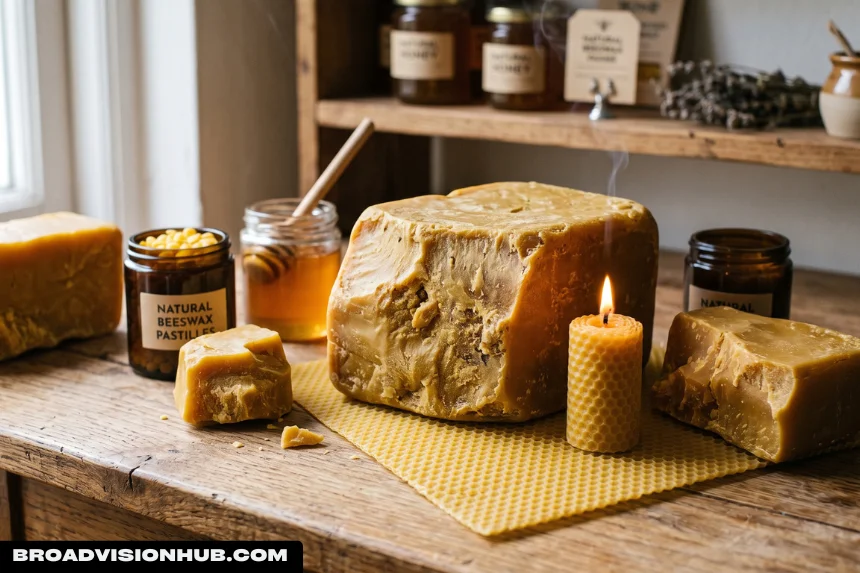
Beeswax benefits skin, food storage, household care, and craft projects mainly because it forms a flexible, moisture-resistant layer. In skincare, it can slow water loss and improve the texture of balms. Meanwhile, food manufacturers use it as a glaze and coating. It also works well in reusable wraps, candles, furniture conditioners, and art supplies.
However, beeswax is not a cure-all. Evidence does not show that beeswax candles purify indoor air or that pure beeswax treats eczema, infections, or wounds. Therefore, the most useful guide separates proven physical functions from health claims that still need better research.
Beeswax Benefits at a Glance
| Use | Potential benefit | Important limitation |
|---|---|---|
| Lip balm and salves | Forms a barrier that slows moisture loss | It does not add water to the skin by itself |
| Creams and cosmetics | Adds thickness, structure, and slip | Beeswax alone may not stabilize every emulsion |
| Food coatings | Reduces moisture transfer and adds shine | Only food-grade wax belongs in edible applications |
| Reusable wraps | Creates moldable, water-resistant fabric | Heat can melt the coating |
| Wood and leather care | Leaves a thin protective film | It may not suit every finish or material |
| Candles | Holds shape and may provide a mild natural aroma | Burning candles still produces indoor particles |
| Crafts | Can be melted, molded, carved, or painted with | Hot wax can cause burns and fires |
| Sustainability | Can replace some disposable products | Benefits depend on sourcing, additives, and repeated use |
What Is Beeswax?
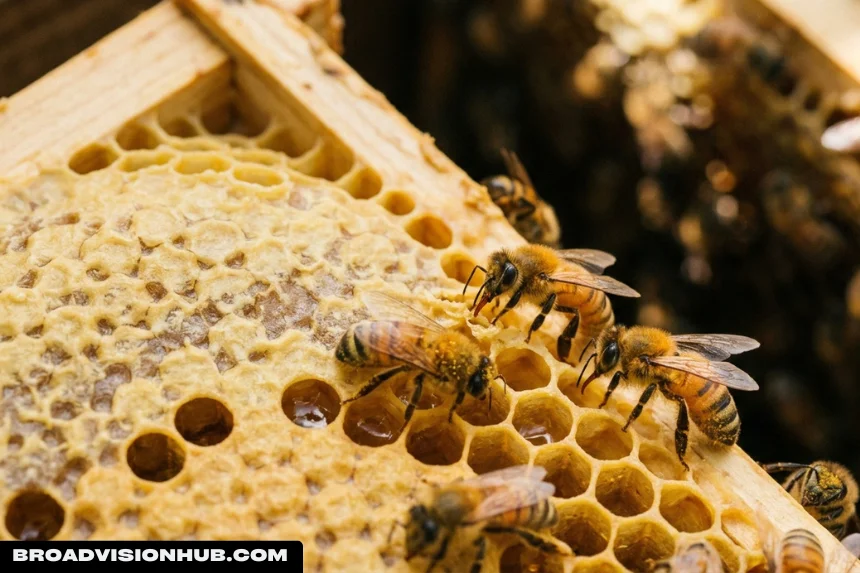
Beeswax is a natural wax that worker honeybees produce to build honeycomb. After beekeepers remove the honey, they can melt and filter the comb to recover the wax. The FAO beeswax specification describes it as a mixture containing fatty-acid esters, hydrocarbons, free fatty acids, and smaller amounts of fatty alcohols.
Beeswax generally melts at about 62 to 65 C, or 144 to 149 F. Consequently, it stays firm at ordinary room temperature but softens with warmth. This behavior explains why it works in lip balms, solid lotions, wraps, polishes, and candles.
Yellow beeswax retains its familiar golden color and may have a light honey-like aroma. White beeswax starts as yellow wax but undergoes additional processing or bleaching. Although their appearance differs, both forms can perform similar technical functions when their grade suits the intended use.
What Are the Main Beeswax Benefits?
The main benefits of beeswax come from its physical properties rather than from it acting like a medicine. It creates a protective film, resists water, adds structure, and helps control texture. Therefore, it can solve practical problems across several product categories.
Its most useful functions include:
- Slowing moisture loss from skin and lips
- Softening and protecting dry-feeling areas in a complete formula
- Thickening balms, salves, sticks, and ointments
- Helping some formulas remain stable and easy to apply
- Reducing moisture transfer in food coatings
- Making reusable fabric wraps flexible and water resistant
- Leaving a protective film on wood, leather, and tools
- Providing structure for candles
- Supporting art, sewing, and craft projects
- Replacing some disposable or petroleum-based materials when reused responsibly
These functions are valuable. Nevertheless, the benefit depends on the product’s full formula, quality, and intended purpose.
Beeswax Benefits for Skin
Beeswax is common in lip balms, hand salves, body butters, barrier creams, and solid lotion bars. Primarily, it works as an occlusive or semi-occlusive ingredient. In other words, it forms a light layer that slows the movement of water out of the skin.
A review of beeswax in skincare describes beeswax as an emollient and barrier-forming ingredient that can help reduce transepidermal water loss. However, the review found only a small number of clinical studies. Thus, its role as a cosmetic barrier has stronger support than broad claims about treating disease.
It Helps Reduce Moisture Loss
Dry skin often benefits from a combination of water, humectants, emollients, and occlusives. Beeswax contributes to the occlusive part of that system. Once a moisturizer supplies water and softening ingredients, beeswax can help slow evaporation.
Therefore, beeswax does not technically hydrate skin by adding water. Instead, it helps the skin hold on to moisture already present. This distinction matters because a beeswax-only product may feel protective without correcting every cause of dryness.
It Protects Dry or Chapped Lips
The lips lose moisture easily because they have a thinner protective surface than much of the surrounding skin. Consequently, a well-formulated beeswax lip balm can create a useful shield against dry air, wind, and repeated moisture loss.
The wax also gives a lip balm its shape. Oils and butters can soften the lips, while beeswax keeps those ingredients in a portable stick or pot. However, fragrances, flavors, propolis, and other ingredients can irritate sensitive lips. The complete ingredient list matters more than the presence of beeswax alone.
It Improves the Feel of Balms and Salves
Beeswax changes how a product spreads, melts, and stays on the skin. For example, adding more wax usually makes a balm firmer, while using less produces a softer texture. As a result, formulators can adjust the wax-to-oil ratio for a stick, tin, lotion bar, or ointment.
In addition, beeswax can reduce the greasy feeling of a completely liquid oil mixture by giving it more body. Still, too much wax may feel heavy or drag across the skin. A balanced formula is essential.
It Supports Formula Structure
Cosmetic makers use beeswax as a stiffening agent and viscosity modifier. It can also help suspend pigments or other oil-soluble components. Therefore, it is useful in products such as lipstick, mascara, pomade, and protective salves.
Nevertheless, beeswax is not a universal replacement for a proper emulsifier. A cream containing both oil and water may separate unless its formula includes an emulsification system designed for that purpose. Homemade product makers should follow a tested formula rather than simply adding wax and assuming it will preserve or stabilize the product.
Can Beeswax Treat Eczema or Psoriasis?
Current evidence does not establish pure beeswax as a treatment for eczema or psoriasis.
One small study of a honey, beeswax, and olive-oil mixture reported improvement among some participants with dermatitis or psoriasis. However, the study involved a three-ingredient mixture and a limited number of people. Consequently, it cannot show that beeswax alone produced the improvement.
Moreover, some people with inflamed skin may react to beeswax, propolis residue, fragrance, or another ingredient in a balm. Anyone with persistent rash, cracking, bleeding, infection, or severe itching should seek medical advice. Beeswax products should complement appropriate care, not replace it.
Beeswax Benefits in Food and Food Storage
Food applications use beeswax mainly as a coating, glazing agent, release agent, stabilizer, or carrier. The FDA food-ingredient database lists recognized technical uses for beeswax in food. Likewise, international food specifications identify it as a glazing and surface-finishing material.
However, authorization for specific food uses is not proof that eating beeswax provides a special nutritional benefit. It simply means suitable beeswax can perform approved technical functions under the applicable conditions.
It Can Reduce Moisture Transfer in Food Coatings
Because beeswax repels water, it can help slow moisture movement through a food coating. This property may reduce dehydration, shrinkage, or surface changes in some fruits and confectionery products.
A review of beeswax fruit coatings found that beeswax-containing films can improve moisture-barrier performance. Nevertheless, results depend on the fruit, coating thickness, storage conditions, and other formula ingredients. More wax is not automatically better because a coating must also allow suitable gas exchange.
It Adds Shine and Helps Prevent Sticking
Food producers may use a very thin beeswax layer to add gloss or protect a surface. In addition, its release properties can help prevent some foods from sticking during processing.
Only food-grade beeswax should touch food in an edible application. Craft wax may contain pigments, fragrances, dirt, pesticides, or other substances that do not belong in food. Therefore, buyers should check the label and the supplier’s intended-use information.
It Makes Reusable Food Wraps Possible
A beeswax wrap usually combines cotton fabric with beeswax and, in some products, plant oil or tree resin. Warm hands soften the coating, allowing the fabric to fold around bread, produce, cheese, or a bowl. Once cool, the wrap holds its shape.
Reusable wraps can reduce the need for some disposable plastic film. However, they require appropriate care:
- Wash them with cool water and mild soap.
- Let them air-dry completely before storage.
- Keep them away from ovens, microwaves, dishwashers, and hot pans.
- Avoid using them for raw meat or raw fish because the wrap cannot tolerate the hot washing needed for reliable sanitation.
- Replace a wrap when it smells unpleasant, becomes heavily cracked, or can no longer be cleaned.
Although reusable wraps can be practical, their environmental benefit depends on repeated use, responsible sourcing, and the additives in the coating. A cotton wrap blended with synthetic material, for example, may behave differently from a simple cotton-and-beeswax product.
Beeswax Benefits for Candles
Beeswax holds its shape well and has a relatively high melting range. Therefore, candle makers can use it for pillars, tapers, votives, and molded designs. Natural yellow beeswax may also retain a mild honey-like scent, although the aroma varies by source and processing.
It Creates Firm, Attractive Candles
Pure beeswax can produce a firm candle with a warm color and subtle natural character. Under comparable conditions, its high melting point may support a steady, relatively slow burn. However, wick size, candle diameter, additives, drafts, and maintenance strongly affect burn time and soot.
Consequently, it is inaccurate to promise that every beeswax candle lasts longer or burns cleaner than every soy, paraffin, or blended candle. Product design matters.
Do Beeswax Candles Clean the Air?
No reliable evidence shows that beeswax candles purify a room by releasing beneficial negative ions or removing toxins.
In fact, the EPA guidance on indoor particulate matter identifies burning candles as a source of indoor particles. The amount varies with the wick, fuel, fragrance, flame behavior, and ventilation. Still, a flame is combustion, and combustion creates byproducts.
Therefore, trim the wick according to the manufacturer’s directions, avoid drafts that make the flame flicker, and ventilate the room. People with asthma, fragrance sensitivity, or other respiratory concerns may prefer flameless options.

Household and Craft Uses for Beeswax
Beeswax’s protective film and moldable texture make it useful well beyond cosmetics and food.
It Can Condition Wood and Leather
Beeswax appears in some furniture polishes, cutting-board conditioners, and leather balms. It leaves a thin surface film that can add luster and improve water resistance. Moreover, it can help reduce the dry appearance of compatible finished materials when combined with an appropriate oil.
However, wax does not suit every surface. It can darken unfinished leather, collect dirt, make floors slippery, or interfere with later refinishing. Therefore, test the product on a hidden area and follow the item manufacturer’s care instructions.
For food-contact wood, use a conditioner specifically labeled for that purpose. A homemade mixture is not automatically food safe simply because it contains natural ingredients.
It Lubricates and Protects Small Items
A light application of beeswax can help a wooden drawer slide, reduce friction on a zipper, coat sewing thread, or protect a clean hand tool from moisture. In each case, the wax creates a thin barrier rather than permanently changing the material.
Still, use only a small amount. Excess wax can become sticky, trap dust, or stain fabric. Likewise, do not apply it to mechanical parts that require a manufacturer-approved lubricant.
It Works in Art and Craft Projects
Artists use beeswax in encaustic painting, batik, crayons, sculpture, and modeling. Crafters also use it to seal thread, make ornaments, and create decorative candles.
Because beeswax can be reheated and reshaped, scraps may be reusable in suitable projects. Nevertheless, repeated heating can introduce debris or change the wax. Keep cosmetic, food, and craft batches separate so contaminants do not cross between uses.
Is Beeswax Environmentally Friendly?
Beeswax is renewable in the sense that honeybees can produce more of it. In addition, pure beeswax can replace petroleum-based wax in some applications and may break down more readily than many synthetic materials.
However, “natural” does not automatically mean impact-free. Beekeeping practices, transport, filtration, bleaching, packaging, and product additives all affect the final footprint. Moreover, bees use significant energy and honey to produce wax, so responsible harvest practices matter.
The most defensible environmental benefit comes from using a durable beeswax product repeatedly and buying only what is needed. For example, a wrap used for many months may replace numerous pieces of disposable film. In contrast, a heavily packaged product discarded after a few uses offers a smaller advantage.
Beeswax is also an animal-derived material. Therefore, it is not vegan, even though some vegetarians choose to use it.
Yellow Beeswax vs. White Beeswax
Yellow beeswax is the familiar filtered wax from honeycomb. Its color can range from light gold to brown depending on pollen, propolis, age, and processing. It may also retain a mild natural aroma.
White beeswax is yellow beeswax that has undergone additional bleaching or purification. Consequently, it has a more neutral color that works well in white creams, pale cosmetics, and products where the natural scent or color would be distracting.
Neither color is automatically better. Instead, choose based on grade, purity, intended use, supplier documentation, and desired appearance.
How to Choose the Right Beeswax
The right product depends on what you plan to make.
| Grade or format | Best suited for | What to check |
|---|---|---|
| Food-grade beeswax | Edible coatings and food-contact projects | Label, supplier, and intended food use |
| Cosmetic-grade beeswax | Balms, salves, and personal-care formulas | Ingredient identity, purity, and cosmetic documentation |
| Candle or craft beeswax | Candles, art, sewing, and household projects | Additives, fragrance, color, and melting directions |
| Pellets or pastilles | Easy measuring and controlled melting | Grade and ingredient list |
| Blocks | Larger batches and traditional craft work | Cleanliness and cutting method |
Do not assume that wax sold at a craft store is suitable for food or skin. Likewise, do not rely on color alone to judge purity. Reputable suppliers should state the grade, intended use, and whether the product contains fragrance, color, paraffin, resin, or other additives.
Beeswax Safety and Side Effects
Most people can use appropriately formulated beeswax products without difficulty. Nevertheless, allergy, contamination, heat, and fire require attention.
Contact Allergy
Beeswax can contain small amounts of propolis or related bee-hive material. A review of contact reactions to beeswax reports that reactions appear uncommon but can occur, particularly as allergic contact cheilitis from lip products.
Stop using a product if it causes persistent burning, itching, swelling, blistering, or a worsening rash. In addition, people with known propolis or bee-product allergy should discuss uncertain products with a qualified clinician. Patch testing the finished product may also be sensible for sensitive skin because the other ingredients can matter as much as the wax.
Acne-Prone Skin
Beeswax is often described online as noncomedogenic. However, no single label can predict how every finished balm or cream will behave on every person. Oils, butters, fragrance, application amount, and skin type all influence whether a product feels heavy or contributes to clogged pores.
Therefore, choose products designed for the face and test them gradually if you have acne-prone skin.
Melting and Fire Safety
Beeswax is flammable. Melt it gently with indirect heat, monitor the temperature, and never leave it unattended. In addition, keep water away from hot wax because splashing can cause burns.
When burning a candle, follow the U.S. Fire Administration candle guidance. Use a stable holder, keep the flame at least 12 inches from anything that can burn, and extinguish it before leaving the room or going to sleep.
Common Beeswax Myths
| Claim | Evidence-based answer |
|---|---|
| Beeswax candles purify the air | Unsupported; burning candles creates indoor particles |
| Beeswax detoxifies the body | Unsupported; beeswax is not a detox treatment |
| Beeswax cures eczema or psoriasis | Not established; small studies used mixed formulas |
| Beeswax is always noncomedogenic | Not guaranteed; the full formula and individual skin matter |
| Beeswax is rich in vitamin A | Commonly repeated but not well established by strong compositional evidence |
| All beeswax is edible | Incorrect; only suitable food-grade wax belongs in edible uses |
| Natural beeswax cannot cause allergy | Incorrect; uncommon contact reactions can occur |
| Every beeswax candle burns longer | Not guaranteed; wick, size, airflow, and additives affect performance |
Frequently Asked Questions About Beeswax Benefits
1. What are the main benefits of beeswax?
Beeswax forms a flexible, moisture-resistant film. Therefore, it can reduce skin water loss, thicken balms, coat food, condition surfaces, and provide structure for wraps, candles, and crafts.
2. Is beeswax good for skin?
Yes, beeswax can be useful in a well-formulated skincare product because it slows moisture loss and improves texture. However, it does not treat every cause of dry or irritated skin.
3. Does beeswax moisturize the skin?
Beeswax mainly locks in moisture rather than adding water to the skin. Consequently, it works best alongside humectants, oils, and other moisturizing ingredients.
4. Can beeswax treat eczema or psoriasis?
Evidence does not establish pure beeswax as a treatment for either condition. Although a small study reported benefits from a mixture containing honey, beeswax, and olive oil, researchers could not attribute the result to beeswax alone.
5. Is beeswax safe to eat?
Food-grade beeswax has authorized technical uses in food under specified conditions. Nevertheless, craft or cosmetic wax should not be eaten because it may contain unsuitable additives or contaminants.
6. Are reusable beeswax wraps safe?
They can be useful for bread, produce, cheese, and covered dishes when cleaned and stored correctly. However, avoid raw meat, raw fish, hot food, microwaves, ovens, and dishwashers.
7. Do beeswax candles clean indoor air?
No strong evidence supports that claim. Instead, candles produce combustion particles, so ventilation and proper wick care remain important.
8. Is beeswax antibacterial?
Some beeswax-containing mixtures show antimicrobial activity in laboratory or small clinical studies. However, other ingredients such as propolis, honey, plant extracts, or preservatives may cause that effect, so pure beeswax should not replace an antiseptic or medical treatment.
9. Can beeswax cause an allergic reaction?
Yes, although reported contact reactions appear uncommon. In particular, residual propolis may trigger lip or skin reactions in sensitive people.
10. Is beeswax vegan?
No. Honeybees produce beeswax, so vegan standards generally exclude it. Nevertheless, some non-vegan consumers choose it as a natural alternative to petroleum-based waxes.
Conclusion
The most dependable beeswax benefits come from its ability to form a protective, moisture-resistant layer. As a result, it works well in lip balms, salves, food coatings, reusable wraps, candles, wood conditioners, leather products, and crafts.
However, practical usefulness should not become a medical promise. Beeswax does not purify indoor air, detoxify the body, or provide a proven stand-alone treatment for eczema, psoriasis, infections, or wounds. In addition, allergy and fire risks still require sensible precautions.
Ultimately, the best approach is to choose the correct grade, use a tested formula, and match the wax to the job. When used thoughtfully, beeswax is a versatile material rather than a miracle remedy.
Medical Disclaimer
This article provides general educational information. It does not replace diagnosis or treatment from a qualified healthcare professional. Seek medical advice for persistent skin symptoms, significant allergic reactions, breathing problems, burns, or other health concerns.