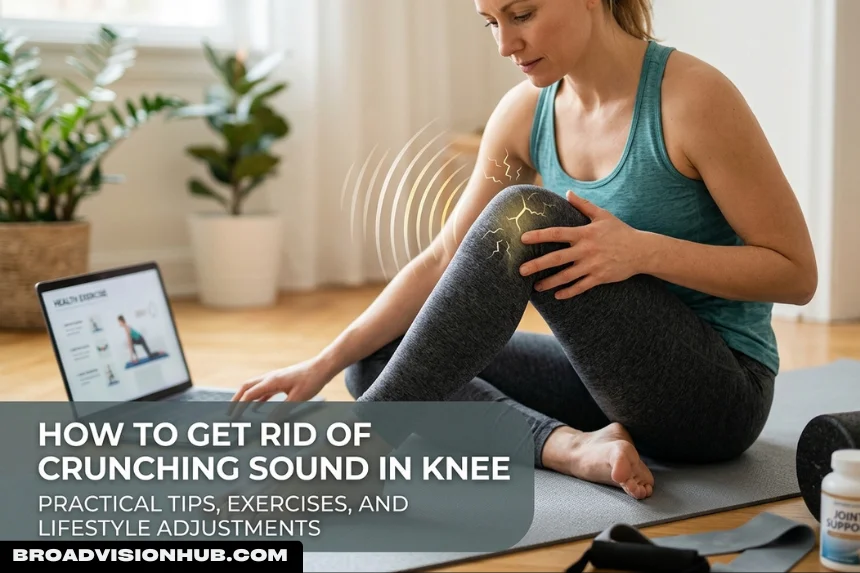
If you are searching for how to get rid of crunching sound in knee, you may feel worried that the noise signals joint damage. A knee can crunch, grind, or crackle while climbing stairs, squatting, exercising, or standing after sitting. However, knee noise does not always mean that cartilage is damaged or that arthritis is present.
The medical term for this sound or sensation is knee crepitus. It can occur in people with healthy knees as well as those with injuries or joint conditions. In fact, a 2025 systematic review found knee crepitus in both pain-free individuals and people with knee osteoarthritis. Therefore, the sound alone cannot confirm cartilage damage or arthritis.
Learning how to get rid of crunching sound in knee starts with checking for other symptoms. Painless noise may not require treatment. On the other hand, pain, swelling, locking, weakness, or a recent injury may point to an underlying problem that needs medical attention.
Medical note: This article provides general educational information. It cannot diagnose the cause of your knee symptoms or replace advice from a qualified healthcare professional.
How Can You Reduce a Crunching Sound in Your Knee?
You may reduce knee crunching by strengthening the muscles around your knee and hips, improving flexibility, warming up before activity, and temporarily modifying painful movements. However, treatment depends on the cause. Painless crepitus may not need treatment, and no exercise can guarantee a completely silent knee.
More importantly, focus on how your knee feels and functions. Pain, swelling, instability, locking, or difficulty bearing weight matters more than noise alone.
Quick Answers About Knee Crunching
| Question | Direct answer |
|---|---|
| What is the crunching sound called? | It is commonly called knee crepitus. |
| Is knee crunching always arthritis? | No. It can occur in people without arthritis or knee pain. |
| Can exercise reduce the sound? | Exercise may improve strength, movement, and related discomfort. |
| Should you stop exercising? | Not necessarily. Continue comfortable movement, but modify painful activities. |
| Can crepitus disappear completely? | It may decrease, although some harmless knee sounds remain. |
| When should you seek medical care? | Seek care after an injury or when noise occurs with pain, swelling, locking, or instability. |
Understanding how to get rid of crunching sound in knee also requires knowing whether the sound occurs with pain, swelling, or instability.
What Is the Crunching Sound in Your Knee?
The first step in learning how to get rid of crunching sound in knee is identifying the type of noise and the movement that triggers it.
Knee crepitus describes a grinding, crackling, creaking, clicking, or popping sensation during movement. You may hear the sound, feel it under your hand, or experience both.
Your knee contains bones, cartilage, ligaments, tendons, muscles, and joint fluid. These structures work together whenever you bend or straighten your leg. As a result, several different movements inside or around the joint can produce noise.
What Does Knee Crepitus Feel Like?
People describe knee crepitus in several ways:
- A soft crackle when bending the knee
- A grinding feeling behind the kneecap
- A clicking sensation during squats
- A pop when standing from a chair
- A snapping sound on the inner or outer side of the knee
- A rough “Rice Krispies” feeling under the kneecap
Although these sounds may seem similar, they can have different causes. Therefore, pay attention to where the sound occurs and whether it comes with pain or other symptoms.
Why Does the Knee Make Noise During Movement?
Some joint noises may come from changes in pressure within the joint. In other cases, tendons or ligaments can move over nearby tissue as the knee bends. Friction between moving joint surfaces may also create grinding or crackling sensations.
However, a painful click after an injury is different from an occasional painless pop. Likewise, locking, buckling, or swelling may suggest a mechanical or inflammatory problem rather than harmless joint movement.
Is Painless Knee Crepitus Normal?
Painless knee crepitus is common and often does not require treatment. The 2025 systematic review estimated that crepitus occurred in approximately 36% of pain-free participants. However, the researchers rated the certainty of much of the evidence as low or very low. Therefore, the percentage should be viewed as an estimate rather than an exact figure.
You can usually continue normal activity when the knee:
- Does not hurt
- Is not swollen
- Moves through its usual range
- Does not lock or give way
- Can support your weight normally
Still, monitor the knee for changes. A healthcare professional should assess new or worsening symptoms.

What Causes a Crunching Sound in the Knee?
Because several conditions can cause crepitus, how to get rid of crunching sound in knee depends on the underlying reason.
Knee crunching does not have one universal cause. Instead, the likely explanation depends on your age, activity level, injury history, and additional symptoms.
Normal Joint-Pressure Changes
Changes in pressure inside a joint can sometimes create a pop or crack. These sounds often occur suddenly and do not cause pain, swelling, or reduced movement.
Moreover, harmless popping may happen only occasionally. It usually does not require treatment when the knee otherwise feels normal.
Tendons or Ligaments Moving During Motion
A tendon or ligament may move over a nearby bony area as you bend and straighten your leg. Consequently, you may feel a light click or snap.
For example, iliotibial band syndrome can cause clicking or popping on the outer side of the knee. It commonly becomes more noticeable during repetitive activities such as running or cycling. Pain or burning may also develop along the outside of the knee.
Patellofemoral Pain Syndrome
Patellofemoral pain syndrome causes pain around or behind the kneecap. It often becomes noticeable during:
- Squatting
- Climbing or descending stairs
- Running
- Kneeling
- Sitting with the knee bent for a long time
Some people also notice grinding or crackling around the kneecap. However, the sound does not necessarily mean that the cartilage has worn away. Patellofemoral pain can involve several tissues around the kneecap, including tendons, the fat pad, bone, and the tissue lining the joint.
Knee Osteoarthritis
Knee osteoarthritis can cause creaking, clicking, snapping, or grinding. However, arthritis usually involves more than sound alone.
Additional symptoms may include:
- Pain during or after activity
- Stiffness after rest
- Swelling
- Difficulty bending or straightening the knee
- Weakness or buckling
- Reduced ability to perform daily activities
Therefore, crunching with ongoing pain and stiffness deserves more attention than painless noise.
Meniscus Injury
The menisci are pads of cartilage that help cushion and stabilize the knee. A meniscus injury can cause clicking or cracking during movement.
In addition, the knee may feel swollen, unstable, locked, or caught in one position. Symptoms can become more noticeable while walking, squatting, standing from a chair, or turning the body.
Ligament or Tendon Injury
A sudden pop during a fall, twist, jump, or change of direction may indicate an injury. Ligament injuries can also cause rapid swelling, instability, or difficulty continuing the activity.
Similarly, major tendon injuries may make it difficult or impossible to straighten the knee. As a result, a sudden pop after trauma should not be treated like ordinary painless crepitus.
Plica or IT Band Irritation
Plica syndrome may cause painful catching or snapping on the inner side of the kneecap. Meanwhile, IT band irritation can produce a snapping sensation on the outer side.
Both conditions may worsen during activities that involve repeated bending and straightening. However, a physical examination may be needed because several knee problems can cause similar symptoms.
Previous Knee Surgery
Some people notice clicking or clunking after knee surgery or joint replacement. Certain painless mechanical sounds may occur as the knee moves.
Nevertheless, contact your surgeon or healthcare provider when a new sound develops with pain, warmth, swelling, instability, fever, or reduced movement.
Does a Crunching Sound in the Knee Mean Arthritis?
No, a crunching knee does not automatically mean arthritis. Crepitus appears in pain-free people, individuals with knee injuries, and people with osteoarthritis. Therefore, sound alone cannot establish a diagnosis.
When researching how to get rid of crunching sound in knee, remember that noise alone does not confirm arthritis.
Arthritis becomes more likely when crunching occurs with:
- Persistent or recurring pain
- Morning stiffness
- Swelling
- Reduced range of motion
- Weakness or buckling
- Difficulty walking or using stairs
- Symptoms that gradually worsen
At the same time, research has found an association between knee crepitus and some structural signs of osteoarthritis. However, that does not mean everyone with a noisy knee has arthritis. The systematic review also warned that the available evidence had important limitations.
Consequently, avoid diagnosing yourself from the sound. A clinician can consider your symptoms, medical history, physical examination, and imaging when appropriate.

When Is Knee Crunching Harmless or Concerning?
Use the sound as one piece of information rather than the only warning sign.
Before trying how to get rid of crunching sound in knee at home, check whether any warning signs are present.
| Knee situation | What it may mean | Recommended action |
| Occasional noise without pain | Normal joint or soft-tissue movement | Continue comfortable activity and monitor it |
| Painless crunching during squats | Crepitus that may not require treatment | Check your technique and avoid forcing the sound |
| Mild discomfort after increasing exercise | Temporary irritation or excessive training load | Reduce the aggravating activity and rebuild gradually |
| Ongoing pain with stiffness | Patellofemoral pain, arthritis, or another condition | Arrange a healthcare evaluation |
| Clicking with locking or catching | Possible meniscus or mechanical problem | Seek a prompt assessment |
| Noise with repeated buckling | Possible instability or injury | Stop risky activity and seek medical advice |
| Sudden pop followed by swelling | Possible ligament, tendon, or other acute injury | Obtain urgent medical evaluation |
| Red, hot, swollen knee with fever | Possible infection or inflammation | Seek urgent medical care |
Seek prompt medical attention when you cannot bear weight, cannot fully bend or straighten the knee, have marked or sudden swelling, notice deformity, or develop severe pain after an injury. Fever with redness, warmth, pain, or swelling also requires urgent evaluation.
How to Get Rid of Crunching Sound in Knee Safely
There is no single method that removes every crunching sound. Instead, the best approach depends on whether the knee is painful, swollen, injured, or unstable.
For painless knee crepitus, treatment may not be necessary. However, strength training, gradual activity changes, and improved flexibility may support smoother and more comfortable movement. Strong muscles around the knee also help absorb shock and reduce stress on the joint.
Do Not Treat the Sound When There Are No Other Symptoms
A noisy knee does not always need to be “fixed.” You can usually continue comfortable activity when the knee moves normally and does not hurt, swell, lock, or give way.
Moreover, repeatedly bending the knee to check whether it still crunches can make you more worried about a harmless sound. Focus instead on pain, stability, mobility, and your ability to complete daily tasks.
Still, watch for changes. New pain, swelling, weakness, locking, or symptoms after an injury require closer attention.
Modify Activities That Cause Pain
Complete inactivity is rarely the best long-term response to a noisy knee. Nevertheless, temporarily reducing a painful activity can calm irritation and prevent symptoms from worsening.
A practical approach to how to get rid of crunching sound in knee is reducing painful activities without becoming completely inactive.
Depending on the trigger, you could:
- Use a shallower squat depth.
- Reduce the number of lunges or stair repetitions.
- Lower resistance on a stationary bike.
- Shorten running distance for several sessions.
- Avoid steep hills until symptoms settle.
- Replace jumping with walking, swimming, or cycling.
- Take breaks during activities that require repeated kneeling.
Patellofemoral knee pain often improves with activity changes and targeted physical therapy. In addition, the AAOS recommends gradually increasing training intensity instead of making sudden changes.
Return to more demanding exercise slowly. For example, increase only one factor at a time, such as distance, weight, speed, or frequency.
Warm Up Before Exercise
A short warm-up prepares the muscles and joints for movement. The AAOS recommends five to ten minutes of low-impact activity before a knee-conditioning routine. Walking or riding a stationary bike are common options.
A gentle warm-up may support how to get rid of crunching sound in knee by preparing the surrounding muscles for movement.
Afterward, add a few comfortable movements, such as:
- Slow leg swings
- Gentle knee bends
- Easy heel raises
- Controlled marching
- Light sit-to-stands
A warm-up may make the knee feel less stiff. However, it does not guarantee that every crack or crunch will disappear.
Strengthen the Quadriceps
The quadriceps are the large muscles at the front of the thigh. They help straighten the knee and support the kneecap during walking, stairs, and squats.
Therefore, weak or poorly conditioned quadriceps may reduce control during these movements. Strengthening them may improve function and reduce symptoms linked to some knee conditions. The AAOS includes leg extensions, straight-leg raises, and partial squats in its knee-conditioning guidance.
Begin with easy exercises and controlled movement. Avoid using momentum or forcing the knee through a painful range.
Strengthen the Hips and Glutes
The hip and gluteal muscles help control the position of the thigh. As a result, they also influence how the knee moves during walking, stair climbing, running, and squatting.
The AAOS specifically recommends strengthening the quadriceps and hip muscles for patellofemoral pain because these muscle groups work together to stabilize the kneecap.
Useful options may include:
- Glute bridges
- Clamshells
- Side-lying leg raises
- Standing hip abduction
- Resistance-band side steps
Choose an exercise that you can perform without sharp pain or loss of balance.
Improve Calf and Hamstring Flexibility
Tight calves or hamstrings can make bending, walking, and squatting feel more restricted. Therefore, gentle stretching may improve comfort and range of motion.
However, stretching does not rebuild cartilage or cure arthritis. Its role is to support mobility and make movement easier.
The AAOS knee-conditioning program includes calf and hamstring stretches. It advises gentle stretching after a warm-up and again after strengthening exercises.
Choose Low-Impact Cardiovascular Exercise
Low-impact activity can help you remain active without repeatedly twisting or heavily loading the knee. Suitable options may include:
Low-impact movement may help with how to get rid of crunching sound in knee when running or jumping causes discomfort.
- Walking on a level surface
- Stationary cycling
- Swimming
- Water exercise
- Tai chi
- Light dancing
The CDC lists walking, cycling, swimming, water exercise, and tai chi among joint-friendly activities. It also recommends starting slowly and increasing difficulty in small amounts.
Select an activity that causes little or no joint pain. In addition, reduce the pace, resistance, or duration when symptoms increase.
Increase Your Training Load Gradually
A rapid increase in running, squats, sports, or stair climbing can irritate the knee. For example, doubling your weekly mileage or adding heavy leg training without preparation may exceed your current capacity.
Instead, make gradual changes. Increase one training factor at a time and monitor how the knee responds during the following day.
The AAOS recommends gradually increasing the duration and intensity of exercise. Similarly, the CDC advises starting slowly and progressing in small amounts.
Maintain a Comfortable Weight When Appropriate
Body weight is only one part of knee health. Genetics, previous injuries, muscle strength, occupation, age, and medical conditions also matter.
Still, excess body weight can increase stress on weight-bearing joints and may worsen symptoms in people with knee osteoarthritis. Therefore, gradual weight management may support pain relief when it is medically appropriate.
Avoid extreme diets or rapid weight-loss plans. A healthcare professional or registered dietitian can provide individualized support.
Wear Shoes That Match Your Activity
Choose shoes that fit properly and suit the activity you perform. For example, running shoes should provide a secure fit and should not be excessively worn.
The AAOS recommends wearing shoes appropriate for your activity as one part of preventing recurring patellofemoral pain.
However, no shoe can guarantee silent knees. In addition, expensive inserts or specialized footwear are not necessary for everyone.
Use Ice or Heat for Related Symptoms
Ice may temporarily reduce pain and swelling after an activity or minor injury. Wrap the cold pack in a thin towel, and avoid placing ice directly on your skin. Mayo Clinic advises limiting an ice session to no more than 20 minutes because longer use can damage skin or nerves.
Heat may temporarily ease stiffness or soreness. For example, you could use a warm shower or a covered heating pad before gentle movement. However, heat should not be applied to a red, hot, or acutely swollen knee.
Neither ice nor heat removes the underlying cause of crepitus. Instead, these methods may help manage associated symptoms.

Exercises That May Help a Crunching Knee
The following routine focuses on the muscles that support the knee and hips. However, it is not a diagnosis-specific rehabilitation program.
People recovering from surgery or a significant injury should follow instructions from their surgeon or physical therapist. Likewise, anyone with severe pain, balance problems, neurological symptoms, or an unstable knee should seek professional guidance before starting.
Stop the routine when an exercise causes:
- Sharp or increasing pain
- New or worsening swelling
- Locking or catching
- Buckling or instability
- Numbness or tingling
- Dizziness or loss of balance
- Difficulty bearing weight afterward
The AAOS advises working with a doctor or physical therapist to select suitable exercises. It also warns against ignoring pain during a conditioning program.
Exercises to Reduce a Crunching Sound in the Knee
Exercises are often included in advice about how to get rid of crunching sound in knee, although they cannot guarantee complete silence.
| Exercise | Main purpose | Suggested starting amount |
|---|---|---|
| Quad set | Activates the front thigh muscles | 8–12 repetitions |
| Straight-leg raise | Builds quadriceps control | 6–10 repetitions per side |
| Glute bridge | Strengthens the hips and glutes | 8–12 repetitions |
| Clamshell | Strengthens the outer hip | 8–12 repetitions per side |
| Sit-to-stand | Builds functional leg strength | 6–10 repetitions |
| Calf raise | Strengthens the calf and supports walking | 8–15 repetitions |
| Calf stretch | Improves lower-leg flexibility | Hold for 20–30 seconds |
| Hamstring stretch | Improves back-of-thigh flexibility | Hold for 20–30 seconds |
These amounts are conservative starting points, not universal prescriptions. Begin with one set. Then, increase repetitions only when you can maintain good control without worsening symptoms.
Quad Sets
Lie on your back or sit with one leg straight. Place a rolled towel beneath the knee for support.
Next, tighten the front thigh muscle and gently press the knee toward the towel. Hold for three to five seconds, then relax.
Keep breathing normally. You should feel the thigh tighten without sharp knee pain.
Straight-Leg Raises
Lie on your back. Bend one knee and place that foot flat on the floor. Keep the other leg straight.
Tighten the thigh of the straight leg. Then, slowly lift the leg several inches from the floor. Pause briefly before lowering it with control.
Do not swing the leg. The AAOS also advises tightening the thigh and lifting slowly rather than using momentum.
Glute Bridges
Lie on your back with both knees bent and your feet flat on the floor. Keep your feet about hip-width apart.
Tighten your abdomen and squeeze your glutes. Next, lift your hips until your shoulders, hips, and knees form a comfortable line. Pause, then lower slowly.
Do not lift so high that your lower back arches sharply.
Clamshells
Lie on your side with your knees bent and your hips stacked. Keep your feet together.
Slowly lift the top knee while keeping your pelvis still. Then, lower it with control.
Avoid rolling your upper hip backward. You should feel the muscles along the side of your hip working.
Sit-to-Stands
Sit near the front of a stable chair. Place both feet flat on the floor.
Lean forward slightly from the hips. Then, press through both feet and stand. Slowly sit back down without dropping into the chair.
Use your hands for support when needed. Moreover, choose a higher chair when a low seat causes pain.
Calf Raises
Stand behind a chair or beside a counter for balance. Keep your weight evenly distributed between both feet.
Slowly lift your heels from the floor. Pause, then lower them with control.
Start with both legs. Later, you may progress to one leg when balance and strength allow. The AAOS includes supported calf raises in its knee-conditioning program.
Gentle Calf Stretch
Stand facing a wall. Step one foot behind you and keep that heel on the floor.
Bend the front knee and move your hips gently toward the wall. Stop when you feel a stretch in the calf of the back leg.
Keep your toes facing forward and avoid bouncing. The AAOS uses a similar heel-cord stretch in its knee-conditioning guidance.
Gentle Hamstring Stretch
Lie on your back with both knees bent. Lift one leg and hold behind the thigh rather than pulling directly on the knee.
Gradually straighten the raised leg until you feel a gentle stretch behind the thigh. Hold the position without bouncing.
A towel around the thigh can help when the leg is difficult to reach.
How Often Should You Do the Routine?
Start with two or three nonconsecutive days each week. This schedule gives the muscles time to recover between strengthening sessions.
You may perform gentle flexibility work more often when it feels comfortable. In addition, short sessions can be easier to tolerate than one long workout.
The AAOS notes that knee-conditioning exercises may continue for four to six weeks and that strength and mobility can later be maintained two or three days per week. However, the exact schedule should match your condition and professional guidance.
What Should You Avoid With a Crunching Knee?
Avoiding all movement can weaken the muscles that support the joint. However, forcing painful exercise can also make symptoms worse.
Therefore, try to avoid:
- Continuing through sharp or increasing pain
- Suddenly increasing exercise intensity
- Using heavy weights before mastering control
- Forcing the knee into a deeper painful bend
- Twisting on a planted foot when the knee hurts
- Repeatedly testing a movement that causes pain
- Remaining inactive for long periods without a medical reason
- Assuming that every sound means cartilage damage
- Buying products that promise to regrow cartilage
- Wearing a brace continuously without professional advice
The CDC encourages people with arthritis to remain as active as they can and to avoid unnecessary inactivity. At the same time, activities should cause little or no joint pain and should progress gradually.
How to Get Rid of Crunching Sound in Knee During Squats
Not necessarily. Painless knee crunching during a squat does not automatically mean you are damaging the joint.
Anyone learning how to get rid of crunching sound in knee during squats should focus on pain, control, depth, and training load.
You may continue squatting when:
- The movement does not cause pain.
- The knee does not swell afterward.
- You maintain balance and control.
- The knee does not catch, lock, or buckle.
- You can bear weight normally.
However, modify the movement when it causes discomfort. For example, use a shallower depth, hold a stable support, reduce the weight, or perform a sit-to-stand from a chair.
Partial squats can strengthen the quadriceps, hamstrings, and glutes. The AAOS includes controlled half squats in its knee-conditioning program and recommends avoiding pain during exercise.
Stop squatting and seek medical advice when you experience sharp pain, rapid swelling, locking, repeated instability, or symptoms following a significant injury. In this situation, the problem requires evaluation rather than exercise modification alone.

When Should You See a Doctor for Knee Crunching?
Knee crunching without pain or other symptoms may not require medical treatment. However, arrange an evaluation when the noise comes with persistent pain, swelling, stiffness, weakness, or changes in movement.
Schedule a Routine Medical Appointment When
Contact a healthcare professional when:
- Knee pain keeps returning.
- Symptoms do not improve with activity changes.
- Stiffness affects walking, stairs, or daily tasks.
- The knee becomes swollen after normal activities.
- You cannot exercise as comfortably as before.
- The knee feels weaker or less stable.
- Pain interrupts sleep or daily activities.
- Symptoms gradually become more severe.
A clinician can assess the entire pattern rather than judging the sound alone. This distinction matters because crepitus can occur with several knee conditions, including patellofemoral pain, osteoarthritis, meniscus injuries, and soft-tissue irritation.
Seek Prompt or Urgent Medical Care When
Obtain prompt medical care when:
- The sound starts after a fall, twist, collision, or direct blow.
- You hear a sudden pop during an injury.
- The knee swells rapidly.
- You cannot put weight on the affected leg.
- The knee repeatedly locks, catches, or gives way.
- You cannot fully bend or straighten the knee.
- The joint appears bent, displaced, or deformed.
- You have intense pain after an injury.
- The knee is red, hot, swollen, and painful.
- Knee symptoms occur with fever or chills.
Mayo Clinic recommends urgent attention after a major injury when the knee appears deformed, cannot bear weight, swells suddenly, causes intense pain, or produces a popping sound at the time of injury. Redness, warmth, tenderness, and fever can also indicate a condition that needs prompt evaluation.
Similarly, locking, painful swelling, buckling, or catching can accompany meniscus and other soft-tissue injuries. Therefore, these symptoms should not be managed as harmless crepitus without an examination.
How a Healthcare Professional May Diagnose the Cause
A healthcare professional will usually begin by asking about your symptoms and examining the knee. Imaging may be helpful in selected cases. However, painless noise alone does not always require scans.
Medical History
Your clinician may ask:
- When did the sound begin?
- Did it start suddenly or gradually?
- Was there a recent injury?
- Where do you feel pain?
- Which activities trigger the sound?
- Does the knee swell, lock, or give way?
- Do you have stiffness after resting?
- Have you had previous knee surgery?
- Have you recently changed your exercise routine?
These details help distinguish normal joint noise from an injury or chronic knee condition.
Physical Examination
During the examination, a clinician may:
- Look for swelling, redness, warmth, or bruising.
- Check where the knee feels tender.
- Measure how far the knee bends and straightens.
- Assess ligament and joint stability.
- Observe kneecap movement.
- Test quadriceps, hamstring, and hip strength.
- Check flexibility and balance.
- Watch how you walk, squat, or climb a step.
For suspected patellofemoral pain, the examination may also include kneecap alignment, hip rotation, gait, muscle strength, and lower-limb flexibility.
X-Rays and Other Imaging
An X-ray may help detect a fracture, bone changes, joint-space narrowing, or signs of osteoarthritis. However, an X-ray does not show every soft-tissue injury.
An MRI provides detailed images of cartilage, tendons, ligaments, muscles, and other soft tissues. Therefore, a clinician may request one when symptoms suggest a meniscus or ligament injury. An MRI may also be considered when symptoms do not improve after appropriate conservative treatment.
Ultrasound can show some soft-tissue structures while the knee moves. Meanwhile, CT scans may help assess complex bone problems or subtle fractures. Imaging choices depend on the history and examination findings.
Laboratory Tests
Blood tests are not routinely needed for ordinary painless crepitus. Nevertheless, a clinician may order them when infection, gout, rheumatoid arthritis, or another inflammatory condition seems possible.
In some cases, fluid may be removed from the joint and tested. This procedure can help identify infection, crystals, bleeding, or inflammation.
Medical Treatment for a Crunching or Grinding Knee
Treatment depends on the diagnosed cause. Therefore, a person with patellofemoral pain may need a different plan than someone with arthritis, a torn ligament, or a locked meniscus.
The goal is usually to reduce pain, restore movement, improve strength, and help the person return to daily activities. Simply making the knee silent is not normally the main treatment goal.
Physical Therapy
A physical therapist can create an exercise program based on your strength, flexibility, activity level, and diagnosis.
Treatment may include:
- Quadriceps strengthening
- Hip and glute strengthening
- Mobility exercises
- Balance training
- Gradual activity progression
- Walking or running assessment
- Squat and stair technique
- Sport-specific movement training
Strengthening the muscles around the knee can improve stability. In addition, movement retraining may help when technique or lower-limb control contributes to symptoms.
Pain-Relief Medication
Pain medicine may help control discomfort caused by certain knee conditions. However, it does not necessarily remove crepitus.
A healthcare professional may recommend an appropriate option based on your medical history, other medications, and the underlying diagnosis. People with kidney disease, heart disease, high blood pressure, stomach ulcers, bleeding problems, pregnancy, or blood-thinning medication should seek professional advice before using nonsteroidal anti-inflammatory drugs.
Do not use pain medicine to continue an activity that causes sharp or worsening symptoms.
Braces, Taping, or Shoe Inserts
Some people benefit from taping, a brace, or an insert. For example, these tools may improve comfort or temporarily support the joint during certain activities.
However, they are not suitable for every cause of knee crunching. They may also become less useful when worn without addressing weakness or activity-related factors. Therefore, use them for a clear reason rather than as a guaranteed cure.
Injections
A clinician may discuss injections when a diagnosed knee condition causes ongoing pain. Possible options depend on the condition and may include corticosteroid, hyaluronic acid, or other injections.
Results vary, and injections are not effective for everyone. In addition, they treat symptoms or specific conditions rather than harmless sound alone. Mayo Clinic notes that evidence and duration of relief differ among injection types.
Surgery
Most people do not need surgery merely because their knee crunches. Instead, surgery may be considered for a significant structural injury, a knee that remains mechanically locked, severe joint disease, or symptoms that do not improve with appropriate nonsurgical care.
Depending on the problem, procedures may repair a torn ligament, treat selected meniscus injuries, remove a loose body, or replace severely damaged joint surfaces.
Therefore, the need for surgery depends on pain, damage, instability, function, and the response to other treatment—not the loudness of the sound.
Can Knee Crunching Go Away Permanently?
Knee crunching may become less noticeable after strength, mobility, movement control, or an irritated condition improves. However, some painless sounds continue even when the knee is strong and functions normally.
For example, a sound related to soft-tissue movement may remain during certain motions. Likewise, osteoarthritis-related crepitus may persist even when treatment improves pain and mobility.
Therefore, a completely silent knee is not always a realistic or medically necessary goal. A better measure of improvement is whether you can:
- Walk comfortably
- Use stairs
- Exercise without worsening pain
- Bend and straighten the knee
- Trust the knee to support you
- Complete daily activities
Focus on function rather than repeatedly checking for noise.
How to Protect Your Knees in the Future
You cannot prevent every knee sound. Nevertheless, several habits may lower the risk of pain, overuse, and avoidable injury.
Build Strength Consistently
Train the quadriceps, hamstrings, calves, hips, and glutes. Strong muscles help support the knee during daily movement and exercise.
Start with manageable resistance. Then, progress gradually as your control improves.
Avoid Sudden Training Increases
A sudden increase in running distance, workout days, squat volume, or exercise intensity may irritate the knee. Patellofemoral symptoms, for example, can follow changes in exercise frequency, duration, or intensity.
Increase one factor at a time. Moreover, allow enough recovery after demanding sessions.
Warm Up Before Demanding Activity
Begin with light movement before running, lifting, or playing sports. A warm-up can prepare the muscles for greater loads and make stiff movement feel easier.
Use Comfortable Movement Technique
You do not need one “perfect” knee position for every exercise. However, movement should remain controlled and should not produce sharp pain, locking, or instability.
Reduce the range, resistance, or speed when you lose control.
Choose Joint-Friendly Activities During Flares
Walking, stationary cycling, swimming, or water exercise may be easier to tolerate during a mild painful flare. After symptoms improve, gradually rebuild your usual activity.
Allow Time for Recovery
Muscles and connective tissues need time to adapt. Therefore, avoid repeating intense lower-body sessions without adequate recovery, especially after a recent increase in exercise.
Address Persistent Symptoms Early
Do not ignore recurring swelling, instability, locking, or worsening pain. Early evaluation may help identify an injury or movement problem before it further limits your activities.
Frequently Asked Questions
The following answers address common questions about how to get rid of crunching sound in knee safely.
Why Does My Knee Sound Crunchy When I Bend It?
Crunching while bending may come from normal joint movement, soft tissues moving around the knee, patellofemoral irritation, cartilage changes, or arthritis. The sound is generally less concerning when it is painless and the knee moves normally.
However, seek an evaluation when bending causes pain, swelling, locking, or reduced motion.
Why Does My Knee Crunch When Climbing Stairs?
Stair climbing increases the load between the kneecap and the thigh bone. Therefore, people with patellofemoral pain may notice crackling or discomfort on stairs.
Weakness, sudden training changes, and poor movement control may contribute. AAOS lists stairs, squatting, running, jumping, and prolonged sitting among common patellofemoral pain triggers.
How to Get Rid of Crunching Sound in Knee Without Pain?
Painless crunching during squats can occur without a serious injury. Joint-pressure changes, soft-tissue movement, and contact around the kneecap may produce noise as the knee bends.
You may continue comfortable squats when there is no pain, swelling, locking, or instability. However, avoid repeatedly forcing the movement simply to test the sound.
Can Weak Muscles Cause Knee Crepitus?
Muscle weakness may contribute to poor knee control and certain painful conditions. In particular, the quadriceps and hip muscles help control the thigh and kneecap during movement.
Still, muscle weakness is not the only possible reason for crepitus. A physical assessment can identify whether strength is a meaningful factor in your case.
Can Dehydration Cause Crunchy Knees?
Dehydration is not considered a common stand-alone cause of knee crepitus. Drinking enough fluid supports overall health, but simply increasing water intake has not been shown to eliminate knee crunching.
Persistent symptoms should be assessed based on pain, swelling, injury history, stability, and function rather than hydration alone.
Does Walking Help Knee Crepitus?
Walking can strengthen the legs, support joint mobility, and help many people remain active. However, walking may not remove every sound.
Begin on a level surface and choose a comfortable pace. Reduce the duration when walking increases pain or swelling.
Can Stretching Stop Knee Grinding?
Stretching may reduce stiffness and improve flexibility. Consequently, movement may feel smoother or more comfortable.
However, stretching cannot guarantee that grinding will stop. It also cannot rebuild worn cartilage. Strengthening and appropriate activity management are often equally important.
Is Knee Crepitus a Sign of Cartilage Damage?
Not always. Crepitus can occur in healthy, pain-free knees as well as knees affected by arthritis or injury.
Cartilage damage becomes more concerning when the noise accompanies persistent pain, swelling, stiffness, locking, reduced movement, or declining function.
Can Young Adults Have Knee Crepitus?
Yes. Knee crepitus can occur at any age. Young adults may notice it after changes in exercise, repetitive activity, patellofemoral irritation, or previous injuries.
Age alone does not determine whether the sound is harmless.
Should I Wear a Knee Brace for Crunching?
A brace is not automatically needed for painless knee noise. It may help selected people with instability, arthritis, or a specific diagnosed condition.
However, unnecessary long-term use may not address the cause. Ask a healthcare professional whether a brace has a clear role in your treatment plan.
Can Physical Therapy Stop Knee Crunching?
Physical therapy may reduce pain, improve strength, restore movement, and make certain sounds less noticeable. Nevertheless, it cannot guarantee a silent knee.
The main goal is to improve comfort, confidence, stability, and function.
Is It Safe to Exercise With a Crunching Knee?
Exercise is generally reasonable when the noise is painless and the knee remains stable. Start gradually and modify activities that cause discomfort.
Stop exercising and seek advice when you experience sharp pain, swelling, locking, buckling, or difficulty bearing weight.
Conclusion
Learning how to get rid of crunching sound in knee begins with understanding whether the noise is painless or connected to another symptom. In many cases, painless crepitus does not require treatment.
Strengthening the legs and hips, warming up, improving flexibility, and adjusting painful activities may improve comfort and function. However, these steps cannot guarantee that every sound will disappear.
Most importantly, do not ignore a sudden injury, rapid swelling, severe pain, locking, instability, fever, or difficulty bearing weight. These symptoms need medical evaluation. Ultimately, a strong, comfortable, and dependable knee matters more than a completely silent one.
Read More :